
ChatGPT for Financial Services: What Business Gets Now
OpenAI launched ChatGPT for Financial Services on GPT-6 Astra. See which processes it automates, what ROI to expect, and how financial firms use it today.
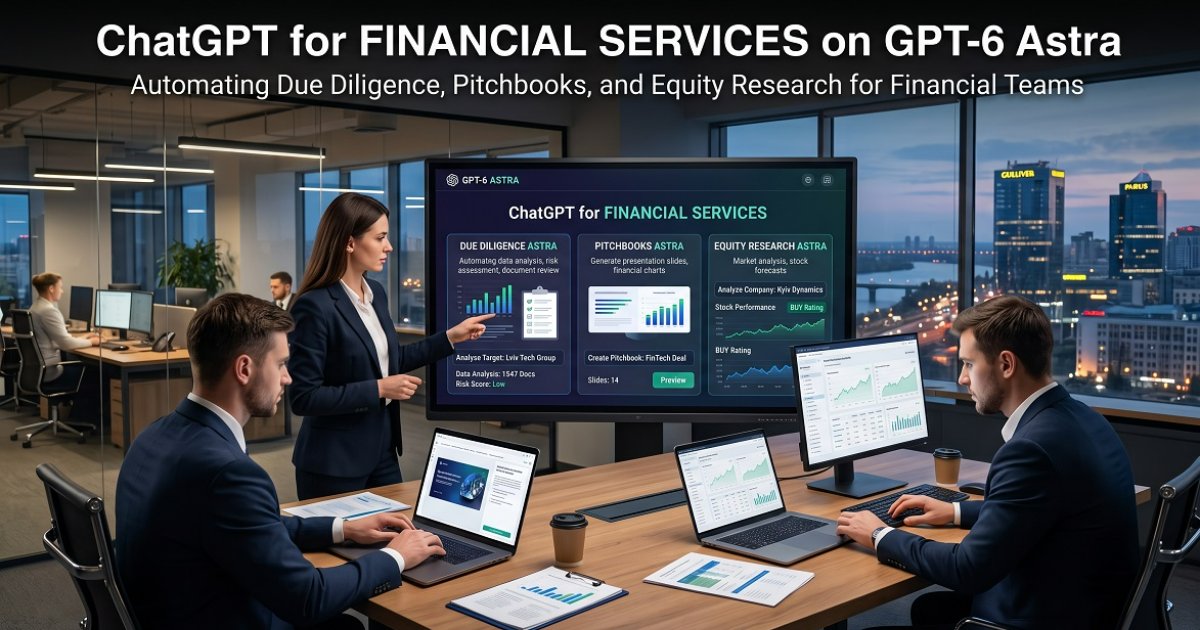
The Pitch Deck That Took Three Days Now Takes Three Hours
The financial industry has spent a decade insisting that AI is a research assistant at best — a useful search engine dressed in a suit. That framing is now obsolete. OpenAI's launch of ChatGPT for Financial Services isn't an incremental upgrade to a chatbot; it's a purpose-built system that sits inside the actual workflow of investment banking and equity research, pulling live data, reasoning over it, and producing client-ready materials in your firm's own template.
What makes this moment worth examining closely isn't the press release — it's the specific design choices that reveal which bottlenecks OpenAI actually solved, and which ones remain. The ROI case for financial institutions hinges on a few concrete details that most coverage has glossed over. Those details are what this article unpacks.
On September 10, 2026, OpenAI officially introduced ChatGPT for Financial Services — a tailored version of its enterprise product, ChatGPT Work, powered by GPT-6 Astra and built in direct collaboration with Morgan Stanley and Evercore as design partners. The product targets investment banking and equity research first, automating the research, modeling, and client-material workflows that have historically consumed the bulk of junior bankers' time.
This isn't a generic AI deployment. It's a vertical product shaped by real institutional pain points — and understanding exactly what it does (and doesn't do) is the starting point for any business leader evaluating where AI fits into their financial operations.
What the Product Actually Does: A Functional Breakdown
Research and Data Access Without the Setup Tax
One of the most persistent friction points in financial services AI adoption has been data connectivity. Getting a language model to reason over proprietary financial data typically requires custom MCP connectors, data pipeline work, and ongoing maintenance — a setup tax that delays value by weeks or months.
ChatGPT for Financial Services eliminates that tax for the most common data sources. According to OpenAI's official announcement, the product ships with built-in premium data from Daloopa, PitchBook, LSEG News, and Crunchbase — indexed and hosted directly by OpenAI to enable higher accuracy and lower latency. Firms can also connect their existing subscriptions to datasets from providers like Bloomberg or FactSet through approximately 50 MCP connectors, without rebuilding their data infrastructure.
The practical effect: an analyst can open the interface — which looks like the familiar ChatGPT chat window, with added toggles for financial data — and immediately begin querying earnings transcripts, company fundamentals, private-company data, and market news. No IT ticket. No waiting for a data team to configure an integration.
Financial Modeling and Artifact Creation
The second major capability is artifact generation. In a live demonstration at launch, OpenAI's VP of Product Nick Turley showed the system evaluating a potential M&A target: pulling relevant financial figures from integrated data sources, reasoning over them, and producing a formatted PowerPoint deck in the bank's own template — complete with the firm's style guide applied automatically.
This is where the product's design logic becomes clear. OpenAI identified that "reliable access to data and high-quality artifact creation proved to be the biggest pain points" for Morgan Stanley and Evercore teams. The system doesn't just answer questions — it produces editable outputs: financial models, research notes, pitchbooks, and client presentations, all formatted to institutional standards.
The effort-level toggle is worth noting: users can set GPT-6 Astra to high, medium, or low reasoning effort. Higher effort consumes more tokens and costs more, but produces more thorough analysis. This gives firms direct control over the cost-quality tradeoff on a task-by-task basis — a meaningful operational lever for managing AI spend.
Granular Citations and Auditability
In regulated environments, the ability to trace a number back to its source isn't a nice-to-have — it's a compliance requirement. ChatGPT for Financial Services addresses this directly: every figure carries a citation that links back to the specific table or passage in the source filing. Charts can be audited against the underlying numbers. Administrators get controls for sensitive deal materials.
This citation architecture is what separates the product from a general-purpose AI assistant. When a senior banker reviews a model or a research note, they can check the evidence at the point of creation — not after the fact, not in a separate audit step.
The citation layer isn't a feature bolted on for compliance theater. It's the mechanism that makes AI-generated financial analysis defensible in front of a client, a regulator, or a board.
The Processes Being Automated — and the ROI Logic
What Junior Bankers Actually Do All Day
To understand the ROI case, you need to understand what's being automated. Investment banking analysts and associates spend the majority of their time on tasks that are information-intensive but not judgment-intensive: pulling data from multiple sources, building and updating financial models, formatting presentations, writing first drafts of research notes, and checking figures for consistency.
These tasks are expensive. A junior investment banker at a major firm represents a significant annual cost when salary, benefits, and overhead are included — and a substantial portion of that cost is spent on work that is, in principle, automatable. ChatGPT for Financial Services targets exactly this layer.
The ROI calculation isn't primarily about headcount reduction. It's about throughput. A team that previously could run due diligence on three potential targets simultaneously can now run it on ten. A research team that published four notes per analyst per quarter can potentially publish eight. The constraint shifts from data-gathering capacity to judgment capacity — which is where experienced professionals actually add value.
Equity Research: From Days to Hours
Equity research is a particularly clear use case. A standard initiation report requires pulling financial statements, building a valuation model, synthesizing industry data, and writing a narrative — work that typically takes days for a junior analyst working under a senior's direction.
With ChatGPT for Financial Services, the data-gathering and initial modeling steps compress dramatically. The system can research companies, analyze earnings, compare peers, and test assumptions — then produce an editable research note that a senior analyst reviews and refines rather than builds from scratch. The senior analyst's time shifts from construction to judgment, which is both more valuable and more scalable.
Compliance and Governance Controls
For financial institutions operating under regulatory scrutiny, the governance architecture matters as much as the features. OpenAI has built enterprise controls into the product: role-based access management, encryption, and audit-log exports. Firms can centrally manage which users access which data connections, and administrators configure firm templates and style guides at the workspace level.
This means the product can be deployed within existing compliance frameworks rather than requiring a parallel governance structure. For a mid-sized asset manager or a regional bank evaluating AI adoption, that's a meaningful reduction in implementation risk.
Who Built This and Why It Matters
The Design Partnership Model
The fact that Morgan Stanley and Evercore served as design partners — not just beta testers — is significant. OpenAI's collaboration with these firms was specifically aimed at identifying "where OpenAI can solve the biggest challenges for financial institutions," according to the official announcement. The product's initial scope (investment banking and equity research) reflects what those institutions identified as their highest-friction workflows.
This design-partnership model produces a different kind of product than a general-purpose AI tool configured for finance. The pain points are real and verified by practitioners. The feature set reflects actual workflow requirements, not a product manager's hypothesis about what bankers need.
For business leaders evaluating the product, this provenance matters: the use cases aren't theoretical. They were stress-tested against the operational reality of two of the most demanding financial institutions in the world.
BBVA's Enterprise Deployment: Scale in Practice
The Morgan Stanley and Evercore partnership isn't the only data point on institutional AI adoption. BBVA has separately expanded its ChatGPT Enterprise deployment to all 120,000 employees across 25 countries — one of the largest enterprise generative AI rollouts in the financial services industry. The deployment includes security and privacy controls, access to OpenAI's latest models, and tools for creating internal agents connected to BBVA's own systems.
The BBVA case illustrates a different dimension of the ROI story: not just automating specific workflows, but building institutional AI capability at scale. When a bank deploys AI across every function — from retail banking to risk to operations — the compounding effect on productivity and decision speed becomes a structural competitive advantage.
When AI capability is distributed across an entire institution rather than siloed in one team, the organization starts to move at a different speed. That's not a productivity gain — it's a category shift.
For more on how AI governance frameworks enable this kind of scale deployment without creating new risks, see OpenAI Wiki Incident: Build AI Governance Now.
What This Means for Business Leaders Outside Investment Banking
The Vertical AI Playbook
ChatGPT for Financial Services is explicitly the first in a series of vertical products. OpenAI's VP of Product has stated that the company plans to release tailored solutions for "a number of sectors" beyond financial services. The investment banking launch is the template — and the template reveals the playbook: identify the highest-friction, highest-cost workflows in a specific industry, integrate the relevant data sources natively, build artifact-generation capabilities that match institutional output standards, and wrap it in enterprise governance.
For business leaders in adjacent sectors — insurance, asset management, corporate treasury, private equity — the question isn't whether a similar product is coming. It's how to position your organization to adopt it effectively when it does.
What "Tailored" Actually Requires
The product's value depends on configuration. Firm templates and style guides must be set up by an administrator before the artifact-generation capabilities reach their full potential. Data connections beyond the built-in sources require setup. Role-based access controls need to be configured against the firm's existing organizational structure.
This isn't a criticism — it's a realistic picture of what enterprise AI deployment requires. The firms that will extract the most value from ChatGPT for Financial Services are those that invest in the configuration work upfront: defining which templates the system should use, which data sources are authorized for which roles, and which workflows are the highest-priority targets for automation.
The firms that treat it as a plug-and-play tool and skip the configuration step will get a fraction of the value. The firms that treat it as an infrastructure investment — something that requires setup but then compounds over time — will see the ROI that the product is capable of delivering.
The Security and Prompt Injection Question
Any financial institution deploying AI at this level should be aware of the security surface that comes with it. When AI systems have access to sensitive deal data, earnings information, and client materials, the risk profile is different from a general-purpose assistant. For a detailed analysis of prompt injection risks in financial AI contexts, Prompt Injection in GPT-6 Astra: Finance Risk is worth reading before deployment decisions are finalized.
Implementation Priorities: Where to Start
Map Your Highest-Cost Information Workflows
Before evaluating ChatGPT for Financial Services — or any vertical AI product — the most useful exercise is a workflow audit focused on information intensity. Which processes in your organization require pulling data from multiple sources, synthesizing it, and producing a formatted output? Those are the candidates for the highest ROI.
In investment banking, the answer is obvious: due diligence, pitchbook creation, equity research. In corporate finance, it might be earnings analysis, board reporting, or covenant monitoring. In asset management, it could be portfolio research, manager due diligence, or regulatory reporting.
The product's current scope is investment banking and equity research, but the underlying architecture — integrated data, reasoning model, artifact generation, citation layer — is applicable to any information-intensive financial workflow. OpenAI has indicated that expansion into other financial services categories is on the roadmap.
Evaluate the Data Integration Layer First
The built-in data from Daloopa, PitchBook, LSEG News, and Crunchbase covers a significant portion of investment banking data needs. But every institution has proprietary data — internal models, client data, deal databases — that won't be in any third-party feed.
The 50-plus MCP connectors provide a path to integrating those sources, but the integration work requires planning. Before deployment, map which data sources your highest-priority workflows depend on, and assess which of those are available through built-in integrations versus which require custom connector work.
Build the Governance Framework in Parallel
The product includes enterprise security and governance controls, but those controls only work if they're configured. Role-based access, audit-log exports, and data-connection management need to be set up against your firm's actual organizational structure and compliance requirements.
The firms that will move fastest are those that treat governance configuration as a parallel workstream — not something to figure out after the tool is already in use. For a broader framework on AI governance in enterprise contexts, Your AI Agent Passed Every Test. That's the Problem offers a useful perspective on why governance design matters before deployment, not after.
FAQ
What is ChatGPT for Financial Services and how does it differ from standard ChatGPT Enterprise? ChatGPT for Financial Services is a tailored version of ChatGPT Work, powered by GPT-6 Astra, with built-in premium financial data from providers including Daloopa, PitchBook, LSEG News, and Crunchbase. Unlike standard ChatGPT Enterprise, it ships with native financial data access, firm-template artifact generation, and granular citation tracking — all configured for investment banking and equity research workflows without requiring custom data pipeline setup.
Which specific tasks does it automate in investment banking? The product is designed to handle company research, earnings analysis, peer comparison, assumption testing, financial model creation, and the production of client-ready materials including pitchbooks and research notes — formatted to the firm's own style guide. In a live demonstration, OpenAI showed it evaluating an M&A target and producing a formatted PowerPoint deck from integrated data sources.
What data sources are included, and can firms add their own? Built-in data includes Daloopa, PitchBook, LSEG News, and Crunchbase. Firms can also connect existing subscriptions to providers like Bloomberg or FactSet through approximately 50 MCP connectors. OpenAI indexes and hosts the built-in data on its own infrastructure to improve retrieval accuracy and enable source tracing.
What are the enterprise security and compliance features? The product includes role-based access management, encryption, audit-log exports, and centralized data-connection management. Administrators can configure which users access which data sources and set firm-wide templates and style guides. Every figure in AI-generated outputs carries a citation traceable to the source filing.
Is this product available to firms outside investment banking? Currently, the product is focused on investment banking and equity research. OpenAI has stated that its work with design partners will inform expansion into other financial services categories, and that the company plans to release tailored solutions for additional sectors beyond financial services.
How is pricing structured? OpenAI has not published a public price list for ChatGPT for Financial Services. Access and pricing are handled through OpenAI Sales or an existing OpenAI account team, based on the organization's specific needs and scale.
The launch of ChatGPT for Financial Services marks a concrete shift in what enterprise AI can deliver to financial institutions — not as a pilot or a proof of concept, but as a production-grade tool shaped by the operational requirements of real institutions. The firms that move from evaluation to configuration now will have a meaningful head start on the ones still debating whether AI is ready for regulated environments.
For leaders who've spent years managing the gap between what AI promised and what it actually delivered, that shift brings something more than a productivity metric: it brings the clarity of knowing your most expensive information workflows are finally under control, backed by auditable data rather than analyst memory. And when your board or investors ask how you're building a scalable, technology-forward operation — this is the kind of answer that changes the conversation.
The next step is a workflow audit and a conversation with OpenAI's enterprise team. If you want to think through which processes in your organization are the highest-priority candidates for automation before that conversation, book a 15-minute consultation.
Have questions? Ask the AI agent right now
Responds in seconds, knows everything about our services and will help with your situation
You might also like
Anthropic Wants to Slow AI: What It Means for Business
Anthropic CEO Dario Amodei called to pace AI development. Here's what his 3-step plan means for businesses building on LLMs — and how to stay ahead.
NewsGoogle Gemini & Travel Safety: The AI Planning Shift
Three hikers rescued on Mount Shasta after trusting Gemini blindly. Here's what the incident reveals about AI travel planning and the business opportunity it unlocks.
NewsClaude Proved Fermat's Theorem in 11 Days
Claude autonomously formalized Fermat's Last Theorem in 11 days via Prove2Me — 13M lines of Lean code, 29,500 theorems. What this means for AI agents in business.