
Preserve Your Margin: QR Payments and AI Agents
How to get rid of acquiring commissions and automate sales through QR payments and AI agents. Real savings for your business with examples and ROI.
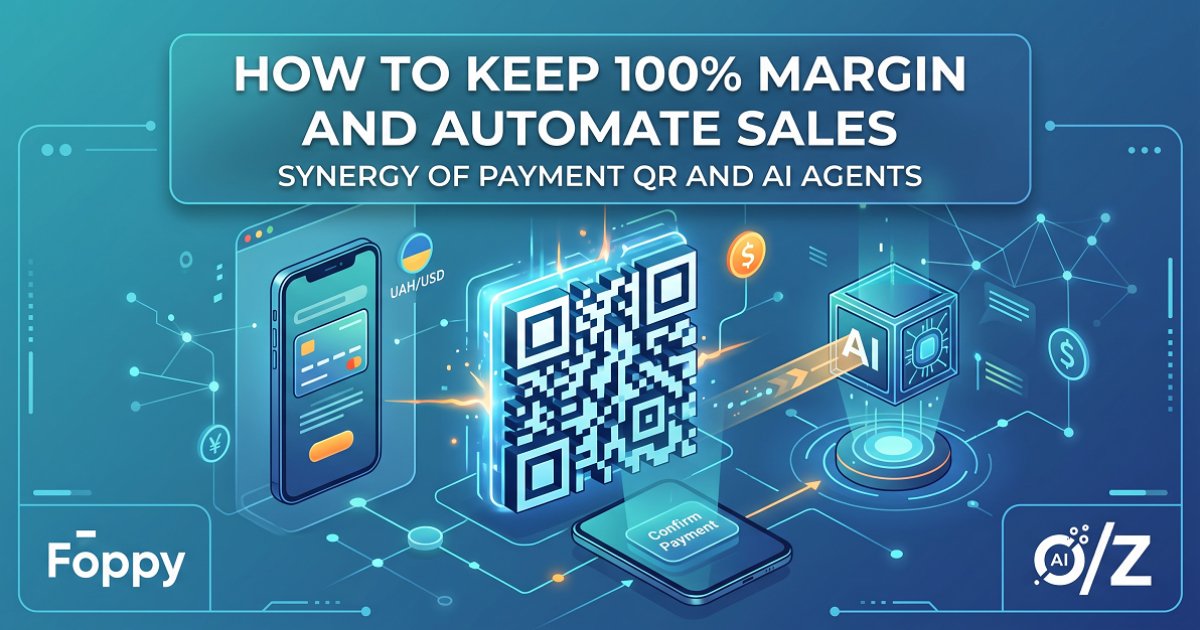
Internet acquiring is eating your margin — and it can be stopped
Every time a customer pays by card online, 1.5% to 3.5% of the amount disappears into the acquiring bank's pocket. For a business with low margins or high turnover — this is not a trifle, but a systemic problem. If your monthly turnover is 500,000 UAH, you "gift" the bank 7,500 to 17,500 UAH per month. That's 90,000 to 210,000 UAH per year — money that could go toward development, marketing, or salaries.
Automating sales through QR payments and AI agents — this is not theory from a technological future. It's already an available solution that allows you to bypass expensive internet acquiring without losing convenience for the customer and without burdening managers with manual work. In this article, we'll break down the mechanics of operation, the real economics of the solution, and step-by-step implementation logic for businesses of any scale.
Why traditional acquiring is a hidden tax on your business
Most business owners perceive acquiring commissions as an unchangeable reality — "that's how the market works." But in reality, it's a management decision that can be revisited.
How much acquiring really costs
Let's look at a typical structure of internet acquiring costs in Ukraine:
- Interchange fee (to the card-issuing bank): 0.2–1.5%
- Payment system commission (Visa/Mastercard): 0.1–0.3%
- Acquiring bank and payment gateway commission: 0.5–1.5%
- Total: 1.5% to 3.5% from each transaction
For e-commerce with a 15–20% margin — this means that on acquiring alone, you lose up to 20% of your profit. For online courses, digital products, consulting services — where margins are higher — the percentage may seem less critical. But in absolute numbers, with a monthly turnover of 1 million UAH or more, it's already a serious line item.
Hidden pain: manual verification and chargebacks
Beyond percentages, acquiring carries operational risks:
- Chargebacks — a customer can dispute a payment, and you lose both the product and the money
- Fund freezes — the bank can freeze payouts if suspicious activity is detected
- Manual reconciliation — managers spend hours matching payments to orders
- Technical failures — the payment gateway can go down during peak sales
All of this together creates not just financial losses, but systemic operational burden.
QR payments as an alternative: mechanics, advantages, and real savings
QR payments — this is a transfer of funds directly to your settlement account through an instant payment system. The customer scans the QR code, confirms the amount in their banking app — and the money arrives in your account. No intermediaries. No percentages.
How this works technically
Ukrainian infrastructure is already ready for large-scale use of QR payments:
- NBU SEP (System of Electronic Payments) allows instant transfers between banks
- IBAN transfers and the Monobank/Privat24 Pay system allow you to generate dynamic QR codes with amount and payment purpose
- Webhook notifications from banks allow automatic confirmation of fund receipt
A dynamic QR code contains: recipient details, exact amount, unique order identifier. After payment, the bank sends a webhook to your server — and the system automatically confirms the order.
Cost comparison: acquiring vs QR
| Parameter | Acquiring | QR Payment |
|---|---|---|
| Transaction commission | 1.5–3.5% | 0–0.5% |
| Chargeback risk | Yes | No |
| Settlement speed | 1–3 days | Instant |
| Technical dependency | Payment gateway | Banking API |
| Manual verification | Often needed | Automatic |
With a monthly turnover of 300,000 UAH and an average commission of 2.5% — switching to QR payments saves 7,500 UAH per month or 90,000 UAH per year. This pays for AI agent implementation in 1–2 months.
AI agent as the engine of sales automation: from inquiry to payment confirmation
QR payments solve the financial part. But for complete sales automation, you need one more component — an AI agent that guides the customer from first contact to completed transaction without involving a live manager.
What an AI agent does in this scheme
An AI agent integrates with your business through messengers (Telegram, Viber), website, or phone and executes the entire sales cycle:
- Customer qualification — identifies needs, budget, timelines
- Product presentation — provides relevant information, addresses objections
- Order formation — captures details, confirms terms
- QR code generation — automatically creates personalized code with exact amount
- Payment tracking — receives confirmation from bank via webhook
- Confirmation and delivery — sends customer receipt, product access, or passes order to fulfillment
The entire cycle — without human involvement. Managers are involved only in non-standard situations.
Real scenario: online course or digital product
A customer wrote in Telegram at 11 PM: "I want to buy your marketing course."
- The AI agent clarifies which of the three packages suits them
- Provides comparison, answers questions about the program
- Customer chooses a 4,800 UAH package
- Agent generates QR code with exact amount and order identifier
- Customer scans, pays through Privat24
- System receives webhook, automatically sends course access
- Customer receives confirmation and begins learning
Time from first message to access: 7 minutes. Manager involvement: zero. Bank commission: 0 UAH.
For educational business this is especially critical — for more details on AI possibilities in this niche, read the article AI agent for education and online courses: sales, support, and student retention.
Integration with CRM and accounting systems
An AI agent doesn't work in a vacuum. It connects with:
- CRM system — records every contact, deal, payment. For example, AI agent for KeyCRM allows you to fully automate the sales funnel in the popular Ukrainian CRM
- Warehouse or catalog — checks availability, prices, conditions
- Accounting — automatically generates primary documents
- Email/SMS systems — sends confirmations, reminders, upsells
Implementation: step-by-step roadmap for your business
Transition to the QR + AI agent model — this is not months of development. With the right approach, you can get first results in 2–3 weeks.
Step 1: Audit current acquiring expenses
First of all — calculate your real losses:
- Gather data on turnover for the last 3 months
- Calculate total commissions (they're in your acquiring bank statement)
- Add operational expenses: manager time on verification, losses from chargebacks
This will become your basis for calculating ROI from AI agent and justifying investment.
Step 2: Choose a banking partner for QR
Not all banks are equally suitable for automated QR payments. Selection criteria:
- Open API availability with webhook notification support
- Instant notifications about receipt (not batch processing)
- Dynamic QR codes with ability to pass amount and comment
- Technical documentation and support for integrators
Among Ukrainian banks, the best developed API are at Monobank (monobank API), Privat24 (Privat24 Business API), and some neobanks. Corporate solutions are also offered by PUMB and Oschadbank.
Step 3: Configure AI agent and sales logic
At this stage, business logic is described:
- Conversation scenarios — what questions the agent asks, how it responds to objections
- Product catalog — prices, conditions, options
- Qualification rules — when to transfer to live manager
- QR generation logic — linking to specific order
- Post-payment actions — what happens automatically
Step 4: Testing and launch
- Conduct 20–30 test transactions in various scenarios
- Check edge cases: cancellations, partial payments, repeated payments
- Train your team to monitor exceptions
- Start with one channel (e.g., Telegram), then scale
For e-commerce, this approach has already proven effective — see specific figures and mechanics in the case study AI agent for e-commerce: case of 34% conversion growth in 3 months.
Which businesses benefit most from this
Sales automation through QR and AI agents is suitable for almost any B2C and B2B segment, but maximum benefit is received by:
Businesses with large transaction volumes
- Online stores — hundreds of orders per day, every commission counts. Details: AI agent for online store: case of automating 100+ requests per day
- Restaurants and delivery — orders via Telegram bot without aggregator commissions
- Beauty salons — booking payment without POS terminal and commissions
Businesses with digital products
- Online courses, training programs
- Consulting services, coaching
- Subscriptions and SaaS solutions
- Digital content and access
Service businesses with recurring payments
- Insurance companies (policy renewals)
- Legal and accounting firms
- Medical and veterinary clinics
For service businesses it's also important to correctly determine when the AI agent handles things on its own and when a human is needed — this is covered in detail in the article AI agent vs live manager: when to choose what and how to combine.
Important: legal aspect
QR payments through IBAN transfers — this is an absolutely legal tool. Funds arrive at the official settlement account of an individual entrepreneur or legal entity, are reflected in accounting, and are subject to taxation in the standard manner. No "gray schemes" — just optimization of bank commission costs.
FAQ: Answers to common questions
Is it legal to bypass acquiring through QR payments? Yes, absolutely legal. QR payment through IBAN is a regular bank transfer to an entrepreneur's or company's settlement account. Funds are reflected in official reporting and taxed in the standard manner, like any other income to the account.
Will customers agree to pay via QR instead of card? Practice shows that most customers adapt easily, especially if the interface is convenient. The AI agent explains the payment process step by step, and the QR itself is scanned from any banking app in 10–15 seconds. An added bonus for customers — faster confirmation and fewer risks.
How much time does implementing such a system take? With an available bank API and properly configured AI agent, the basic scheme launches in 2–3 weeks. Full integration with CRM, warehouse, and accounting can take 4–6 weeks depending on the complexity of business processes and availability of technical documentation.
What if a customer paid but the webhook didn't arrive? A properly configured system has a backup mechanism: the agent checks payment status through the bank API every 1–2 minutes for a certain period (for example, 15 minutes). If confirmation doesn't arrive — the order transitions to "pending verification" status and notifies the manager. Such situations are rare and easily resolved.
Is this scheme suitable for B2B settlements between legal entities? For B2B, settlements between companies traditionally go through invoice issuance and bank transfer — acquiring is rarely used here anyway. However, an AI agent significantly speeds up this process: automatically generates an invoice, sends it to the client, tracks payment, and confirms fund receipt without involving an accountant or manager.
Margin Under Your Control
Sales automation through a combination of QR payments and AI agents — this is not just a way to save on commissions. It's an architectural solution that simultaneously reduces costs, removes operational burden from your team, and increases conversion due to 24/7 availability. Businesses implementing this solution today gain a competitive advantage that will be hard to catch up with in a year. If you want to calculate potential savings for your specific business and get an implementation roadmap — contact us for a free consultation, and we'll prepare a personalized plan within 48 hours.
Have questions? Ask the AI agent right now
Responds in seconds, knows everything about our services and will help with your situation
You might also like
Basis Cuts Tax Workbook Time in Half with GPT-6 Astra
How Basis used GPT-6 Astra to complete a 50-tab tax workbook 2x faster — architecture, reasoning controls, ROI, and a step-by-step guide for finance teams.
Pricing & ROICustom AI Agent Development Cost: What You Actually Pay For
Custom AI agent development costs $10K–$500K+ internationally, or $4K–$200K+ built by a Ukraine-based team. What drives the price, what you get, and a real case with hard numbers.
Pricing & ROIDeepSeek-V4: 1M Token Context at Disruptive Cost
DeepSeek-V4 brings a 1M-token context window at a fraction of OpenAI and Anthropic prices. Here's what it means for your business costs and AI strategy.