
AI Agent for Logistics: Tracking and Customer Support
How logistics and transport companies use AI agents to track shipments, handle customer inquiries, and automate communication between dispatchers, drivers, and clients.
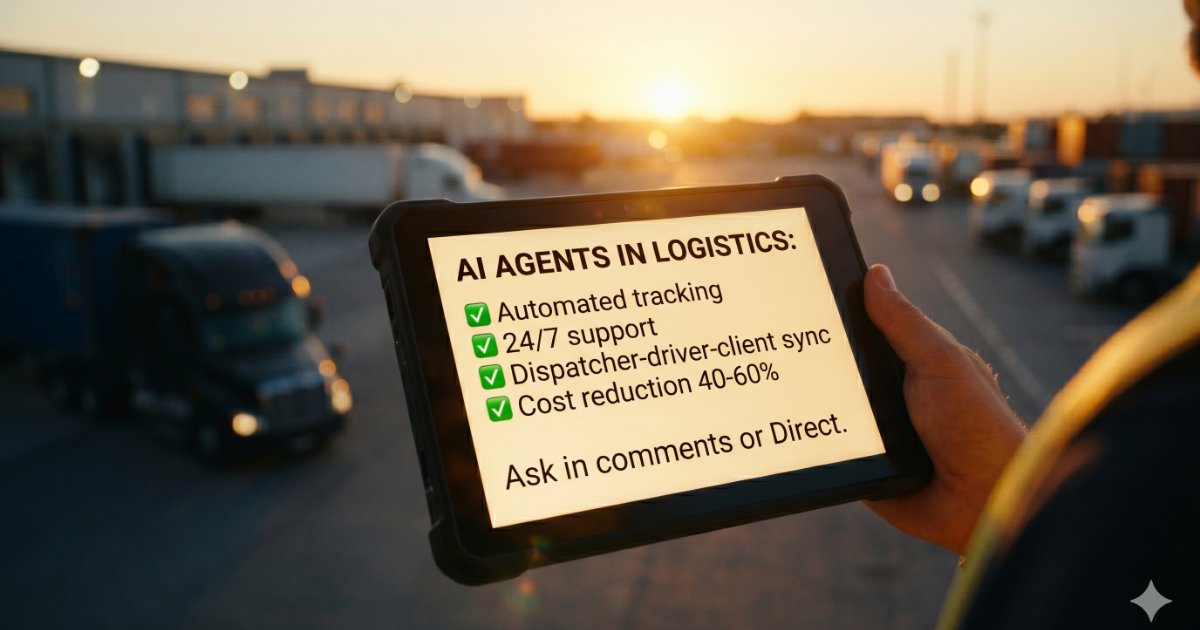
The Core Problem for Logistics Companies
A dispatcher at a logistics company receives hundreds of messages per day. Clients ask: "Where's my shipment?", "When will it arrive?", "Why is there a delay?" Drivers ask: "Where do I go next?", "The client isn't responding — what should I do?" All of this flows through the dispatcher's phone or Telegram.
A dispatcher physically can't respond to everyone at once. Clients get frustrated, call multiple times, leave negative reviews. An AI agent handles routine requests, freeing the dispatcher for genuinely complex situations. For how this compares to a live manager, see AI Agent vs Live Manager.
What an AI Agent Does for Logistics
Real-Time Shipment Tracking
A client writes: "Where is my package?" — the agent connects to the tracking system and responds:
"Your shipment is currently in Poltava. Driver Ivan Petrenko, estimated arrival in Kharkiv — today at 4:30 PM. No delays on the route."
No call to the dispatcher. No waiting. The client gets information in 5 seconds.
Notifications for Route Changes
The agent automatically notifies clients of any changes:
- Delay due to traffic or weather: "Your delivery is delayed by approximately 2 hours. New estimated arrival: 6:30 PM."
- Driver or vehicle change: client receives updated contact details
- Cargo arrived at the warehouse: "Your shipment is at the warehouse. Available for pickup from 9 AM to 6 PM."
Accepting New Shipping Requests
The agent collects all the data for a new order without manager involvement:
- Pickup and delivery addresses
- Cargo type and weight
- Desired loading and delivery dates
- Contact details
After collecting the data, the agent creates a request in the system or sends the manager a ready package for pricing. See how customer support automation in 2026 is reshaping high-volume businesses like logistics.
Handling Common Questions
The agent answers standard client requests:
- Shipping rates (base rates by route)
- Cargo insurance conditions
- Packaging requirements
- Documents required for international shipping
- Warehouse hours and pickup schedule
Driver Communication
The agent can also automate part of the driver communication:
- Sending loading/unloading addresses
- Confirming cargo pickup
- Reminding about required documents
- Collecting photo proof of delivery
Real Case: Transport Company in Odesa
Situation: Company with 35 trucks, delivery across Ukraine. 2 dispatchers handling 150–200 inquiries per day. Clients complained about slow response times. Dispatchers were constantly overwhelmed.
Implementation:
- AI agent on Telegram and Viber for clients
- Integration with TMS system for shipment tracking
- Automatic notifications when delivery status changes
- New order intake script
Results after 2 months:
- 68% of delivery status inquiries resolved automatically
- Client response time: from 40 minutes down to 30 seconds
- Dispatchers freed up 4 hours per day for complex issues
- Repeat complaints decreased by 55%
Connected Channels
- Telegram — primary channel for B2B clients
- Viber — for individuals and small businesses
- WhatsApp — for international clients
- Website — tracking form and chat widget
- Email bot — for automated replies to standard requests
Cost and Payback Period
| Company Size | Implementation Cost | Monthly Support |
|---|---|---|
| Small carrier (up to 10 vehicles) | $375 – $625 | $50 – $87 |
| Mid-size company (10–50 vehicles) | $750 – $1,375 | $100 – $175 |
| Large carrier | from $1,750 | from $200 |
Payback: If the agent replaces 0.5 of a dispatcher's workload in routine queries, the salary savings amount to $200–$300/month. Implementation pays off in 2–3 months.
What the AI Agent Doesn't Replace
The agent doesn't replace the dispatcher in complex situations:
- Accidents, breakdowns, or force majeure on the route
- Conflict situations with clients
- Negotiations on non-standard shipping terms
- Customs clearance and legal questions
The agent handles routine; the dispatcher resolves exceptions.
Dispatchers Freed From the Routine
An AI agent for a logistics company is an automatic support service that answers clients in seconds, tracks shipments, and accepts new orders without queues or wait times. Dispatchers no longer drown in routine questions and can focus on real problems. Payback: within 2–3 months.
Have questions? Ask the AI agent right now
Responds in seconds, knows everything about our services and will help with your situation
You might also like
LangChain vs CrewAI vs AutoGen: Choose Right
LangChain, CrewAI, or AutoGen for your multi-agent system? A practical framework guide for CEOs and COOs making the build-or-buy decision in 2026.
EnterpriseGPT-6 Sol & Luna: AI Model Strategy for Business
GPT-6 Sol and Luna give CTOs a real choice between speed, cost, and quality. Here's how to match each model to the right business task.
Pricing & ROIDeepSeek-V4: 1M Token Context at Disruptive Cost
DeepSeek-V4 brings a 1M-token context window at a fraction of OpenAI and Anthropic prices. Here's what it means for your business costs and AI strategy.