
The Tragedy of the Cognitive Commons in the AI Era
A new framework warns that rational AI adoption can erode professional expertise across entire industries. Here's what business leaders must do before it's too late.
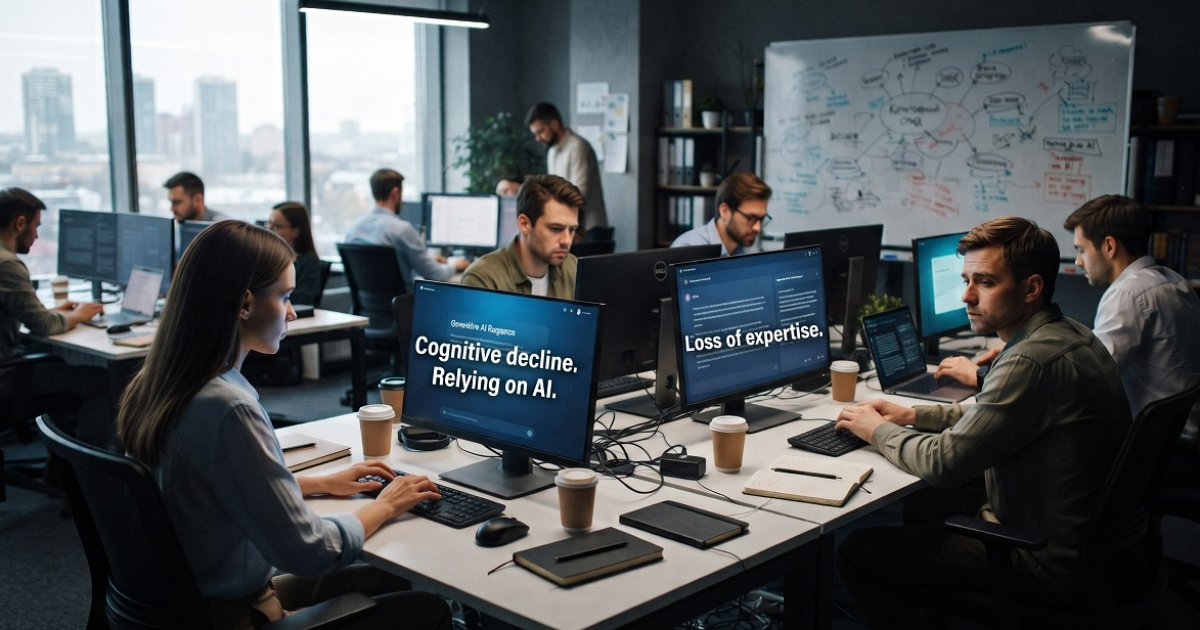
Until recently, a company that automated its junior-level workflows was simply considered efficient. Fewer entry-level hires, faster output, lower cost per task — the logic was airtight. Then researcher Nolan Lovett published a paper in Human Resource Development Review (July 2026) that reframed the entire equation. The paper introduced a concept called the Cognitive Commons — the shared pool of professional expertise that an industry depends on for its own renewal. And it argued that every company making the individually rational decision to replace junior cognitive work with AI is, collectively, draining that pool dry.
For decades, companies treated junior roles as a cost center. Now a growing body of research suggests those roles were actually the hidden infrastructure through which industries reproduced their own knowledge. AI didn't just automate tasks — it removed the mechanism. And the damage won't show up on any quarterly dashboard. The senior experts validating AI outputs today look competent. The problem is who comes after them — and whether anyone will be capable of judging the work at all. The specific numbers, the sectors already showing early signals, and the concrete steps executives can take to protect their organizations without abandoning automation — all of that is ahead.
Why This Isn't the Usual "AI Will Take Our Jobs" Story
The standard automation anxiety focuses on displacement: AI replaces workers, workers lose income, society adjusts. Lovett's framework describes something structurally different — and more insidious.
Professional expertise in most fields isn't transmitted through formal training alone. New lawyers learn by researching cases and drafting documents. New financial analysts learn by building models and stress-testing assumptions. New software engineers learn by writing, debugging, and maintaining code under real conditions. These tasks are productive for the employer in the short term, but they are also the cognitive crucible in which junior professionals develop pattern recognition, judgment, and deep domain intuition.
When AI absorbs those tasks, the junior employee still exists — but the learning doesn't happen. They hit senior-level productivity metrics without accumulating senior-level understanding. Lovett calls this the difference between Internalized Mastery (deep domain knowledge built through sustained cognitive struggle) and Distributed Mastery (the ability to orchestrate human-AI systems). Both matter. But Distributed Mastery built on a hollow foundation is a liability dressed as a skill.
The most dangerous moment isn't when AI makes a mistake. It's when no one in the organization has the expertise left to recognize that it did.
This is what Lovett calls the Validation Tether: effective oversight of AI outputs depends on the very expertise that AI adoption is quietly eroding. The tether frays gradually, invisibly, over years — and then snaps.
The Collective Action Trap
The "tragedy of the commons" framing, borrowed from Garrett Hardin's 1968 paper in Science, is precise here. Individual actors behaving rationally deplete a shared resource that no single actor owns or is responsible for maintaining.
In the cognitive version: each company that eliminates entry-level analytical, legal, or engineering roles benefits immediately — lower headcount, faster throughput, reduced training costs. But the profession as a whole loses the pipeline through which expertise regenerates. No single company caused the problem. No single company can fix it alone. And because the depletion is generational rather than immediate, it's invisible until it's severe.
Early labor market data is already showing the pattern. A study cited in Lovett's paper found employment declines in AI-exposed occupations concentrated specifically among young workers, while more experienced workers in the same fields held steady or even saw growth. The Federal Reserve Board found that growth in programming jobs has nearly halved since ChatGPT launched. These aren't signs of a healthy transition — they're signs of a pipeline narrowing at the entry point.
The World Economic Forum's Future of Jobs 2025 report found that 41% of employers plan workforce reductions due to AI within five years. The cuts are rational at the firm level. The aggregate effect on professional knowledge ecosystems is a different matter entirely.
Two Mechanisms, One Outcome
Lovett identifies two distinct pathways through which AI disrupts expertise regeneration — and understanding both matters for how you respond as an executive.
The first is direct elimination. AI systems handle work that used to go to junior employees. The entry-level position disappears. The learning opportunity disappears with it.
The second is subtler and arguably more dangerous. Even when junior roles survive, AI assistance allows those employees to reach productivity benchmarks that previously required years of experience. The output looks fine. The underlying cognitive development never happened. The organization gets the appearance of competence without the substance — and has no reliable way to tell the difference until a crisis exposes the gap.
What This Means for Your Business Specifically
If you run a company that relies on knowledge work — legal, financial, technical, strategic — you are almost certainly somewhere on this curve already. The question isn't whether AI is affecting your expertise pipeline. It's whether you have any visibility into how far along the erosion has gone.
A few diagnostic questions worth sitting with:
- When your senior people review AI-generated outputs, are they genuinely evaluating them — or pattern-matching on surface features?
- Could your mid-level team members perform the core analytical tasks without AI assistance if they had to?
- When you hire junior talent today, what cognitive work are they actually doing that builds judgment?
These aren't rhetorical. They're the kind of questions that separate organizations that are automating intelligently from those that are automating themselves into fragility.
The Communications of the ACM noted that in a 2025 survey conducted by Microsoft Research, knowledge workers reported that generative AI made tasks seem cognitively easier — which is precisely the condition under which deskilling accelerates without anyone noticing. As one researcher at Aarhus University put it: "Deskilling — and any fallout it creates — will be visible only in hindsight."
This connects directly to a broader strategic risk that executives building multi-agent AI systems should be tracking. If your AI infrastructure is handling an increasing share of complex decisions, the humans nominally overseeing those decisions need to be genuinely capable of overriding them — not just clicking approve. For a deeper look at how AI agent infrastructure can fail in ways that aren't immediately visible, see Your AI Agent Infrastructure Will Fail. The Only Question Is When — and Whether You'll Recover in Time.
The Balance Point: Automation Without Hollowing Out
The answer is not to slow AI adoption. The competitive pressure is real, the efficiency gains are real, and the companies that refuse to automate will simply lose ground to those that do. Lovett himself is explicit that bans or restrictions on AI use are not among his proposals.
The answer is to automate deliberately — with explicit attention to which cognitive tasks are load-bearing for expertise development, and which are genuinely rote.
Protect the Cognitive Crucible
Not all junior work is created equal. Data entry, formatting, basic retrieval — these are tasks where AI replacement carries minimal expertise cost. But case analysis, model-building, code debugging, contract review — these are the tasks where the cognitive struggle is the point. Automating them away doesn't just save time; it removes the training ground.
Lovett recommends what he calls AI-free learning environments: structured contexts where junior professionals work through problems without AI assistance, specifically to build the internalized mastery that makes them capable of genuine oversight later. This isn't nostalgia — it's infrastructure maintenance.
Phase AI Introduction Against Demonstrated Competence
Rather than giving new hires full AI access from day one, consider phasing it. Let junior team members demonstrate baseline competence in core domain tasks before layering in AI augmentation. This mirrors how flight simulators work: you don't give a pilot autopilot until they can fly manually. The goal isn't to make work harder for its own sake — it's to ensure the human in the loop is actually capable of being in the loop.
Measure Expertise, Not Just Output
Most organizations measure what AI makes easy to measure: speed, volume, error rates on defined tasks. Almost none measure the depth of human expertise in their teams — because it's harder to quantify and slower to degrade. Building some form of domain competence assessment into your talent development process isn't a luxury; it's the only way to detect erosion before it becomes a crisis.
Professional associations are beginning to respond — Lovett recommends that they test domain competence through certifications alongside AI skills. Forward-thinking companies won't wait for industry bodies to set the standard. They'll build internal benchmarks first.
This connects to a broader point about how AI budgets and ROI get measured. If your measurement framework only captures efficiency gains and ignores the human capital costs of deskilling, you're making decisions on incomplete data. AI Budgets Don't Get Cut Because the Technology Failed — They Get Cut Because the Measurement Did explores exactly this gap.
The Sectors Where the Signal Is Already Loud
The erosion isn't uniform. It's concentrated in sectors where AI has moved fastest and where entry-level cognitive work was most clearly defined.
Software development is the most visible case. The Federal Reserve data on halved growth in programming jobs is a leading indicator, not a lagging one. Junior developers who spend their days reviewing AI-generated code rather than writing it are not developing the debugging intuition, the architectural judgment, or the failure-mode pattern recognition that makes a senior engineer genuinely valuable. The output metrics look fine. The pipeline is narrowing.
Legal services face a structurally similar problem. New lawyers learn by doing research and drafting — tasks that AI now handles with increasing competence. The concern isn't that AI legal research is bad. It's that the lawyers who will need to evaluate AI legal research in ten years are currently not learning how to do it themselves.
Financial analysis is another high-exposure area. Model-building, scenario analysis, and due diligence work — the cognitive tasks that used to take junior analysts years to master — are increasingly AI-assisted from the start. The analysts who emerge from this environment may be highly productive. Whether they're genuinely expert is a different question.
The pattern across all three: AI primarily replaces codified knowledge while practical experience stays in demand — but the pipeline for producing that practical experience is being cut off at the source.
What Boards and Investors Are Starting to Ask
There's a governance dimension here that hasn't fully surfaced yet — but will.
Boards and investors are beginning to understand that AI adoption creates a new category of organizational risk: not the risk that AI will fail, but the risk that the humans overseeing AI will lack the expertise to catch it when it does. This is a fiduciary concern. It belongs in risk registers alongside cybersecurity and regulatory compliance.
Executives who can demonstrate that they've thought through this — who can show a board not just their AI adoption metrics but their expertise preservation strategy — are positioning themselves as genuinely sophisticated operators, not just technology adopters. The distinction matters. Anyone can deploy a tool. It takes a different kind of leadership to understand what the tool is doing to the organization's long-term capability.
The executives who get this right will feel something specific: not just the operational satisfaction of running a leaner, faster organization, but the deeper confidence that comes from knowing their teams are genuinely capable — that the humans in the loop are actually in the loop. That's a different quality of control than efficiency metrics can provide.
When your board asks how you're managing AI risk, the answer that earns trust isn't "we have guardrails on the model." It's "we have a strategy for maintaining the human expertise that makes those guardrails meaningful." That's the answer that changes how investors and directors perceive you — from a technology adopter to a systems thinker who understands what automation actually costs.
FAQ
What exactly is the "Tragedy of the Cognitive Commons"? It's a framework introduced by researcher Nolan Lovett in Human Resource Development Review (2026), drawing on commons theory to describe how individually rational AI adoption decisions can collectively deplete the shared pool of professional expertise that industries need to renew themselves. Each company benefits from automating junior cognitive work; the profession as a whole loses the pipeline through which expertise regenerates.
How is this different from normal automation-driven job displacement? Standard displacement concerns focus on workers losing income. The Cognitive Commons problem is about the loss of the mechanism through which expertise is reproduced — even when workers keep their jobs. Junior employees assisted by AI can hit productivity benchmarks without developing the deep domain knowledge those benchmarks were designed to reflect. The organization looks competent; the underlying capability has eroded.
Which industries are most at risk right now? Software development, legal services, and financial analysis show the clearest early signals, because AI has moved fastest in these fields and entry-level cognitive work was most clearly defined. The Federal Reserve found that growth in programming jobs has nearly halved since ChatGPT launched — a leading indicator of pipeline narrowing.
Does this mean companies should slow down AI adoption? No — and Lovett himself doesn't recommend restrictions. The answer is deliberate automation: protecting the specific cognitive tasks that are load-bearing for expertise development (case analysis, model-building, debugging, drafting) while automating genuinely rote work. Phased AI introduction and AI-free learning environments for junior staff are among the concrete proposals.
How do I know if my organization is already affected? Ask whether your senior people are genuinely evaluating AI outputs or just pattern-matching on surface features. Ask whether mid-level staff could perform core analytical tasks without AI assistance. If the honest answer to either question is uncertain, the erosion has likely already begun.
What should I put in front of my board on this topic? Frame it as a new category of organizational risk: not AI failure, but the degradation of human oversight capacity. Present an expertise preservation strategy alongside your AI adoption metrics — domain competence benchmarks, phased AI introduction policies, and AI-free learning environments for junior staff. That's the conversation that signals genuine strategic depth.
The Cognitive Commons concept is new. The dynamic it describes is already underway. The companies that will navigate this well aren't the ones that automate the most — they're the ones that automate with enough self-awareness to know what they're trading away, and deliberate enough to protect what matters.
If you want to map out where your organization sits on this curve — which roles are genuinely safe to automate, which are load-bearing for expertise, and what a phased approach would look like for your specific context — start a conversation with our AI strategy team.
Have questions? Ask the AI agent right now
Responds in seconds, knows everything about our services and will help with your situation
You might also like
Knowledge Graph AI: How It Runs Your Business
Knowledge Graph AI connects your siloed data into one reasoning layer — cutting approval cycles, reducing hallucinations, and automating decisions at scale.
AutomationAI Agents vs. CAPTCHA: What Businesses Should Do
AI agents hit CAPTCHAs every day — and it's costing businesses real money. We break down the causes, the consequences, and practical solutions for automation.
AutomationBuild a Procurement AI Agent With DeepMind's Blueprint
Google DeepMind's Co-Scientist architecture reveals how to build AI agents for corporate procurement. Here's the step-by-step blueprint for CEOs ready to act.