
AI Agents vs. CAPTCHA: What Businesses Should Do
AI agents hit CAPTCHAs every day — and it's costing businesses real money. We break down the causes, the consequences, and practical solutions for automation.
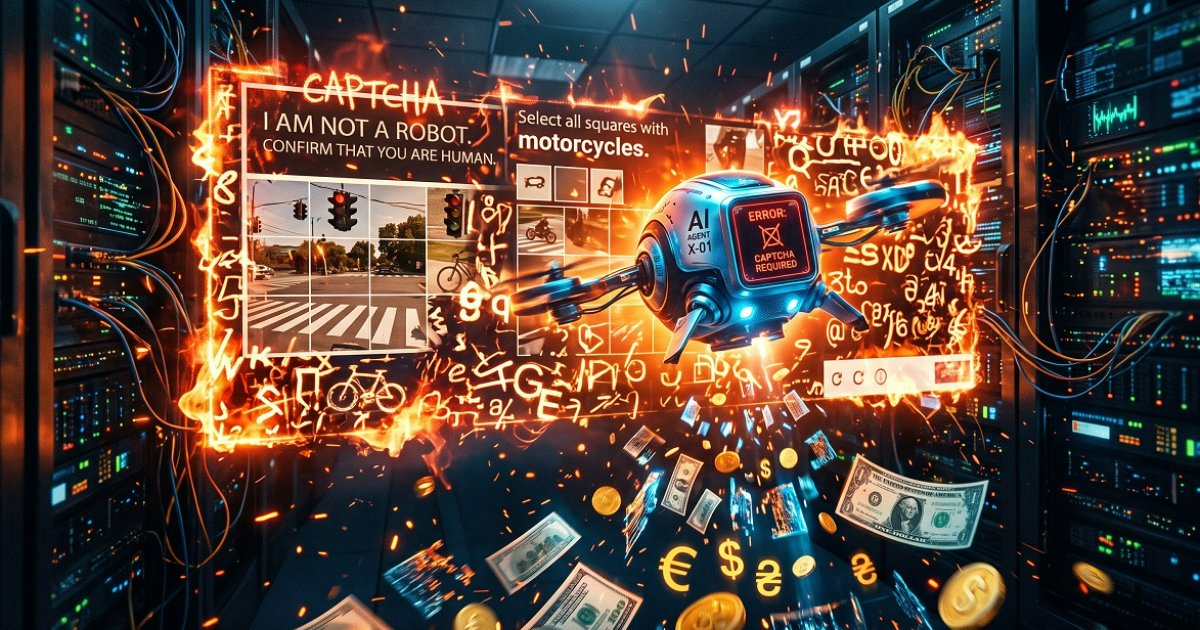
Your AI agent stopped mid-task. Not because of a bug in the code, not because of a server outage — because of a blurry image of traffic lights. CAPTCHA won the round again.
For businesses building automation on top of AI agents, this isn't a minor inconvenience. It's a systemic problem that breaks pipelines, eats up team time, and undermines the ROI of the entire project.
Why CAPTCHA Exists — and Why It's Become a Problem for AI
CAPTCHA was built to tell humans apart from bots. But an AI agent isn't a bot in the old sense. It's doing real work on behalf of a real person. And that's exactly where the system breaks down.
Websites see non-human click speeds, unusual navigation patterns, the absence of "human" micro-delays — and they block the agent. Even when it's doing exactly what a procurement manager or analyst would do.
Bot-protection logic has been built up over decades. First came simple text puzzles. Then image recognition. Then behavioral analysis. Each new layer of defense emerged in response to the previous one being cracked. But now the situation has flipped: the protection designed to filter out malicious bots is starting to filter out useful agents.
Companies deploying agents for price monitoring, data collection, automated form-filling, or booking all run into the same wall: the agent reaches a certain step and stops. What follows is either manual intervention or a failed task.
What Gets Blocked — and Why It Hurts
Typical Failure Points
Agents most commonly hit CAPTCHAs in three situations:
- High-frequency requests — when an agent queries a site more often than an average user would in an hour
- Fresh sessions — when an agent launches without cookies, browser history, or any of the other fingerprints of a "live" human
- Sensitive actions — login, payment, registration, file downloads
In each of these cases, the anti-bot system fires not because the agent is doing something harmful, but because it doesn't behave like a human. That's the fundamental mismatch between how protection was designed and how modern automation actually works.
The Real Cost of a Stoppage
An agent stopping mid-pipeline isn't just a delay. It's a cascade. The task goes unfinished. The data isn't collected. The report isn't ready. Someone on the team has to manually figure out what happened, restart the process, or do the work themselves.
When these stoppages happen regularly — and they do — it means part of your automation isn't actually automated. It's just pushed the manual work to a later stage.
Automation that stops at a CAPTCHA isn't automation. It's semi-automation with hidden costs baked into human oversight.
Three Approaches Businesses Are Using Right Now
1. CAPTCHA-Solving Services
There are specialized services — both fully automated (ML-based) and hybrid (with humans in the loop) — that accept a CAPTCHA from the agent, solve it, and return the answer. The agent picks up where it left off.
Pros: relatively straightforward to integrate, works for most CAPTCHA types. Cons: added latency, cost at scale, and legal questions around sites' terms of service.
2. Browser Automation with Human-Like Behavior
Instead of solving a CAPTCHA after it appears — prevent it from appearing in the first place. Tools like Playwright or Puppeteer, combined with libraries that simulate human behavior (randomized delays, mouse movements, realistic scroll patterns), reduce the likelihood of triggering anti-bot systems.
It's more complex to set up, but produces a cleaner outcome: the agent doesn't stop because it's never flagged as an agent.
3. Official APIs Instead of Scraping
The cleanest solution is to go straight to the source. If a site provides an API, the agent calls that instead of the web interface. No CAPTCHAs, no blocks, a stable response structure.
The catch: not every data source has an API. And even when one exists, access may cost money or require separate negotiations.
What You Should Do Right Now
There's no silver bullet that closes this issue once and for all. But there are a few steps that meaningfully reduce the problem:
- Audit your pipelines — identify every point where agents regularly stop due to CAPTCHA. That's your pain map.
- Prioritize by impact — not all stoppages are equally damaging. Start with the ones blocking critical processes or occurring most frequently.
- Test your approaches — for each pain point, evaluate which of the three approaches above delivers the best cost-to-reliability ratio.
- Monitor continuously — CAPTCHA systems get updated. What works today may stop working in a month. Ongoing monitoring of agent success rates is non-negotiable.
If your team is already building agentic architecture, it's worth designing CAPTCHA handling as a dedicated component from the start — not bolting it on later as a patch. How to properly architect these kinds of systems is covered in detail in our piece on the AI procurement agent based on the Google DeepMind Co-Scientist architecture.
The Legal Side
Bypassing a CAPTCHA isn't always the same as breaking the law. But the line between "technically possible" and "legally permissible" can be razor-thin.
Most sites' terms of service prohibit automated access without explicit permission. That's not criminal law — but violations can lead to IP bans, account closures, or civil claims.
Before deploying agents on external resources, your legal team should review the ToS of every target site. That's not paranoia — it's basic hygiene. The broader question of legal risks in AI automation is explored in more depth in the context of the Sony & Warner lawsuit against Anthropic.
Where the Industry Is Heading
The CAPTCHA problem for AI agents isn't permanent. The industry is already working on solutions from both sides.
On the protection side: verification systems are emerging that shift the question from "prove you're human" to "prove you're authorized." Access tokens, verified agent identities, API-first approaches from major platforms.
On the automation side: browser-based agents are getting increasingly sophisticated at replicating human behavior. Some providers already offer "stealth modes" for automation that pass most behavioral checks.
But until these solutions become the standard, businesses have to work with what exists. That means designing agents around real-world constraints — not ideal conditions.
It's also worth keeping an eye on the broader AI agent security landscape — particularly the issues of hidden instructions embedded in documents and prompt injection attacks, which are growing more relevant as agents gain access to external resources.
FAQ
Is it legal to use CAPTCHA-solving services? It depends on the jurisdiction and the specific site's terms of service. The service itself isn't illegal, but using it may violate the target site's ToS. Always review the terms before deploying.
Can an AI agent fully replace a human when dealing with CAPTCHA? Modern agents can solve certain types of CAPTCHAs autonomously, but the most sophisticated variants — behavioral checks in particular — still require either human intervention or specialized services.
How much does integrating a CAPTCHA-solving service cost? Prices range from fractions of a cent to a few cents per solve. At high volumes, this can become a meaningful line item — which is why calculating ROI before implementation matters.
Are there alternatives that avoid CAPTCHA entirely? Yes. Official APIs, data partnership agreements, or negotiating "agent access" directly with site owners all allow you to sidestep the problem at the architecture level.
How do you tell if CAPTCHA is the main cause of agent failures — and not something else? Logging. Every step an agent takes should be recorded with a response code and error type. If the agent stops, the logs should show exactly where and why.
Does the situation change as new AI models emerge? Yes, but not linearly. Newer models are better at mimicking human behavior — but CAPTCHA systems are getting more sophisticated too. It's an arms race, and businesses need to build flexibility into their architecture rather than betting on any single solution indefinitely.
Summary
CAPTCHA is not a technical footnote. For businesses seriously building automation on AI agents, it's a real operational risk with a real price tag.
Solutions exist. None of them are perfect, but together they provide enough tools to keep agents running reliably. The key is not to ignore the problem or leave it for later. The deeper agents are integrated into your processes, the more every unplanned stoppage costs.
If you want to understand how to build an agentic architecture that accounts for these constraints from day one — get in touch. We'll help you design a system that works in the real world, not just in a demo.
Have questions? Ask the AI agent right now
Responds in seconds, knows everything about our services and will help with your situation
You might also like
Build a Procurement AI Agent With DeepMind's Blueprint
Google DeepMind's Co-Scientist architecture reveals how to build AI agents for corporate procurement. Here's the step-by-step blueprint for CEOs ready to act.
AutomationGoogle Preferred Sources: A New Weapon for Publishers
Google's new Preferred Sources button gives publishers a direct tool against AI traffic loss. Here's what it actually does — and what your content business must do next.
AutomationThe Tragedy of the Cognitive Commons in the AI Era
A new framework warns that rational AI adoption can erode professional expertise across entire industries. Here's what business leaders must do before it's too late.