
AI Agents in SMS & Messengers: Sales Playbook
AI agents living inside SMS and messengers are reshaping sales and support. Real business scenarios, ROI estimates, step-by-step setup guide, and key risks.
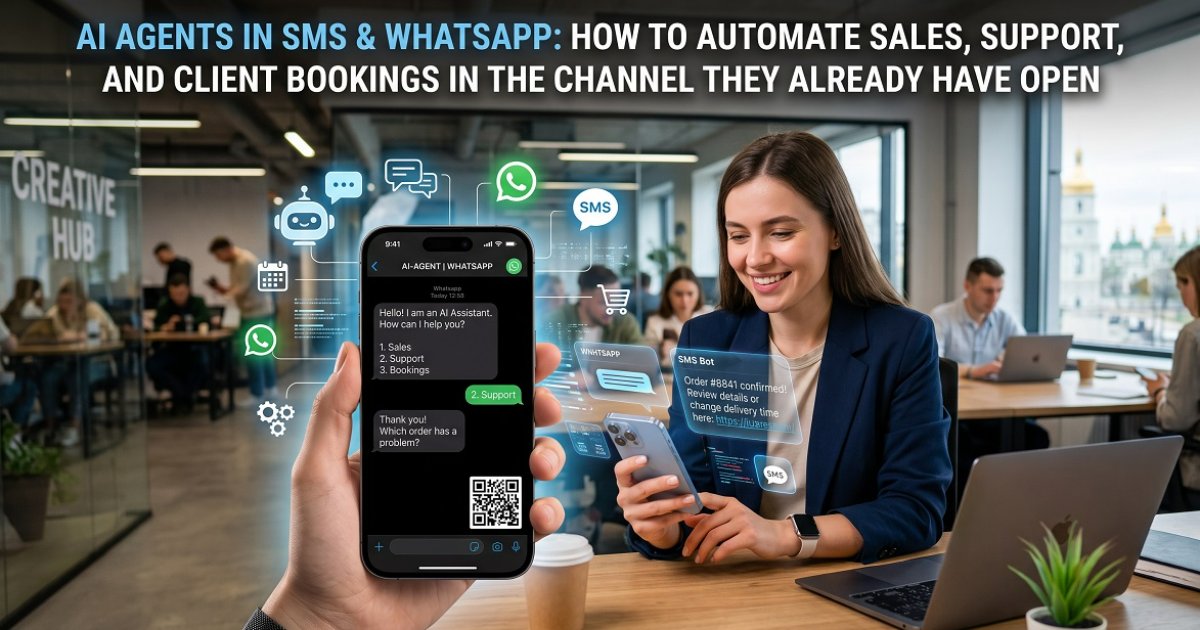
The Channel Your Customers Already Have Open
A prospect texts your business number at 11:47 PM asking about pricing. No one is on shift. The message sits unread until morning — by which point the prospect has already booked a demo with a competitor. Meanwhile, three rows down in your CRM, a post-purchase support ticket from a loyal customer has been waiting six hours for a first response. Both conversations happened in the same channel your customers use to text their friends: SMS or a messenger app they already have installed.
What TechCrunch documented in early October 2026 is not a feature update — it is a structural shift in where AI agents now live. A new class of assistants operates entirely inside text messages, with no app to download, no login screen, no onboarding friction. For a business owner, the implications run deeper than "faster replies." The real question is what happens to your sales funnel, your support costs, and your competitive position when the agent answering at midnight is indistinguishable from your best human rep — and costs a fraction of one.
The wave TechCrunch described is already funded at scale. Instinct, one of the most prominent text-native AI agents, raised $1 billion in September 2026 at a $10 billion valuation — backed by Sequoia Capital, Benchmark, and Coatue. The agent operates entirely over SMS and voice, with no mobile app at all. Folk works across iMessage, WhatsApp, and Telegram. Caddy lives in iMessage for iPhone users and RCS for Android users. Poke — the first AI agent approved for Apple's Messages for Business platform — relayed over 100 million messages before that milestone. Photon, a developer infrastructure startup, raised $4.5 million in seed funding specifically to help businesses build agents that run over iMessage and WhatsApp.
The infrastructure is here. The question is how to put it to work.
Why Text Beats Every Other Automation Channel
Email open rates have been declining for years. Push notifications get disabled. Chatbots on websites require the customer to navigate there first. SMS and messenger apps sit in a different category: they are the primary communication layer for most people on the planet, checked dozens of times a day, with no competing inbox noise.
For businesses, this creates a channel with structural advantages that no other automation surface can match:
- Zero installation barrier. The customer already has iMessage, WhatsApp, or SMS. There is nothing to download, no account to create, no app to rate.
- Persistent context. A text thread carries history. An AI agent operating in that thread can reference what was discussed last week, last month, or at the moment of purchase — without the customer repeating themselves.
- Asynchronous but fast. Unlike a phone call, the customer can respond when convenient. Unlike email, the response loop is measured in minutes, not hours.
- High trust signal. Customers who give a business their mobile number have already crossed a psychological threshold. The channel feels personal, not transactional.
The agent answering at midnight is not a chatbot reading from a script. It is an autonomous system that can check inventory, qualify intent, update a CRM record, and schedule a follow-up — all before your team arrives in the morning.
For a CEO thinking about where automation delivers the highest leverage, the math is straightforward: the channel with the highest engagement rate, combined with an agent that can take real action rather than just answer questions, is where the ROI concentrates.
Four Business Scenarios That Work Right Now
Lead Qualification at Scale
The classic problem: marketing generates leads, sales can't follow up fast enough, and the best prospects go cold. A text-native AI agent changes the timing equation entirely.
When a prospect fills out a form or clicks an ad, the agent sends a personalized SMS within seconds — not a generic "thanks for your interest" message, but a qualifying question tied to what the prospect actually clicked on. Based on the reply, the agent scores the lead, asks follow-up questions, and either books a meeting directly into a sales rep's calendar or routes the lead to a nurture sequence. The human rep enters the conversation only when the lead is warm and qualified.
The practical result: response time drops from hours to under a minute, and sales reps spend their time on conversations that are already moving forward rather than cold outreach.
Post-Purchase Support and Retention
Support tickets that arrive after a sale are expensive to handle and easy to lose. A customer who can't get a quick answer to a simple question — "where is my order?", "how do I return this?", "can I upgrade my plan?" — either churns silently or escalates to a human agent, which costs more.
An AI agent operating in the same messenger thread where the purchase confirmation was sent can handle the entire tier-one support layer: order status, return initiation, FAQ resolution, and escalation routing. The customer never leaves the channel they already trust. The agent has full context from the purchase history. Resolution happens in the thread, not across three different platforms.
Appointment Booking and Reminders
For service businesses — clinics, law firms, consultancies, fitness studios — no-shows are a direct revenue leak. An AI agent in SMS can handle the entire scheduling loop: initial booking, confirmation, reminder 24 hours before, rescheduling if the customer cancels, and a follow-up after the appointment to collect feedback or book the next session.
This is not a new idea, but the execution has historically required custom integrations and dedicated booking software. Text-native agents collapse that stack: the agent connects to the calendar, handles the conversation, and updates the record — all inside a message thread the customer initiated.
Agentic Commerce and Upsell
Instinct's partnership with Shopify, announced in late September 2026, points toward where this goes commercially: a customer texts to ask about a product, the agent searches the merchant catalog, surfaces relevant options, and initiates a checkout — all inside the conversation. According to the company's founder, users who make purchases through Instinct spend over $1,300 per month on average through the agent.
For B2B businesses, the equivalent scenario is an agent that handles renewal conversations, surfaces upgrade options at the right moment in the customer lifecycle, and processes the transaction without routing the customer to a separate portal.
A Step-by-Step Implementation Guide
This is where most articles stop at the concept level. Here is how to actually build a text-native AI agent workflow for a sales or support use case.
Step 1: Define the Specific Workflow First
Do not start with the technology. Start with one process that has a clear input, a clear output, and a measurable cost today. Good candidates: lead response time, tier-one support ticket volume, appointment no-show rate. Pick one. Define what "done" looks like for the agent — what action it takes, what it hands off to a human, and what it logs.
Step 2: Choose the Right Messaging Infrastructure
Your choice of channel determines your integration path:
- SMS/RCS — broadest reach, works on every phone, no app required. Requires a business phone number (typically via a provider like Twilio or a similar CPaaS platform). RCS adds richer formatting on Android.
- WhatsApp Business API — high engagement in markets outside North America, supports rich media and buttons, requires Meta approval for the Business API tier.
- iMessage for Business — Apple's verified business channel, now open to third-party AI agents following Poke's approval. Highest trust signal for iOS users.
- Telegram — strong in tech-forward and international markets, open API, easiest to integrate for developers.
For most businesses starting out, SMS/RCS via a CPaaS provider is the lowest-friction entry point. WhatsApp Business API is the right choice if your customer base is primarily outside North America.
Step 3: Select the Agent Layer
You have three options, depending on your technical resources and customization needs:
Off-the-shelf text agents (Folk, Caddy, Poke, Instinct) — fastest to deploy, limited customization, best for personal productivity and light business use cases.
Business-focused platforms — purpose-built for sales and support workflows, with CRM integrations, conversation routing, and analytics built in. These sit between off-the-shelf tools and fully custom builds.
Custom-built agents — maximum control over behavior, integrations, and data handling. Requires engineering resources or an external development partner. If you are evaluating the build-vs-buy decision, the cost breakdown for custom AI agent development is worth reviewing before committing to either path.
Step 4: Connect to Your Existing Systems
The agent is only as useful as the data it can access. At minimum, connect it to:
- Your CRM (for lead data, customer history, and record updates)
- Your calendar or scheduling system (for appointment workflows)
- Your order management or ticketing system (for support workflows)
- Your product catalog or knowledge base (for sales and FAQ handling)
Most modern CRM platforms expose APIs that allow agents to read and write records. If your systems are fragmented, this integration step is where the real complexity lives — and where the ROI calculation needs to account for setup time.
Step 5: Define Escalation Rules Explicitly
Every text-native agent needs a clear escalation protocol: which situations trigger a handoff to a human, how that handoff is communicated to the customer, and how the human agent receives context from the conversation so far. Escalation without context transfer is the fastest way to destroy the customer experience the agent was building.
A simple rule set: escalate on any expression of frustration, any request the agent cannot fulfill with confidence above a defined threshold, and any transaction above a defined value.
Step 6: Measure, Then Iterate
The metrics that matter for text-native agent workflows:
- First response time (target: under 60 seconds for inbound leads)
- Resolution rate without human escalation (tier-one support benchmark: 60–80% for well-scoped workflows)
- Conversion rate from agent-qualified leads vs. unqualified leads
- No-show rate before and after agent-driven reminders
- Cost per resolved ticket vs. human-handled baseline
Run the agent on a defined segment for 30 days before expanding. The data from that period will tell you more than any benchmark.
Real Case: What the Numbers Look Like
A mid-sized e-commerce retailer — operating across three markets, with a support team of twelve — deployed a text-native AI agent on their WhatsApp Business channel to handle post-purchase support. The scope was deliberately narrow: order status inquiries, return initiation, and delivery exception handling.
Before deployment, the average first response time on WhatsApp was 4.2 hours. The tier-one resolution rate — tickets resolved without escalation — was 41%. Each human-handled ticket cost approximately $8.50 in fully loaded labor.
After 60 days with the agent handling the initial layer:
- First response time: under 90 seconds, around the clock
- Tier-one resolution rate: 74% (the remaining 26% escalated to human agents with full conversation context)
- Cost per resolved ticket: $1.20 for agent-handled cases
- Customer satisfaction score on agent-handled tickets: 4.1 out of 5, compared to 4.3 for human-handled cases — a gap small enough that the business accepted it in exchange for the cost reduction
The net result over 60 days: support labor costs on the WhatsApp channel dropped by approximately 58%. The human team shifted from answering repetitive status questions to handling complex cases and proactive outreach — work that actually requires judgment.
That shift — from reactive firefighting to deliberate, high-value work — is what the operational model looks like when it's working. And for a CEO who has spent years watching their best people answer the same questions on repeat, the feeling of finally having that problem solved is not just a metric. It is a genuine relief.
ROI Framework and Risk Assessment
Where the ROI Comes From
Text-native AI agents generate measurable returns in three places:
Labor cost reduction — the most direct line. If a human agent handles 40 tickets per day at $8–12 per ticket in fully loaded cost, and an AI agent handles 70% of that volume at $0.50–2.00 per interaction, the math is straightforward. Scale that across a support team of ten and the annual savings are material.
Revenue from speed — less obvious but often larger. Studies on lead response time consistently show that the probability of qualifying a lead drops sharply after the first five minutes. An agent that responds in under 60 seconds, at any hour, captures opportunities that would otherwise go cold. For businesses with high-value leads, even a modest improvement in qualification rate translates to significant revenue.
Retention from resolution quality — customers who get fast, accurate answers in the channel they prefer churn less. The cost of acquiring a new customer is typically three to five times the cost of retaining an existing one. An agent that resolves a post-purchase issue before it becomes a complaint is doing retention work at scale.
For a structured approach to quantifying these returns before you commit budget, the AI ROI framework provides a methodology that applies directly to messaging automation projects.
The Risks You Need to Price In
Data handling and consent. Text-native agents operate in personal communication channels. The legal and reputational exposure from mishandling customer data in this context is higher than in a web chatbot. Instinct's early controversy — where disconnecting an email account did not automatically delete the data the agent had indexed — is a concrete example of what can go wrong. Before deploying any agent in a messaging channel, audit what data it retains, where it is stored, and what your deletion policy is.
Hallucination in high-stakes conversations. An agent that confidently gives a customer incorrect information about a return policy, a delivery date, or a product specification does damage that is hard to undo in a personal channel. Scope the agent's knowledge base tightly, and build in explicit uncertainty handling — the agent should know when to say "let me confirm that with the team" rather than guess.
Escalation failure. If the handoff from agent to human breaks — because the human doesn't receive the context, or the customer has to repeat everything — the agent has made the experience worse, not better. Test escalation paths as rigorously as you test the agent's primary responses.
Channel policy compliance. WhatsApp Business API, Apple Messages for Business, and RCS all have policies governing how businesses can initiate conversations, what content is permitted, and how opt-out requests must be handled. Violations can result in account suspension. Know the rules of the channel before you build on it.
Boards and investors increasingly distinguish between companies that have deployed AI as a cost-reduction measure and those that have rebuilt their customer-facing operations around it. The former is a line item. The latter is a competitive moat.
Choosing the Right Agent for Your Business Size
The right entry point depends on your current infrastructure, team size, and the complexity of the workflow you are automating.
| Business size | Recommended starting point | Primary use case | Expected setup time |
|---|---|---|---|
| Small (1–20 people) | Off-the-shelf text agent (Folk, Poke) | Appointment booking, basic FAQ | 1–3 days |
| Mid-market (20–200 people) | Business messaging platform with AI layer | Lead qualification, tier-one support | 2–4 weeks |
| Enterprise (200+ people) | Custom agent on CPaaS infrastructure | Multi-channel support, agentic commerce | 6–12 weeks |
For teams evaluating the underlying AI frameworks that power custom agent builds, the comparison of LangChain, CrewAI, and AutoGen covers the architectural trade-offs in practical terms.
The pricing landscape for text-native agents is still forming. Folk's Pro plan runs at $8.33 per month. Ollie offers paid plans starting at $25 per month for 150 messages. Enterprise-grade deployments on WhatsApp Business API or custom infrastructure are priced on volume and integration complexity. The range is wide enough that the right question is not "what does it cost?" but "what does it cost relative to the process it replaces?"
Frequently Asked Questions
Do customers actually respond well to AI agents in SMS and messengers? Response rates in messaging channels are significantly higher than in email, and customers who opt into text communication with a business have already signaled a preference for that channel. The key variable is quality: an agent that gives fast, accurate, relevant answers earns trust quickly. An agent that gives generic or incorrect responses in a personal channel damages trust faster than a bad email would.
What is the difference between a text-native AI agent and a traditional SMS chatbot? Traditional SMS chatbots follow decision trees — they present options, the customer picks one, and the bot follows a script. Text-native AI agents understand natural language, maintain context across a conversation, can take real actions in connected systems (updating a CRM, booking a calendar slot, initiating a return), and handle unexpected inputs without breaking. The user experience is closer to texting a knowledgeable person than navigating a menu.
Which messaging channel should a business prioritize first? It depends on your customer base. For North American businesses, SMS/RCS reaches the broadest audience with no app requirement. For businesses with significant customer bases in Europe, Latin America, or Southeast Asia, WhatsApp Business API typically delivers higher engagement. For businesses serving primarily iOS users in premium segments, Apple Messages for Business is worth the additional setup complexity.
How do I handle customers who don't want to interact with an AI agent? Transparency and easy opt-out are both good practice and, in many jurisdictions, legally required. The agent should identify itself as automated when asked directly, and there should always be a clear path to a human — either by request or by the agent recognizing that the conversation has moved beyond its scope.
What happens when the AI agent makes a mistake? Mistakes will happen. The mitigation is in the design: scope the agent's authority narrowly at first, build in confidence thresholds below which it escalates rather than answers, and monitor conversation logs regularly in the first 30–60 days. A mistake caught in a text thread is recoverable. A mistake that propagates through an automated workflow without human review is not.
Is this technology mature enough for enterprise deployment? The infrastructure is mature — CPaaS providers, WhatsApp Business API, and Apple Messages for Business are all production-grade platforms used by large enterprises today. The AI agent layer is moving fast, with most consumer-facing products still in beta or early access as of late 2026. Enterprise deployments typically use more controlled, custom-built agent layers rather than off-the-shelf consumer tools, which gives them more control over behavior, data handling, and integration.
The shift TechCrunch documented is not a trend to monitor — it is a capability gap that is opening between businesses that deploy text-native AI agents now and those that wait for the technology to "mature." The channel is already where your customers are. The agents are already funded, built, and running. The businesses that figure out the right workflow, connect it to the right systems, and measure it rigorously will not just cut costs — they will build a customer experience that competitors running on human-only support simply cannot match at scale.
The companies that treat messaging automation as an operational decision rather than an IT experiment are the ones their boards will be talking about in two years.
Have questions? Ask the AI agent right now
Responds in seconds, knows everything about our services and will help with your situation
You might also like
Gemini 3.8 Live Avatar: Video Agents for Business
Google's Gemini 3.8 Live with Live Avatar brings real-time video agents to enterprise. See how video AI transforms customer service, training, and sales.
AutomationHow to Choose an AI Agent Vendor: Business Checklist
A practical checklist for CEOs and COOs on how to choose an AI agent development vendor — with red flags, key criteria, and a real case with numbers.
AutomationApple Locks macOS Full Disk Access: AI Agent Fix
Apple tightened macOS Full Disk Access controls due to AI agent risks. Here's which business workflows break, what to audit now, and how to adapt your automation.