
LangChain vs CrewAI vs AutoGen: Choose Right
LangChain, CrewAI, or AutoGen for your multi-agent system? A practical framework guide for CEOs and COOs making the build-or-buy decision in 2026.
The Framework Question Nobody Asks Correctly
Most companies treat the choice of a multi-agent framework as a technology decision. It isn't. It's an operational architecture decision — and getting it wrong doesn't just slow down your developers, it locks your entire automation strategy into the wrong shape for years. The framework you pick determines which processes you can automate, how much human oversight you'll need to maintain, and whether your system can survive the scale that comes with actual business growth.
What follows isn't another feature matrix. It's a decision guide built around what your business actually needs to accomplish — with a clear-eyed look at where each framework genuinely wins, where it quietly fails, and one significant shift in the landscape that most comparison articles are still ignoring.
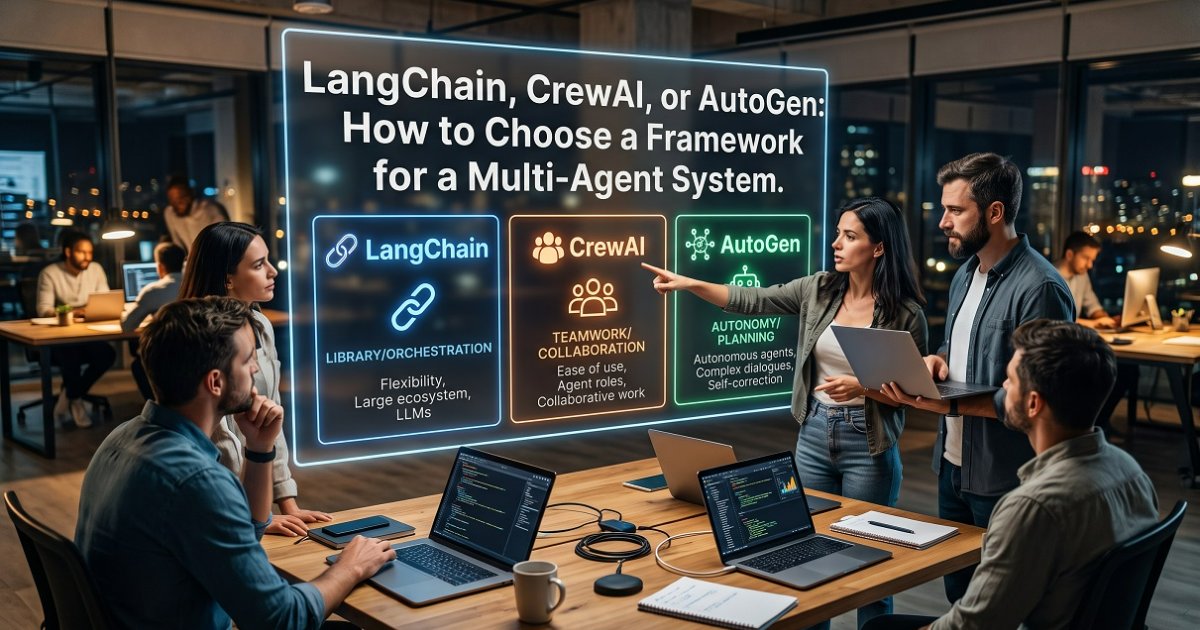
The three names that dominate every conversation about multi-agent AI — LangChain, CrewAI, and AutoGen — are not interchangeable tools that do roughly the same thing. Each was built around a fundamentally different mental model of how agents should work together. Choosing between them without understanding that distinction is like hiring a logistics director, a project manager, and a research analyst for the same role and wondering why the output is inconsistent.
This guide cuts through the noise for the executive who needs to make a real decision: which framework becomes the backbone of your automated operations, and what does that choice cost you if you get it wrong?
What Each Framework Actually Is
Before comparing features, it's worth being precise about what these tools are at their core — because the architecture shapes everything downstream.
LangChain: The Ecosystem Play
LangChain is the oldest and most widely adopted of the three, with over 130,000 GitHub stars and more than 600 integrations with external tools, APIs, and data sources. Its strength is breadth. If your business runs on a patchwork of SaaS tools — a CRM here, an ERP there, a compliance database somewhere else — LangChain's integration library is genuinely hard to beat.
The framework's approach to multi-agent work runs through LangGraph, its graph-based orchestration layer. LangGraph models agent workflows as directed graphs with explicit state transitions, which gives you precise control over what happens at every step. That control comes at a cost: LangGraph has a steep learning curve, and teams consistently report higher debug time compared to more opinionated alternatives.
LangChain also ships LangSmith, an observability and tracing platform that lets you inspect every agent call, token usage, and decision branch. For businesses where auditability matters — financial services, healthcare, legal — this is not a nice-to-have. It's a compliance requirement.
The framework you pick doesn't just determine what you can build today. It determines what you can audit, explain, and defend tomorrow.
CrewAI: Speed With Structure
CrewAI takes a different bet. Instead of giving you maximum flexibility, it gives you a clear mental model: a crew of agents, each with a defined role, goal, and set of tools, collaborating on a shared task. You define a Researcher, a Writer, a Reviewer — and CrewAI handles the orchestration.
The result is dramatically faster time-to-prototype. Teams regularly stand up working multi-agent workflows in a fraction of the code that LangGraph requires. CrewAI processes over 450 million agentic workflows per month according to its own published figures — a number that reflects real production adoption, not just developer experimentation.
Crucially, CrewAI removed its dependency on LangChain entirely in version 1.14, running as a fully standalone framework. It has since added enterprise features including FedRAMP High certification, dedicated VPCs, and SSO integration — signals that the platform is serious about regulated industries and larger organizations.
The tradeoff: CrewAI's opinionated structure is its strength until your use case doesn't fit the crew/role model. When workflows become highly stateful, require complex branching logic, or need fine-grained control over agent memory, the abstraction starts to feel like a constraint rather than a convenience.
AutoGen: The Honest Answer in 2026
AutoGen deserves a direct statement that most comparison articles are still dancing around: the original AutoGen framework entered maintenance mode on October 2, 2025. Microsoft is no longer adding features to it — only bug and security fixes. New builds targeting the AutoGen lineage should point to the Microsoft Agent Framework (MAF), which reached general availability on April 3, 2026, and officially merges AutoGen's agent abstractions with Semantic Kernel's enterprise-grade capabilities.
This matters enormously for any business making a multi-year infrastructure decision. Committing to legacy AutoGen today means committing to a framework with a defined end-of-life trajectory.
That said, AutoGen's core contribution — conversation-driven multi-agent collaboration, where agents reason through problems by talking to each other rather than following a predefined task graph — remains genuinely powerful for certain use cases. Research workflows, code generation pipelines, and exploratory analysis tasks where the path to the answer isn't known in advance are still natural fits. The Microsoft Agent Framework carries this capability forward with stable APIs, native support for MCP and A2A protocols, and a long-term support commitment.
For teams already on the Microsoft stack (.NET, Azure), the migration path from AutoGen to MAF is the clearest forward direction in the ecosystem.
Matching Framework to Business Need
The right framework isn't the most powerful one. It's the one that fits the shape of the problem you're actually solving.
When Your Processes Have Clear Roles
Procurement approval chains. Content production pipelines. Customer onboarding sequences. Compliance review workflows. These are processes where the work naturally breaks into distinct responsibilities — someone researches, someone drafts, someone reviews, someone approves.
CrewAI was built for exactly this shape. You model your existing process as a crew, assign each step to an agent with the right tools and constraints, and the framework handles the handoffs. For a mid-sized business trying to remove the human bottleneck from a five-step approval cycle, this is the fastest path from idea to running system.
The RAG vs CAG architecture guide covers how retrieval-augmented approaches fit into these pipelines — relevant if your agents need to pull from internal knowledge bases during the workflow.
When Control and Auditability Are Non-Negotiable
Financial reconciliation. Regulatory reporting. Any process where you need to explain, step by step, why the system made a specific decision.
LangGraph is the right answer here. Its graph-based state machine means every transition is explicit and logged. Combined with LangSmith's tracing, you get a complete audit trail that satisfies both internal governance requirements and external regulators. The higher development cost is real — but for processes where a single unexplained decision can trigger a compliance event, that cost is justified.
Independent benchmarks have found that LangGraph runs approximately 2.2 times faster than CrewAI on identical tasks, which matters when you're running high-volume automated workflows at scale.
When You're Running on Microsoft Infrastructure
If your business runs on Azure, uses .NET services, or has existing Semantic Kernel integrations, the Microsoft Agent Framework is the natural choice — not because it's necessarily superior in every dimension, but because the integration story is dramatically simpler. MAF supports MCP, A2A, AG-UI, and OpenAPI standards out of the box, and it runs natively on Microsoft Foundry alongside Azure OpenAI, Anthropic, and AWS Bedrock.
The AI ROI framework is worth reading alongside this decision — particularly the sections on total cost of ownership, which often shifts significantly when you factor in integration and maintenance overhead rather than just licensing.
When You're Still Figuring Out the Problem
Not every automation initiative starts with a clear process map. Sometimes the value is in exploration — letting agents reason through an ambiguous problem, generate hypotheses, test them, and iterate.
For this kind of work, the conversational multi-agent model that AutoGen pioneered (and that AG2, the independent Apache-licensed fork, continues to develop) remains the most natural fit. The agents talk through the problem. Dead ends get surfaced and abandoned. The solution emerges from the conversation rather than being specified in advance.
For processes where the path to the answer isn't known in advance, a conversation-driven architecture isn't a workaround — it's the correct design.
This is also where the choice of underlying model matters most. If your agents are doing complex reasoning across large document sets, the context window and reasoning capabilities of the model become the binding constraint — a topic covered in depth in the DeepSeek-V4 analysis.
The Decision Framework: Four Questions Before You Choose
Frameworks don't fail because they're bad. They fail because they were chosen for the wrong reasons. Before committing, answer these four questions honestly.
1. What does your process actually look like? Draw it out. If it looks like a flowchart with defined roles and handoffs, CrewAI fits. If it looks like a state machine with complex branching and rollback conditions, LangGraph fits. If it looks like a whiteboard conversation with no fixed structure, the AutoGen/AG2 model fits.
2. Who will maintain this system in 18 months? LangChain and LangGraph have the largest developer community and the most mature documentation. CrewAI is growing fast. The Microsoft Agent Framework is new but backed by Microsoft's long-term support commitment. Legacy AutoGen has a defined maintenance horizon. Factor this into your build decision — the framework your team can actually debug at 2am matters more than the one that looks best in a demo.
3. What does your compliance environment require? If you need audit trails, LangSmith is currently the most mature observability layer in the ecosystem. If you need FedRAMP High, CrewAI's enterprise tier has it. If you need Azure-native deployment with enterprise SLAs, MAF is the path.
4. Are you building a product or automating a process? Building a product that other people will use requires stability, documentation, and a framework with a long-term roadmap. Automating an internal process gives you more flexibility to choose based on fit. These are different decisions, and conflating them leads to over-engineered internal tools and under-engineered customer-facing products.
FAQ
Is AutoGen still worth using in 2026? Legacy AutoGen entered maintenance mode in October 2025 — no new features, only security and bug fixes. For new projects, Microsoft's official recommendation is to target the Microsoft Agent Framework, which reached GA in April 2026. The AG2 fork (maintained by AutoGen's original creators) is an active alternative for teams that want the conversational multi-agent model without the Microsoft stack dependency.
Can I use LangChain and CrewAI together? CrewAI deliberately removed its LangChain dependency in version 1.14 and now runs as a standalone framework. You can use LangChain tools within a CrewAI workflow, but the frameworks are no longer architecturally coupled. Most teams choose one as the primary orchestration layer rather than running both in parallel.
Which framework is easiest to get started with? CrewAI has the lowest barrier to entry for structured multi-agent workflows — teams consistently report faster time-to-prototype compared to LangGraph. For teams already familiar with Microsoft tooling, AutoGen Studio (a no-code interface for AutoGen) offers a graphical way to build workflows without writing code.
Does framework choice affect which AI models I can use? All three frameworks support multiple model providers, including OpenAI, Anthropic, and open-weight models. LangChain has the broadest integration surface. The Microsoft Agent Framework supports Microsoft Foundry, Azure OpenAI, Anthropic, AWS Bedrock, and Ollama. CrewAI supports major providers through its model abstraction layer.
What's the total cost of ownership difference? The frameworks themselves are open-source and free. The real cost differences come from observability tooling (LangSmith runs approximately $39 per seat), cloud hosting, and — most significantly — developer time. LangGraph's higher complexity translates to measurably more debug time. CrewAI's faster setup reduces initial development cost but may require rearchitecting if your use case outgrows its role-based model.
How do I handle human-in-the-loop requirements? LangGraph has first-class support for human-in-the-loop checkpoints — the workflow can pause, surface a decision to a human, and resume based on the response. CrewAI supports it but with more manual configuration. This is a critical consideration for any process where regulatory or risk requirements mandate human sign-off at specific stages.
The executives who get this decision right don't just ship faster — they build something that compounds. A well-chosen framework means your automation layer grows with the business instead of becoming the thing that holds it back. When the board asks why margins improved or why the approval cycle dropped from five days to four hours, the answer traces back to an architectural decision that most of their peers are still treating as a developer problem.
That's the real value of getting the framework right: not just operational efficiency, but the confidence that comes from knowing your systems are built on a foundation that won't need to be torn out in eighteen months. Control over operations instead of constant firefighting. Calm about the processes that used to keep you up at night.
If you're at the point of choosing a framework — or realizing the one you chose isn't working — book a 15-minute consultation to map the right architecture to your specific processes.
Have questions? Ask the AI agent right now
Responds in seconds, knows everything about our services and will help with your situation
You might also like
Open vs Closed AI Models: What to Choose in 2026
Anthropic's official stance on open-weights models reframes the debate. Here's what CTOs and business owners need to know to make the right LLM choice in 2026.
ComparisonApple vs OpenAI: New Rules for Business AI Agents
Apple vs OpenAI: how the confrontation between tech giants is changing the AI-agents market and what it means for Ukrainian business today.
ComparisonOpen-Weight Models 2026: Cheap Agents Catch Up
Open-weight models of 2026 are breaking records: small businesses launch AI agents for pennies where millions used to be required. Facts, cases, comparisons.