
Open vs Closed AI Models: What to Choose in 2026
Anthropic's official stance on open-weights models reframes the debate. Here's what CTOs and business owners need to know to make the right LLM choice in 2026.
The Debate That's Costing Businesses Real Money
On July 27, 2026, Anthropic CEO Dario Amodei published a formal position paper on open-weights AI models — the same day Moonshot AI released the full 2.8-trillion-parameter Kimi K3 weights publicly on Hugging Face. The timing was not accidental. More than 50 companies, including Nvidia, Microsoft, Meta, and Palantir, had just signed a letter urging policymakers to avoid restricting open-weight models. Anthropic was the only major lab that did not sign. The industry wanted to know exactly where it stood.
What followed was one of the most consequential policy clarifications in AI's recent history — not because it announced a new product, but because it redrew the map of how businesses should think about model choice. The specifics of Anthropic's three-part framework, the distillation incident that triggered it, and the concrete criteria that should guide your own procurement decision are all ahead.
The open-weights versus closed-model question has moved from a developer forum debate into the boardroom. Procurement teams are asking it. Legal is asking it. And CTOs who haven't formed a clear answer are making expensive decisions by default rather than by design.
Anthropic's position paper doesn't resolve the debate — but it gives business decision-makers something more useful than a verdict: a structured way to think about risk, capability, and control.
What Anthropic Actually Said (And What It Didn't)
The first thing to understand is what Anthropic's statement is not. It is not a product announcement. Anthropic is not releasing open-weight versions of Claude. The paper is a policy clarification, and its opening line is deliberately blunt: Dario Amodei wrote that "Anthropic has never advocated for a ban on open-weights models" — with the emphasis his own.
That framing matters because the industry had assumed otherwise. When Anthropic declined to sign the Nvidia-backed coalition letter, critics on X accused the company of quietly lobbying for restrictions that would protect its proprietary business. Amodei's response was to publish a full position rather than a press statement.
The core of that position rests on a distinction that most business conversations about AI completely miss: the difference between open-weights models without dangerous capabilities and those that approach the frontier of what the most powerful systems can do.
According to Amodei, open-weights models that lack dangerous capabilities are, in his words, "a public good" — they provide real value to businesses, developers, and researchers at no cost beyond the compute needed to run them. That's a meaningful endorsement of the open-weights ecosystem from the CEO of a company that builds exclusively closed models.
Where Anthropic draws the line is at the frontier. The concern isn't openness as a principle. It's the irreversibility of releasing weights for the most capable systems. Once weights are published, they cannot be withdrawn. Safeguards can be stripped. Copies can be downloaded, redistributed, and run on private infrastructure beyond any monitoring. For models with genuinely dangerous capabilities — those that could meaningfully assist in cyberattacks or biological weapons development — that permanence is the problem.
Open-weights models without dangerous capabilities are a public good. The question for your business isn't which camp to join — it's which category your use case actually requires.
The Three Policies Anthropic Wants Instead of a Ban
Rather than advocating for blanket restrictions, Anthropic's position paper proposes three targeted measures. Understanding them helps business leaders read the regulatory landscape for the next two to three years — because these proposals are likely to shape procurement rules, compliance requirements, and vendor contracts.
First: tighter chip export controls. Amodei's primary concern is not American businesses using open-weight models from Chinese labs. It's the possibility that authoritarian governments build AI systems more powerful than anything available in the West — and keep them closed, deploying them for military or surveillance purposes. The policy response he advocates is restricting advanced chip exports and prosecuting smuggling, not restricting which models businesses can use.
Second: enforcement against industrial-scale distillation. This is where the paper gets specific in a way that directly affects vendor relationships. Anthropic accused a Chinese AI lab of running what it described as the largest known distillation attack against Claude to date — a campaign involving approximately 654,000 fake accounts and nearly 41 million exchanges, used to train a competing model on Claude's outputs. Amodei argues that targeted legal and commercial frameworks should address this, not broad open-weights restrictions.
Third: mandatory safety testing for all sufficiently capable models — open or closed. This is the most consequential proposal for businesses evaluating AI vendors. Amodei proposes that any model crossing a capability threshold should be required to pass safety testing covering cybersecurity risks, biological risks, and alignment before release. He has also raised the idea of an international body to administer that testing. Critically, this requirement would apply regardless of whether the model's weights are published.
The regulatory implication: if these proposals gain traction, the compliance burden for deploying frontier AI will increase for everyone — but the risk of sudden model withdrawal or access restriction will fall disproportionately on businesses that have built deep integrations with open-weight systems that later fail safety thresholds.
What "Open Weights" Actually Means for Your Operations
Before choosing a model architecture, it helps to be precise about what open weights actually give you — and what they don't.
What You Gain
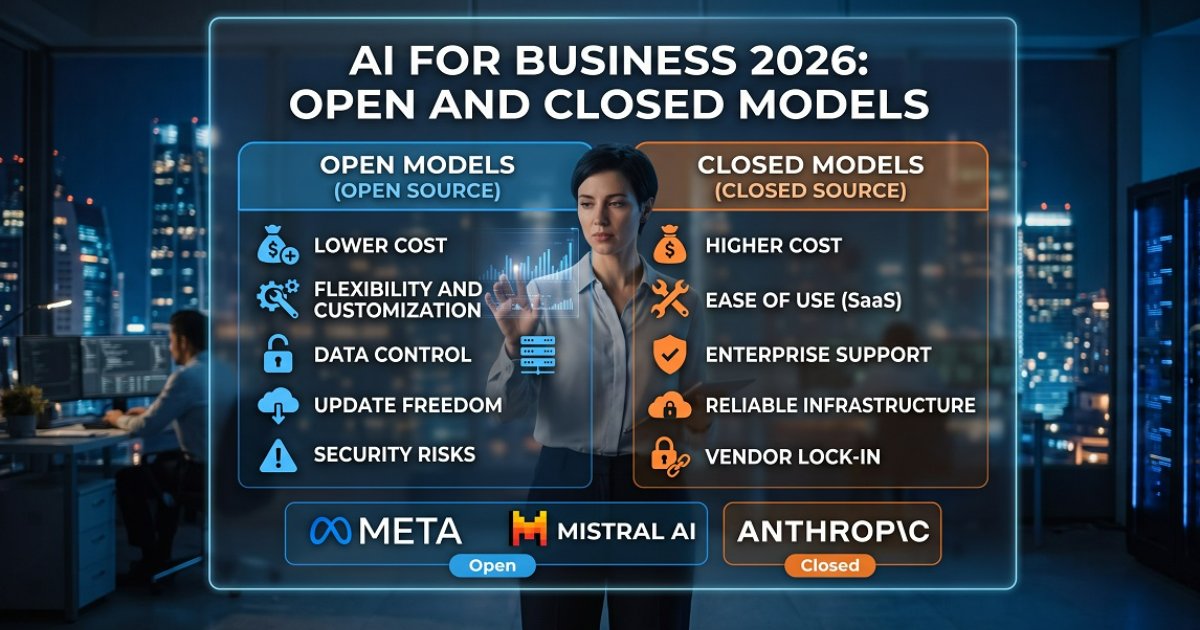
When a model's weights are publicly available, you can download and run the model on your own infrastructure. That means no API dependency, no per-token pricing, and no vendor controlling your access. For high-volume, low-sensitivity workloads — document classification, internal search, structured data extraction — this can translate into significant cost reduction. You can fine-tune the model on proprietary data without sending that data to a third-party server. You can deploy it in air-gapped environments where external API calls are prohibited by compliance rules.
For businesses in regulated industries where data residency requirements are strict, or for teams building products where inference cost at scale is a primary constraint, open-weight models like Meta's Llama series or Mistral's releases have become genuinely competitive options.
What You Give Up
The UK AI Security Institute report cited in Anthropic's position paper puts it plainly: the same openness that enables local deployment "precludes many of the safety measures that closed model developers can use to detect and disrupt misuse, iterate on safeguards as vulnerabilities emerge, control user access and withdraw models." Once weights are released, those options are gone permanently.
For businesses, this translates into a different kind of operational risk. When you run an open-weight model, you own the safety layer. There is no vendor pushing a patch when a new jailbreak technique emerges. There is no abuse monitoring. If your deployment is exploited — through prompt injection or adversarial inputs — the response is entirely your engineering team's problem.
That's not an argument against open weights. It's an argument for being honest about your team's capacity to manage that responsibility.
The Hidden Cost of "Free"
Self-hosting a capable open-weight model is not free. It requires GPU infrastructure, MLOps expertise, ongoing maintenance, and security hardening. For a mid-sized business without a dedicated ML platform team, the total cost of ownership for a self-hosted model can exceed the cost of a well-negotiated API contract with a closed-model provider — especially once you factor in the engineering time spent on model updates, safety evaluations, and incident response.
The math changes at scale. At very high inference volumes, or for use cases where data sovereignty is non-negotiable, self-hosting often wins. The mistake is assuming it wins by default.
The Closed-Model Case: What You're Actually Buying
Choosing a closed model — Claude, GPT-4o, Gemini, or their successors — is not primarily a capability decision. It's a governance decision.
When you use a closed model via API, you're purchasing a managed service that includes safety filtering, abuse monitoring, model updates, and — critically — a vendor who bears some responsibility for the model's behavior. That last point matters more than most procurement teams realize. As AI agents take on more consequential tasks — approving purchase orders, drafting compliance documents, routing customer escalations — the question of who is accountable when something goes wrong becomes a board-level concern, not just an engineering one.
Closed models also offer something that's genuinely hard to replicate with open weights: continuous improvement without migration cost. When Anthropic releases a new Claude version, API customers get access without rebuilding their infrastructure. When a new safety issue is discovered, the vendor patches it. The operational burden stays with the provider.
The trade-off is dependency. Vendor lock-in with AI providers is a real risk — pricing can change, APIs can be deprecated, and access can be restricted for policy reasons. Businesses that have built deep integrations with a single closed-model provider are exposed to that provider's strategic decisions in ways that can be difficult to unwind quickly.
The real question isn't open versus closed. It's: which risks are you equipped to own, and which do you need a vendor to carry?
A Decision Framework for Business Leaders
The Anthropic position paper, read carefully, offers business leaders something more useful than a verdict on open versus closed models. It offers a risk-stratification framework. Here's how to apply it.
Step 1: Classify Your Use Case by Sensitivity
Not all AI workloads carry the same risk profile. Internal productivity tools — meeting summarization, document drafting, code assistance — have a fundamentally different risk profile than customer-facing agents, financial decision support, or compliance automation. The higher the consequence of a model error or a safety failure, the stronger the case for a closed model with active vendor oversight.
For AI agents handling procurement or approval workflows, where a single miscategorized transaction can trigger a compliance audit, the managed safety layer of a closed model is not a luxury — it's part of the control architecture.
Step 2: Assess Your Data Sovereignty Requirements
If your industry requires that data never leave a specific jurisdiction, or that model inference happen on-premises, open weights may be the only viable path. This is common in healthcare, defense contracting, and certain financial services contexts. In these cases, the question shifts from "open or closed?" to "which open-weight model has the capability profile and safety track record we need?"
Step 3: Evaluate Your Internal Safety Capacity
Running an open-weight model in production means owning the safety layer. Before committing, answer honestly: does your team have the capacity to evaluate new jailbreak techniques as they emerge? To audit model outputs at scale? To respond to a safety incident within hours rather than days? If the answer is no, the apparent cost savings of self-hosting will likely be consumed by the first serious incident.
Step 4: Model the Regulatory Trajectory
Anthropic's proposed mandatory safety testing framework — if it becomes policy — would require any sufficiently capable model to pass pre-release testing regardless of whether its weights are open. Businesses building on open-weight models that later fail to meet those thresholds could face sudden access disruption or compliance exposure. Factor regulatory risk into your architecture decisions now, not after the rules are written.
Step 5: Don't Treat This as a Permanent Decision
The open-weights landscape is moving fast. Models that were clearly inferior to closed alternatives eighteen months ago are now competitive on many benchmarks. The right answer in 2026 may not be the right answer in 2027. Build your AI architecture with the assumption that you will need to swap components — and design your agent harness and integration layer to make that swap possible without rebuilding from scratch.
The Governance Layer Nobody Talks About
The open-versus-closed debate tends to focus on capability and cost. The governance dimension gets less attention — and it's where the most consequential business risks actually live.
When Anthropic describes the irreversibility of open-weight releases, it's pointing at something that matters deeply for enterprise risk management: the inability to respond. A closed-model vendor can withdraw a model, patch a vulnerability, or restrict access to a specific use case. An open-weight model, once released, cannot be recalled. If a vulnerability is discovered in a model your team has deployed, the patch has to come from you.
This is not hypothetical. The AI security landscape in 2026 includes active research into adversarial attacks, prompt injection, and model extraction — all of which are easier to execute against open-weight deployments where the attacker can study the model's weights directly. For businesses running AI agents with access to sensitive systems, this is a material security consideration that belongs in your threat model.
The governance frameworks being built around AI agents increasingly distinguish between the model layer and the control layer. The model you choose matters less than the controls you build around it. But the model choice does affect which controls are available to you — and which you have to build yourself.
When a CTO walks into a board meeting and can articulate exactly which risks are owned by the vendor and which are owned internally — with a clear rationale for each — that's not just good governance. It's the kind of systematic thinking that changes how investors and directors perceive the leadership team. It signals that AI adoption in this organization is a managed process, not a series of bets.
FAQ
Does Anthropic oppose open-weight AI models? No. Dario Amodei stated explicitly in the July 2026 position paper that Anthropic has never advocated for a ban on open-weights models, and described open-weight models without dangerous capabilities as a public good. The company's concern is specifically about frontier models with capabilities that could enable serious harm — not the open-weights category as a whole.
What are the main business risks of using open-weight models? The primary risks are operational: you own the safety layer, which means you're responsible for monitoring, patching, and responding to security incidents. There's also regulatory risk — if mandatory safety testing requirements are introduced, models that fail those tests could become non-compliant, disrupting deployments built around them. Finally, self-hosting costs are often underestimated; GPU infrastructure, MLOps staffing, and maintenance can exceed API costs for many mid-sized businesses.
What is distillation, and why does it matter for my vendor choice? Distillation is a training technique where a smaller model learns by processing outputs from a larger, more capable model. Anthropic described a large-scale distillation attack against Claude — allegedly running tens of millions of exchanges through fake accounts to train a competing model. This matters for vendor choice because it illustrates how the open-weights ecosystem can create IP and competitive risks that extend beyond the businesses directly involved.
When does a closed model make more sense than an open-weight one? Closed models are generally the better choice when: the use case involves high-consequence decisions (compliance, financial approvals, customer-facing agents); your team lacks the capacity to manage a self-hosted safety layer; regulatory requirements don't mandate on-premises deployment; or you need continuous model improvement without migration overhead. The managed governance layer of a closed-model API is a real operational asset, not just a cost line.
Will regulation change the open-weights landscape significantly? Anthropic's proposed framework — mandatory safety testing for all sufficiently capable models, open or closed — would, if adopted, create new compliance requirements for open-weight deployments. Businesses should monitor regulatory developments in their operating jurisdictions and build their AI architecture with enough modularity to adapt. The regulatory trajectory in 2026 points toward more oversight, not less, regardless of which model type you choose.
The open-weights versus closed-model question doesn't have a universal answer — and any vendor or consultant who tells you otherwise is selling you a preference, not a framework. What Anthropic's position paper actually provides is a cleaner vocabulary for the real question: which risks belong to your vendor, and which belong to you?
Get that allocation right, and you'll feel what good AI governance actually produces — not excitement about the technology, but calm. The calm of knowing that your critical processes are running on a foundation you understand, with accountability assigned at every layer. That's the state worth building toward.
The businesses that will lead in the next three years aren't the ones that picked the right model in 2026. They're the ones that built the right decision architecture — and kept it legible enough to change.
Have questions? Ask the AI agent right now
Responds in seconds, knows everything about our services and will help with your situation
You might also like
Apple vs OpenAI: New Rules for Business AI Agents
Apple vs OpenAI: how the confrontation between tech giants is changing the AI-agents market and what it means for Ukrainian business today.
ComparisonOpen-Weight Models 2026: Cheap Agents Catch Up
Open-weight models of 2026 are breaking records: small businesses launch AI agents for pennies where millions used to be required. Facts, cases, comparisons.
ComparisonAI Agent vs Live Manager: When to Choose Which
Comparing AI agents and human managers on speed, cost, and quality. When AI wins, when it falls short — and how to build the ideal combination for your business.