
Apple vs OpenAI: New Rules for Business AI Agents
Apple vs OpenAI: how the confrontation between tech giants is changing the AI-agents market and what it means for Ukrainian business today.
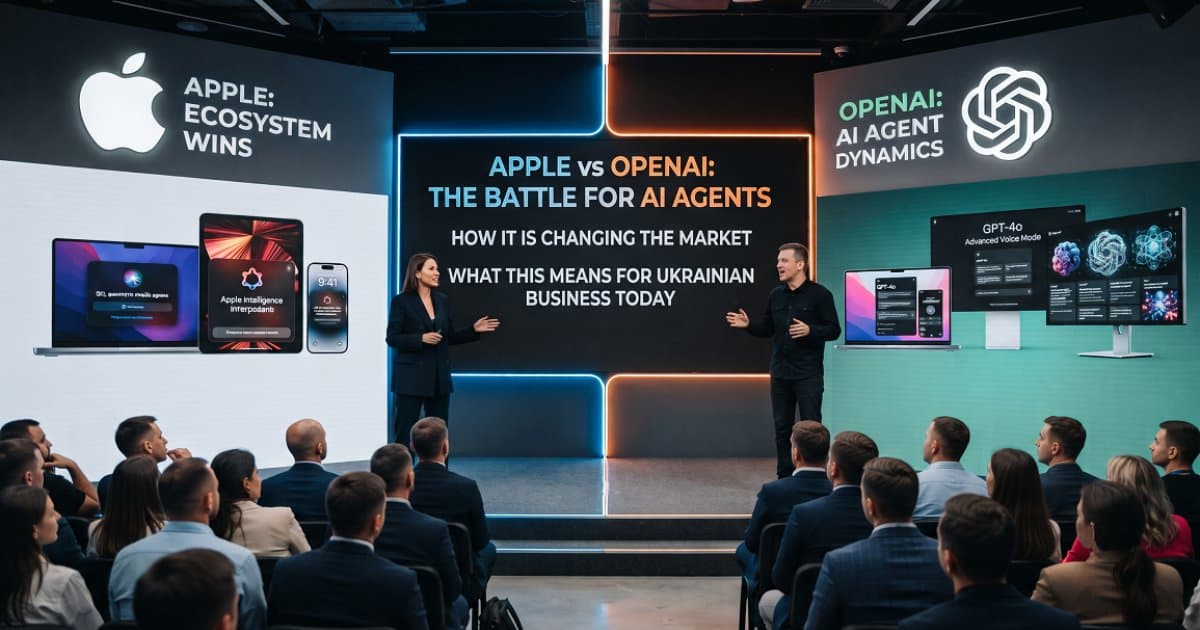
The Apple vs OpenAI Battle: Why It Matters to Your Business
Imagine that two of the biggest players in the technology industry suddenly disagree on what AI-agents should be — and this dispute directly determines which tools you'll be able to use in your business tomorrow. This is exactly what's happening between Apple and OpenAI: their confrontation has long gone beyond corporate negotiations and turned into a real war of architectures, business models, and AI-automation philosophies.
For small and medium-sized business owners in Ukraine, this is not an abstract story from Silicon Valley. Apple vs OpenAI — this is a concrete choice between two different approaches to building business agents: Apple's closed, deeply integrated into devices ecosystem approach and OpenAI's open, cloud-based, API-oriented approach. Whether one of them wins or how they coexist depends on the cost of AI implementation in your company, the level of data privacy, and how flexible your automated processes will be. Let's figure out what's actually happening — and how to use it to your advantage.
Chronology of Confrontation: From Partnership to Competition
How the Collaboration Began
Back in June 2024, Apple and OpenAI announced a partnership: ChatGPT was to become embedded in Siri and Apple Intelligence. It seemed like a win-win deal — Apple gets a powerful language model, OpenAI gets billions of devices as a distribution channel. But just a few months later, it became clear: the interests of both parties conflicted at a fundamental level.
Apple absolutely did not want user data to go to OpenAI servers without clear control. OpenAI, in turn, builds its business precisely on the fact that data passes through its cloud infrastructure. An additional trigger was that OpenAI began developing its own AI-browser and device — directly competing with Safari and iPhone.
Breaking Point: OpenAI Goes Into Hardware
In 2025, OpenAI announced the acquisition of io Products — a startup founded by former Apple designer Jony Ive — for $6.5 billion. The goal: to create their own AI device, which, according to Sam Altman, will become "the most important consumer product since the iPhone". For Apple, this is no longer a partner, but a direct competitor in the most profitable segment — consumer hardware.
Apple's response didn't take long: the company accelerated development of its own on-device AI models, tightened restrictions for third-party AI on its devices, and began actively investing in its own language model under the code name Ajax. This is not just a corporate conflict. This is two different visions of where and how AI-agents will live in the coming years.
Two Architectures — Two Different Futures for Business Agents
Apple's Model: Privacy as a Competitive Advantage
Apple builds its agents around the concept of Private Cloud Compute — computations happen either directly on the device or in an isolated cloud environment where even Apple supposedly has no access to your data. For business, this means:
- Lower risk of corporate data leaks when working with confidential information
- Deeper integration with macOS, iOS, iPadOS — agents can seamlessly manage calendar, mail, files
- Limited customization: you work within what Apple allows
- Higher entry cost: you need Apple devices, often — subscriptions to corporate plans
Apple Intelligence already today allows you to automate: email summarization, message prioritization, basic document processing. But this is just the beginning. Real business agents from Apple will appear in 2026-2027, when the company opens APIs for developers.
OpenAI's Model: Openness and Scale
OpenAI builds an ecosystem around GPT-4o, o3, Operator and multi-agent frameworks. Key characteristics for business:
- API access from day one — you can build your own agents without being tied to a specific device
- Operator — an agent that independently performs tasks in a browser: books, buys, fills out forms
- Wide ecosystem of plugins and integrations
- Greater flexibility, but also greater responsibility for configuring security
For small businesses in Ukraine, the opportunity to build AI-agents through API-integrations with existing tools is particularly interesting — this allows you to start without large capital investments.
What Happens at the Intersection of Two Approaches
The irony of the Apple vs OpenAI situation is that the confrontation forces both companies to improve faster. Apple is rushing with its own language models, OpenAI — with privacy solutions. For business, this means: competition between two giants lowers prices and improves the quality of tools available to you right now.
What This Specifically Means for Your Business in Ukraine
Platform Choice — This Is a Strategic Decision
If your team is fully on Mac and iPhone, it makes sense to wait for mature solutions from Apple Intelligence and build processes around them. If your stack is diverse — Windows, Android, cloud services — OpenAI and its partners give you more flexibility right now.
It's important to understand: choosing between Apple and OpenAI is not a choice between "safe" and "unsafe". It's a choice between different compromises: control vs. flexibility, privacy vs. functionality, tight integration vs. wide choice of tools.
Practical Scenarios for SMBs
Scenario 1: Agency or Consulting If you work with clients' confidential data — financial reports, legal documents — Apple's device-based processing approach reduces risks. But right now you can use OpenAI Enterprise with non-training agreement guarantees.
Scenario 2: E-commerce or Retail Here the OpenAI approach wins: Operator can automate work with suppliers, order processing, customer inquiries. Real automation is available right now through API.
Scenario 3: HR and Onboarding AI-agent in HR processes — this is already a reality in Ukraine. And here both platforms have their advantages: Apple — for internal communications, OpenAI — for external interactions and RAG systems.
Risks That Are Rarely Discussed
The key risk of Apple-OpenAI confrontation for business is ecosystem fragmentation. If in a year an agent you implemented based on OpenAI stops working with your team's Apple devices (or vice versa), you'll face expensive reconfiguration.
The second risk is single vendor dependency. By choosing exclusively Apple or exclusively OpenAI, you put your business processes at the mercy of decisions by one corporation. That's why it's worth looking at open-weight models, which provide independence from any giant.
The Balance of Power: Who Else Is Shaping the Rules
Anthropic and Google — Third Forces in the Confrontation
While Apple and OpenAI battle for dominance, Anthropic quietly builds a reputation as the safest AI for enterprise use. Claude from Anthropic is perhaps the most responsible model for working with business data. No wonder the balance of power between Anthropic and OpenAI is becoming an increasingly relevant topic for strategic planning.
Google, for its part, is integrating Gemini into its entire corporate stack — Workspace, Cloud, BigQuery. For businesses already using Google tools, this is a natural way to implement AI-agents without major infrastructure overhauls.
Why Competition Accelerates AI Accessibility for SMBs
In 2023, a quality API for building an AI-agent cost $0.06 per 1000 tokens. In 2025 — already $0.002-0.005 for comparable quality. This is a 90%+ price reduction — a direct result of competition between OpenAI, Anthropic, Google and new players. For small businesses in Ukraine, this means AI-automation is becoming financially accessible even without a large IT budget.
If earlier a full-fledged AI-agent could cost $6880, today basic automation solutions for routine processes can be built much cheaper — thanks to this competitive race.
Regulatory Context
Don't forget that the Apple vs OpenAI confrontation is happening against the backdrop of increased AI regulation in the US and Europe. Trump's executive order on frontier AI-models is already affecting how American companies deploy agents. For Ukrainian businesses oriented towards European integration, this is an important signal: build AI-processes with future regulatory pressure in mind, not just current capabilities.
Practical Plan: How to Use the Apple vs OpenAI Confrontation for Your Business
Short-term Actions (0-3 months)
1. Audit your current stack. Determine which devices and platforms your team uses. This will determine where Apple Intelligence has a natural advantage and where — OpenAI.
2. Launch a pilot on OpenAI API. Today's OpenAI solutions are more mature for business agents. Choose one routine process — processing incoming requests, summarizing reports, email automation — and test it for 30 days.
3. Establish baseline metrics. Before scaling, it's important to measure the real autonomy of your AI-agent and understand if it's actually solving the problem, not just "looking smart".
Medium-term Actions (3-12 months)
Don't put all your eggs in one basket. While Apple and OpenAI compete, build a modular agent architecture: individual components can be replaced without rebuilding the entire system. Use standardized protocols (MCP from Anthropic, Function Calling from OpenAI) — they provide portability.
Invest in team training. Competition between platforms is good, but only if your people understand how to work with them. Consider free programs from Google as an entry point for skills development.
Monitor Apple Intelligence 2.0. The next major Apple AI release is expected at WWDC 2026. If your business actively uses Apple ecosystem — plan to review your AI strategy after that date.
What You Definitely Shouldn't Do
- Wait for "when everything stabilizes" — the AI-agents market won't stabilize, it will only accelerate
- Copy solutions from large corporations without adapting to SMB scale
- Ignore data security issues — regardless of whether you choose Apple or OpenAI, privacy configuration is critical
- Automate chaos — if a process doesn't work well without AI, it will work even worse with AI
FAQ: Frequently Asked Questions About the Apple vs OpenAI Confrontation
1. Can a small business in Ukraine actually implement AI-agents based on OpenAI or Apple? Yes, and it's more affordable than it seems. OpenAI provides API with a pay-as-you-go model — you pay only for actual use, with no large upfront costs. Apple Intelligence is available on iPhone 15 Pro and newer models and doesn't require additional subscriptions for basic functions.
2. What will happen to the Apple and OpenAI partnership — will they completely separate? The current contract between Apple and ChatGPT continues, but relations have become strained due to hardware competition. More likely, Apple will gradually replace OpenAI with its own models — this is a matter of 2-3 years, not months.
3. Which approach is safer for corporate data — Apple or OpenAI? Both offer enterprise-level protection, but with different models. Apple processes data on-device or in Private Cloud Compute, OpenAI Enterprise guarantees a non-training agreement. For critical data, legal review of both terms is recommended before choosing.
4. Will the Apple vs OpenAI confrontation affect the cost of AI-automation for SMBs? Yes, and positively. Competition between big players has already led to API price drops of 80-90% over two years. Further price reductions are expected — especially in the on-device models segment where Apple is pressuring cloud providers.
5. Which AI-agents from OpenAI are already available for business automation right now? The most practical: Operator (autonomous work in a browser), GPT-4o with Custom Instructions (customized for specific business context), Assistants API with tools for file and code processing. In 2025, OpenAI also opened Agents SDK for building multi-agent systems.
What to Do Right Now
The Apple vs OpenAI confrontation is not just corporate drama, it's an architectural fork that will determine what business agents will look like over the next 5-7 years. For SMB owners in Ukraine, this is a unique opportunity: while giants compete, prices fall, tools become more accessible, and choice — wider. Want to figure out which AI-automation strategy is right for your business — contact our experts for a free consultation and get a concrete action plan, not just general advice.
Have questions? Ask the AI agent right now
Responds in seconds, knows everything about our services and will help with your situation
You might also like
LangChain vs CrewAI vs AutoGen: Choose Right
LangChain, CrewAI, or AutoGen for your multi-agent system? A practical framework guide for CEOs and COOs making the build-or-buy decision in 2026.
ComparisonOpen vs Closed AI Models: What to Choose in 2026
Anthropic's official stance on open-weights models reframes the debate. Here's what CTOs and business owners need to know to make the right LLM choice in 2026.
ComparisonOpen-Weight Models 2026: Cheap Agents Catch Up
Open-weight models of 2026 are breaking records: small businesses launch AI agents for pennies where millions used to be required. Facts, cases, comparisons.