
DeepSeek-V4: 1M Token Context at Disruptive Cost
DeepSeek-V4 brings a 1M-token context window at a fraction of OpenAI and Anthropic prices. Here's what it means for your business costs and AI strategy.
The Price of Reading Everything Just Collapsed
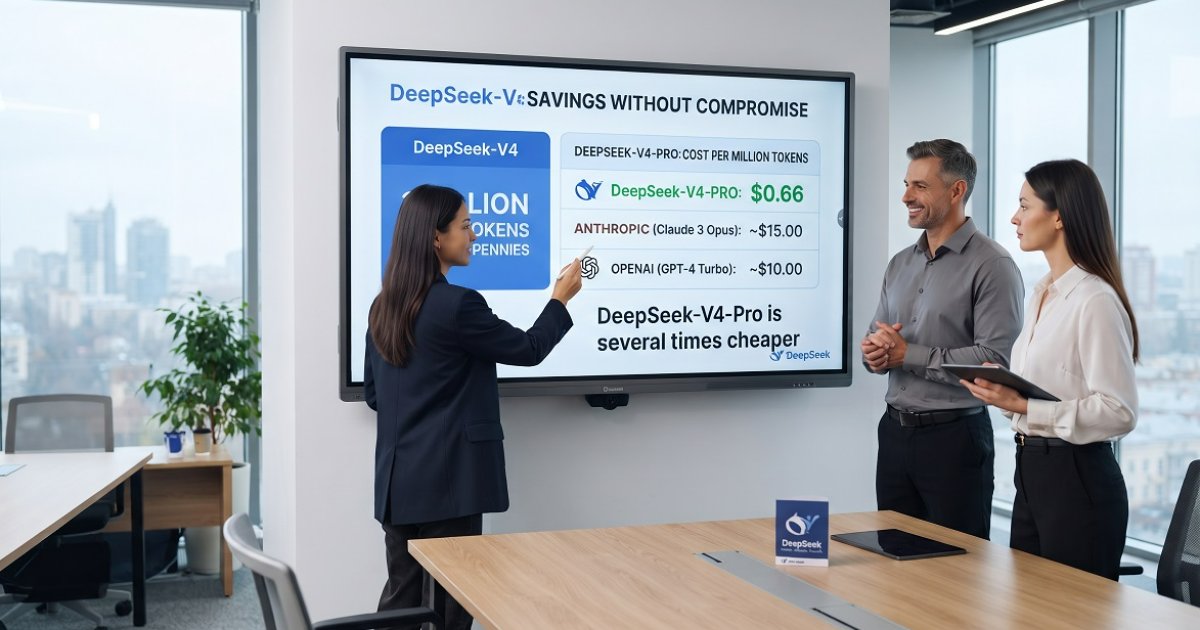
A million tokens. That is roughly 750,000 words — the equivalent of seven full-length novels — processed in a single AI call. DeepSeek-V4-Pro does this at $0.66 per million input tokens off-peak. Its nearest closed-source rival charges multiples of that for a fraction of the context. The math on enterprise AI just changed.
What that number unlocks for businesses dealing with large contracts, sprawling compliance documents, or multi-system knowledge bases is the kind of shift that doesn't announce itself loudly — it shows up quietly in your monthly API bill, and then in your competitive position. The specifics of who wins, who loses, and what the real cost comparison looks like across providers are worth examining carefully before your next infrastructure decision.
For years, the practical ceiling on what you could feed an AI model in one shot was around 128,000 tokens — enough for a long report, not enough for a full contract archive. Anything larger required chunking, retrieval pipelines, and the engineering overhead that comes with them. DeepSeek changed that calculus on April 24, 2026, when it released the V4 family: two open-weight Mixture-of-Experts models — V4-Pro and V4-Flash — both with a one-million-token context window as the default, not an optional add-on.
This isn't a marginal upgrade. It's a different category of tool, and the pricing attached to it is forcing a serious conversation about whether the premium charged by incumbent providers is still justified.
What DeepSeek-V4 Actually Is
Two models, one architecture shift
According to DeepSeek's official announcement, the V4 family consists of two variants. V4-Pro carries 1.6 trillion total parameters with 49 billion activated per token. V4-Flash is the lighter option at 284 billion total parameters and 13 billion active. Both are released under the MIT license — meaning businesses can self-host them without licensing fees — and both natively support a 1,048,576-token context window with up to 384,000 tokens of output.
The architecture behind this is genuinely novel. Previous long-context models hit a wall because attention computation scales quadratically with sequence length — processing a million tokens the naive way is prohibitively expensive. DeepSeek's engineering team solved this with a hybrid attention mechanism that combines Compressed Sparse Attention (CSA) and Heavily Compressed Attention (HCA). According to DeepSeek's technical report, in the 1M-token setting, V4-Pro requires only 27% of the single-token inference FLOPs and just 10% of the KV cache compared to its predecessor, DeepSeek-V3.2. That efficiency gain is what makes the pricing possible.
The model is also integrated natively with leading AI agent frameworks including Claude Code and OpenCode, and it supports both OpenAI ChatCompletions and Anthropic API formats — meaning migration from existing stacks requires minimal re-engineering.
Open weights change the self-hosting equation
The MIT license matters more than it might seem. A business running V4-Flash on its own infrastructure at full GPU utilization can bring inference costs well below any hosted API rate. For organizations with data residency requirements — healthcare, finance, legal — self-hosting isn't just a cost play; it's often a compliance necessity. The open-weight release makes that path viable without sacrificing frontier-adjacent performance.
The real disruption isn't the context window. It's that a million-token context window is now the default — not a premium tier, not a special configuration. The baseline shifted.
The Pricing Reality: A Provider-by-Provider Breakdown
Numbers matter here, so let's be precise. All figures below reflect publicly documented API rates as of mid-2026 and are subject to change.
DeepSeek V4-Pro (off-peak): $0.66 per million input tokens, $1.98 per million output tokens. Cache hits drop to a fraction of that — DeepSeek applies automatic prompt caching, and cache-hit input costs roughly 1/120th of the standard rate, making repeated-context workloads (think: the same compliance document queried hundreds of times a day) nearly free on the input side.
DeepSeek V4-Flash (off-peak): $0.15 per million input tokens, $0.60 per million output tokens. Cache hits fall to approximately $0.003 per million — a 98% reduction from the cache-miss rate.
For comparison, Anthropic's Haiku 4.5 — a mid-tier model, not the flagship — was priced at $1 per million input tokens and $5 per million output tokens, making DeepSeek V4-Flash roughly seven times cheaper on input and nearly eighteen times cheaper on output, according to published pricing data. Claude's Opus-tier models carry significantly higher rates.
On the OpenAI side, the pricing landscape has been shifting rapidly, but even discounted tiers remain materially more expensive than DeepSeek's off-peak rates for equivalent context lengths.
One important nuance: some providers charge a long-context surcharge once prompts exceed 200,000 tokens. Gemini, for instance, doubles its rate past that threshold. DeepSeek applies no such surcharge — the million-token window is priced flat.
| Model | Input ($/M tokens) | Output ($/M tokens) | Context Window |
|---|---|---|---|
| DeepSeek V4-Pro (off-peak) | $0.66 | $1.98 | 1M tokens |
| DeepSeek V4-Flash (off-peak) | $0.15 | $0.60 | 1M tokens |
| Anthropic Haiku 4.5 | $1.00 | $5.00 | 1M tokens |
| OpenAI GPT-6 Luna | ~$0.10–$0.20 | ~$0.50–$1.20 | varies |
Rates are approximate and reflect publicly available documentation; verify current pricing before procurement decisions.
Note that as of late September 2026, OpenAI's GPT-6 Luna has been priced aggressively and undercuts DeepSeek V4-Flash on some metrics — the competitive pressure is clearly working in both directions. The broader point stands: the era of paying a 10–30x premium for long-context processing is ending.
What a Million-Token Context Actually Unlocks for Business
Document-heavy operations
The most immediate use case is any workflow where the bottleneck is the volume of text an AI needs to see at once. Legal teams reviewing merger agreements alongside regulatory precedents. Procurement departments analyzing multi-year supplier contracts against current compliance frameworks. Finance teams cross-referencing audit trails with policy documents.
Previously, these workflows required Retrieval-Augmented Generation (RAG) pipelines — chunking documents, embedding them, retrieving relevant fragments, and hoping the retrieval step didn't miss something critical. RAG is powerful, but it introduces retrieval errors and engineering complexity. With a genuine million-token window, you can load the entire document set into context and let the model reason over it directly. For a comparison of when RAG still makes sense versus when full-context approaches win, see RAG vs CAG: Which AI Architecture Fits Your Business.
Agentic workflows and multi-step automation
DeepSeek's official announcement highlights V4's position as open-source state-of-the-art in agentic coding benchmarks. The practical implication extends beyond code: any multi-step agent workflow that needs to maintain state across a long task — a procurement agent tracking a negotiation thread, a compliance agent auditing a policy change across dozens of affected documents — benefits directly from a larger context window. The agent doesn't lose its place.
According to the technical documentation, V4 is already driving in-house agentic coding at DeepSeek itself, which is a meaningful signal about production readiness.
Knowledge base consolidation
For businesses running fragmented knowledge systems — separate wikis, CRM notes, support ticket histories, product documentation — a million-token context means an AI agent can hold the entire relevant knowledge base in working memory for a single query. The consolidation that previously required months of data engineering can be approximated with a well-structured prompt. This is particularly relevant for knowledge graph and AI-driven business automation approaches, where the quality of reasoning depends directly on how much context the model can access simultaneously.
A model that can read your entire contract archive in one call doesn't just save time. It eliminates a category of risk: the risk that a retrieval step missed the clause that mattered.
The Real Cost Calculation: Beyond the Per-Token Rate
Headline token prices are the starting point, not the ending point. Three factors swing the actual invoice significantly.
Prompt caching is the biggest lever. If your application sends the same large document or system prompt repeatedly — which is exactly what happens in production agent deployments — cached tokens cost a fraction of fresh ones. DeepSeek's cache-hit rate on V4-Flash is approximately 98% below the standard input price. For a workflow that processes the same 500-page policy document a thousand times per day, the effective cost per query drops to near zero on the input side.
Peak vs. off-peak billing is a newer wrinkle. DeepSeek introduced tiered pricing in August 2026, with rates roughly doubling during peak hours. For batch workloads — nightly compliance sweeps, end-of-day report generation — scheduling during off-peak windows cuts the bill in half without any change to the underlying workflow.
Self-hosting economics apply if you have the infrastructure. Running V4-Flash on owned or leased GPU capacity can bring costs below any hosted API rate at sufficient utilization. The MIT license removes the legal friction that would otherwise make this complicated.
The practical takeaway: for a business processing large documents at scale, the all-in cost of DeepSeek V4 with caching and off-peak scheduling is not just cheaper than alternatives — it's a different order of magnitude cheaper. That gap funds real headcount or product investment.
For a structured framework on calculating AI ROI across these variables, the AI ROI Framework: Prove Business Value guide covers the methodology in detail.
Choosing Between V4-Pro and V4-Flash
The decision isn't complicated once you map it to workload type.
V4-Pro is the right choice when reasoning quality is the constraint — complex legal analysis, multi-step financial modeling, code generation across large codebases, or any task where an error has downstream consequences. At $0.66 per million input tokens off-peak, it's still dramatically cheaper than comparable closed-source models, and the 49 billion active parameters deliver frontier-adjacent performance on math, STEM, and coding benchmarks.
V4-Flash is the right choice when throughput and cost are the primary variables — high-volume document classification, first-pass contract review, customer support triage, or any workflow where you're running millions of queries and can tolerate slightly lower reasoning depth. At $0.15 per million input tokens off-peak, with cache hits approaching zero, it's the most cost-efficient path to large-context processing currently available through a hosted API.
A practical architecture for many businesses: route complex, high-stakes queries to V4-Pro and high-volume, lower-stakes queries to V4-Flash. The same API format, the same context window, different cost profiles.
What This Means for Your AI Strategy
The emergence of affordable million-token context changes the calculus on several decisions that many businesses have been deferring.
First, it lowers the bar for AI automation of document-intensive processes. Compliance review, contract analysis, and knowledge management workflows that seemed too complex or too risky to automate — because the AI couldn't see enough context to be reliable — become tractable. The technical barrier was the context window. That barrier is now priced out of existence.
Second, it puts pressure on the "we'll wait for the technology to mature" position. The technology has matured. The question is no longer whether AI can handle your document complexity — it's whether your organization has the processes to deploy it responsibly.
Third, it changes the vendor negotiation dynamic. When a capable open-weight model is available under MIT license, the leverage in conversations with closed-source providers shifts. You have a credible alternative, and the providers know it.
The executives who recognize this shift early — who restructure their AI procurement strategy around the new cost reality rather than the old one — will find themselves explaining to their boards why their AI operating costs are a fraction of competitors'. That's a conversation worth having. Not because it signals technical sophistication, but because it signals the kind of systematic thinking that turns infrastructure decisions into durable competitive advantages.
The feeling of running critical business processes on AI that can genuinely see the full picture — not a retrieved fragment of it — is qualitatively different from what most organizations have experienced so far. It's the difference between asking an analyst who skimmed the document and one who read every page. That confidence, once you have it, is hard to give up.
FAQ
What is the context window of DeepSeek-V4-Pro, and why does it matter? DeepSeek-V4-Pro supports a context window of 1,048,576 tokens — approximately one million tokens. This means the model can process the equivalent of several full-length books or an entire contract archive in a single API call, eliminating the need for chunking or retrieval pipelines in many document-heavy workflows.
How does DeepSeek-V4 pricing compare to OpenAI and Anthropic? At off-peak rates, DeepSeek V4-Flash is priced at $0.15 per million input tokens and $0.60 per million output tokens. Anthropic's Haiku 4.5 was priced at $1 per million input and $5 per million output — making DeepSeek roughly seven times cheaper on input and eighteen times cheaper on output. OpenAI's pricing varies by model and has been shifting competitively, but DeepSeek remains among the lowest-cost options for large-context workloads.
Is DeepSeek-V4 suitable for enterprise use, including self-hosting? Yes. Both V4-Pro and V4-Flash are released under the MIT license, allowing businesses to self-host without licensing restrictions. The models support OpenAI and Anthropic API formats, minimizing migration effort. For organizations with data residency or compliance requirements, self-hosting on owned infrastructure is a viable and cost-effective path.
What is the difference between V4-Pro and V4-Flash? V4-Pro has 1.6 trillion total parameters (49 billion active per token) and is optimized for complex reasoning, coding, and high-stakes analysis. V4-Flash has 284 billion total parameters (13 billion active) and is designed for high-throughput, cost-sensitive workloads. Both share the same one-million-token context window and MIT license.
Does DeepSeek charge extra for long-context prompts beyond a certain length? No. Unlike some providers that apply surcharges for prompts exceeding 200,000 tokens, DeepSeek prices the full million-token context window at a flat rate. This makes it structurally advantageous for workloads that routinely exceed the 128K–200K range where competitors' costs escalate.
How does prompt caching affect the real cost of using DeepSeek-V4? DeepSeek applies automatic prompt caching. Cache-hit input tokens on V4-Flash cost approximately $0.003 per million — roughly 98% below the standard cache-miss rate. For production deployments that repeatedly process the same large documents or system prompts, caching can reduce the effective input cost to near zero, making the total cost of ownership significantly lower than headline rates suggest.
The price floor for serious AI capability just dropped through the floor. The businesses that recalibrate their AI budgets and architectures around this new reality — rather than the pricing assumptions of 2024 — will find that the gap between what they can automate and what their competitors can afford to automate widens faster than anyone expected. That gap is now a strategic asset, and it's available to anyone willing to do the math.
Have questions? Ask the AI agent right now
Responds in seconds, knows everything about our services and will help with your situation
You might also like
AI ROI Framework: Prove Business Value
OpenAI's framework shows how to connect AI usage to real business value. Step-by-step guide with metrics, formulas, and practical scenarios for CEOs and COOs.
Pricing & ROIAI Advertising ROI: OpenAI Rewrites Ad Creation
OpenAI's September 2026 ad platform overhaul shows which advertising functions AI agents can own today — and what that means for your budget and team.
Pricing & ROIGPT-6 Astra ROI: What Fewer Hallucinations Save
GPT-6 Astra cut hallucination rates by two-thirds. Here's the real dollar savings for content teams, legal, and analysts — calculated with hard numbers.