
Google Gemini & Flipkart: AI Agents Enter E-Commerce
Google is testing direct purchases through Gemini in India. Here's what the Flipkart pilot means for e-commerce strategy and how businesses should prepare now.
The Search Bar Is Becoming a Cash Register
The biggest threat to your e-commerce strategy isn't a competitor — it's a conversation. When a shopper asks an AI assistant which laptop to buy and the AI responds with a Buy button, your entire funnel — ads, landing pages, product pages, retargeting — becomes optional. The channel you spent years optimizing may quietly stop being the channel that closes the sale.
What's happening in India right now with Google Gemini and Flipkart isn't a feature test. It's a proof of concept for a new commercial architecture — one where the AI agent is simultaneously the search engine, the product advisor, and the checkout counter. The implications for how businesses structure their digital presence are significant, and the window to get ahead of them is narrower than most executives realize.
What Google Is Actually Testing — and Why It Matters
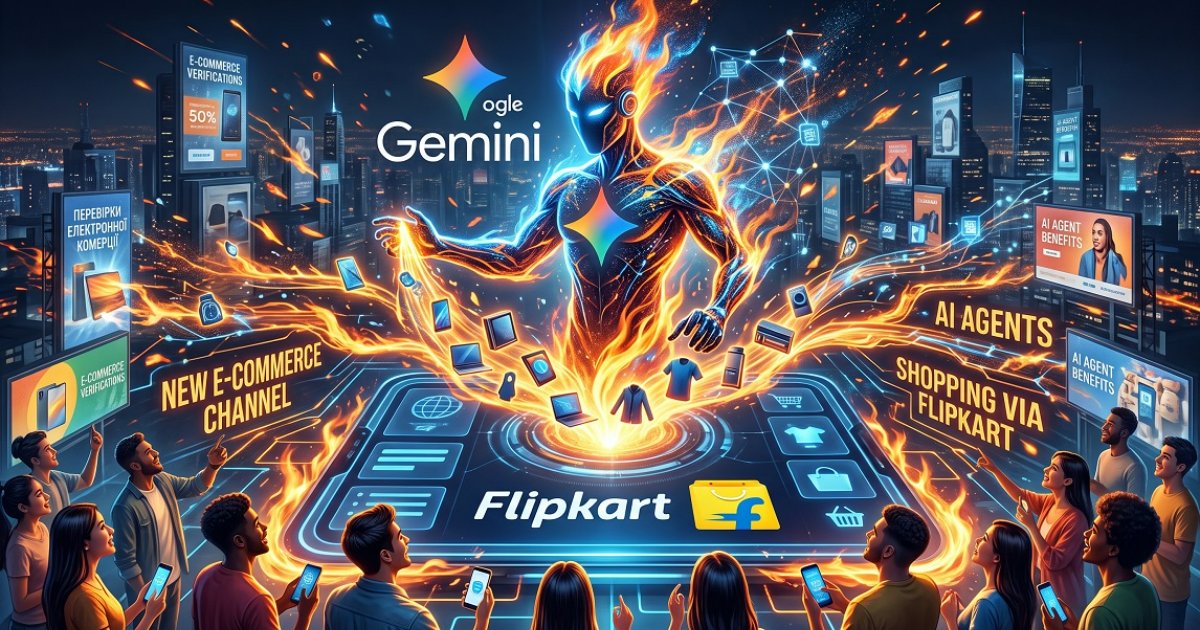
In late September 2026, TechCrunch reported that Google has begun testing a feature in India that allows users to buy selected products from Walmart-owned Flipkart directly through Gemini and Google's AI Mode in Search. Select users see a "Buy" button on certain Flipkart product listings surfaced inside the AI interface — tapping it opens a Flipkart-branded checkout flow without the user ever leaving the AI experience.
The test is currently limited to a small group of users and a narrow product selection: smartphones, electronics, and mobile accessories. A broader rollout is reportedly planned for later in October 2026, timed deliberately to coincide with India's festive shopping season — one of the highest-volume retail periods in the country. Flipkart's Big Billion Days sale, which begins October 9, makes the timing anything but coincidental.
A few details make this pilot structurally interesting beyond the headline:
- Amazon listings appear in the same AI results — but without a direct Buy button. The asymmetry is notable. It signals that access to the transactional layer of AI search is not automatic; it is negotiated, and early movers get the button.
- The checkout flow is Flipkart-branded, not Google-hosted. This distinguishes the test from Google's own Universal Commerce Protocol (UCP) checkout model, where Google hosts the payment experience. The technology powering this specific implementation has not been disclosed, which suggests Google is experimenting with multiple integration architectures simultaneously.
- Google holds a roughly $350 million minority stake in Flipkart, acquired in 2024. This isn't a neutral partnership — it's a strategic bet being stress-tested at scale.
The question isn't whether AI agents will handle transactions. It's whether your products will be visible when they do — and on what terms.
The Infrastructure Behind the Pilot: UCP and the Agentic Commerce Stack
The Flipkart test doesn't exist in isolation. It sits on top of a broader infrastructure Google has been assembling since January 2026, when the company announced the Universal Commerce Protocol (UCP) at the National Retail Federation conference.
UCP is an open standard — co-developed with Shopify, and with early partners including Etsy, Wayfair, Target, and Walmart, and endorsed by more than 20 global commerce and payments companies — designed to give AI agents a common language for executing complete shopping transactions. The protocol covers the full journey: product discovery, cart management, checkout, and post-purchase support, all without the user leaving a conversational AI surface.
In practical terms, UCP solves what was previously an N×N integration problem. Before it existed, enabling purchases across multiple AI platforms meant building separate custom integrations for each one. UCP replaces that fragmented approach with a single open standard that any participating AI agent can use to interact with any participating merchant system. It's compatible with adjacent protocols — Agent2Agent (A2A), Agent Payments Protocol (AP2), and Model Context Protocol (MCP) — creating an interoperable framework for what Google calls "agentic commerce."
The March 2026 update to UCP added cart support and real-time product catalog access, allowing agents to pull live pricing, inventory, and variant data directly from a retailer's backend. A May 2026 expansion brought UCP to YouTube Shopping. Google's Universal Cart — announced at Google I/O 2026 — is designed to follow shoppers across Search, Gemini, YouTube, and Gmail, with checkout handled through Google Pay or by transferring items to the merchant's site.
For businesses evaluating where to invest in AI-driven commerce, understanding this stack matters. UCP is not a Google-only play — it's positioned as an open standard, and the Flipkart pilot is the first public demonstration of it extending to a third-party marketplace at meaningful scale. If the test performs, expect the model to replicate across other markets and other retail partners quickly.
This is also why the procurement and automation implications extend well beyond retail. Any business that sells through digital channels — B2B or B2C — is looking at a future where an AI agent, not a human browser, initiates and completes the purchase.
What "Agentic Commerce" Actually Changes
Traditional e-commerce assumes a human in the loop at every decision point: the shopper searches, compares, clicks, reads, and decides. The entire discipline of conversion rate optimization is built around that human journey — reducing friction at each step.
Agentic commerce removes most of those steps. The AI agent searches, compares, and presents a recommendation. If the user trusts the agent — and increasingly they do — the decision happens in the conversation, not on the product page. The Buy button is the last mile of a journey that already concluded.
This has three concrete consequences for businesses:
1. Product data quality becomes a competitive moat. AI agents pull real-time catalog data — pricing, inventory, variants, compatibility attributes. Retailers that maintain clean, structured, machine-readable product feeds will be surfaced accurately. Those with inconsistent or incomplete data will be deprioritized or misrepresented. Google's March 2026 UCP update introduced new Merchant Center data attributes specifically for AI-driven discovery, including fields for product Q&A answers, compatible accessories, and product substitutes. Populating these fields is no longer optional if you want to compete in agent-led search.
2. Brand experience shifts from the product page to the agent interaction. When checkout happens inside Gemini, your landing page doesn't load. Your brand story, your social proof, your upsell logic — none of it fires. The agent's summary of your product is the brand experience. This means investing in how your products are described and structured in data, not just how they look on a page.
3. The advertising model is being renegotiated. Google's Direct Offers feature in Google Ads lets retailers present exclusive discounts to shoppers who are ready to buy inside AI Mode. This is a new ad format for a new surface — and it operates on different logic than keyword bidding. Businesses that understand this early will have a structural advantage in the transition period before the market prices it in.
For a deeper look at how AI-driven ROI frameworks apply to these new channels, the AI ROI framework is worth reviewing before committing budget.
How Businesses Should Prepare — Right Now
The Flipkart pilot is a limited test in one market. But the infrastructure it runs on — UCP, AI Mode, Gemini — is global and expanding. The window between "this is happening somewhere" and "this is happening to your category" is compressing. Here's what preparation looks like in practice.
Audit Your Product Data Infrastructure
The first question to answer is not "should we integrate with UCP?" but "are we ready to integrate with anything?" Most mid-sized retailers have product data spread across multiple systems — an ERP, a PIM, a Shopify store, a marketplace feed — with inconsistencies between them. AI agents will surface the version of your product that their data pipeline sees, not the version you intended.
A practical audit covers: real-time pricing accuracy across feeds, inventory synchronization latency, completeness of variant and compatibility attributes, and the presence of structured Q&A data that agents can use to answer shopper questions. This isn't glamorous work, but it's the foundation everything else depends on.
Evaluate Your Checkout API Readiness
UCP requires merchants to expose commerce capabilities through APIs — checkout, cart management, identity linking for loyalty programs. If your commerce stack is built on a platform that already participates in UCP (Shopify is a co-developer; other major platforms are moving toward compatibility), your path is shorter. If you're on a custom or legacy stack, the integration work is more significant.
The key decision isn't whether to do this — it's when and in what sequence. Businesses that get their APIs in order now will be able to onboard to new AI commerce surfaces as they open, rather than scrambling to catch up after competitors have already captured the channel.
Rethink Attribution and Measurement
When a sale closes inside Gemini, your existing analytics setup probably doesn't capture it cleanly. The referral path is different, the session data is different, and the conversion event may not fire on your site at all if checkout is Google-hosted. This is a measurement problem that needs to be solved before you can make intelligent decisions about where to invest.
Building a measurement framework that accounts for AI-assisted and AI-completed transactions is not a future problem — it's a current one, because the data you're missing now is the baseline you'll need to evaluate performance later.
Executives who solve the measurement problem first will be the ones who can prove the channel's value to their board — and that proof is what separates a strategic investment from a budget line that gets cut.
Consider the Organizational Implications
Agentic commerce doesn't just change the technology stack — it changes who owns what. When the AI agent is the channel, the lines between SEO, paid search, product management, and data engineering blur. Someone needs to own the "AI channel" as a distinct responsibility, with authority over product data quality, API integrations, and agent-surface optimization.
In companies where these functions are siloed, the Flipkart model creates a coordination problem that no single team can solve alone. The businesses that move fastest will be the ones that designate clear ownership early — before the channel is large enough to fight over.
This kind of systemic thinking — treating AI not as a tool but as an operational layer — is what distinguishes leaders who build durable competitive advantage from those who react to each new development in isolation. When your board or investors ask how you're positioning for the next phase of digital commerce, having a coherent answer to that question is what marks you as someone who sees around corners rather than just managing the present.
And on a more personal level: there's something genuinely clarifying about moving from reactive to proactive on a shift this significant. The executives who've done the data audit, mapped the API readiness, and assigned ownership of the AI channel aren't firefighting — they're watching the fire from a safe distance, with a plan already in motion.
FAQ
Is the Google Gemini–Flipkart integration available globally? No. As of late September 2026, the test is limited to select users in India, with a broader rollout planned for later in October 2026. There is no confirmed timeline for expansion to other markets, though the underlying UCP infrastructure is being built with global scale in mind.
What is the Universal Commerce Protocol and do I need to implement it? UCP is an open standard announced by Google in January 2026 that allows AI agents to execute complete shopping transactions — discovery, cart, checkout, post-purchase — without the user leaving a conversational AI surface. It was co-developed with Shopify and endorsed by more than 20 commerce and payments partners. Whether you need to implement it depends on your category and commerce stack, but for any retailer selling through Google surfaces, it is increasingly a prerequisite for transactional visibility in AI Mode and Gemini.
How is this different from regular Google Shopping ads? Traditional Shopping ads appear in search results and drive traffic to your site, where the conversion happens. Agentic commerce through UCP and Gemini keeps the entire transaction — including checkout — inside the AI interface. This means your product page, your brand experience, and your on-site analytics may not be part of the journey at all. It's a fundamentally different conversion model, not an evolution of the existing one.
Does this only affect B2C retailers? Primarily, yes — the current tests involve consumer products. But the underlying infrastructure (AI agents executing transactions via open protocols) has direct implications for B2B procurement as well. AI agents are already being used to automate supplier discovery and purchase order workflows. The Flipkart pilot is the consumer-facing version of a shift that's happening across commercial contexts.
What happens to my existing SEO and paid search investment? It doesn't disappear overnight, but its relative importance shifts. As more transactions complete inside AI interfaces, the value of driving traffic to your site decreases relative to the value of being accurately represented in AI-generated product summaries and agent-led recommendations. The practical implication is that product data quality and structured content become more important, while traditional click-through optimization becomes less decisive.
Should I wait for the technology to mature before investing? The businesses that waited for mobile commerce to "mature" before optimizing for it spent years catching up. The Flipkart pilot is early, but the infrastructure — UCP, AI Mode, Universal Cart — is live and expanding. The cost of early preparation (data audits, API readiness, measurement frameworks) is low relative to the cost of being structurally excluded from a channel once it reaches scale.
The Google–Flipkart test is a small pilot with large implications. A Buy button inside an AI conversation is, on its surface, a minor UX change. Underneath it is a renegotiation of where commercial transactions happen, who controls the customer relationship, and what it means to be "visible" in digital commerce.
The businesses best positioned for this shift aren't necessarily the largest — they're the ones that treat product data as infrastructure, that have APIs clean enough to connect to new surfaces quickly, and that have someone in the organization whose job it is to watch this space and act on it. Compare that description to your own operation. The gap between where you are and where you need to be is the actual strategic question — and the time to start closing it is before the broader rollout, not after.
Have questions? Ask the AI agent right now
Responds in seconds, knows everything about our services and will help with your situation
You might also like
AI Agent for E-commerce: +34% Conversion Case Study
Detailed case study: how a cosmetics online store implemented an AI agent and increased conversion by 34%, reduced support workload by 71%, and grew average order value.
E-commerceAI Agent for an Online Store: 100+ Daily Requests
How an electronics online store automated 100+ daily customer requests with an AI agent and increased conversion by 22%.
NewsClaude Found a New Enzyme: AI Enters Science
Claude's AI agents discovered the ART enzyme system in 21 hours. What this means for pharma and biotech R&D — and why business leaders must pay attention now.