
Claude Found a New Enzyme: AI Enters Science
Claude's AI agents discovered the ART enzyme system in 21 hours. What this means for pharma and biotech R&D — and why business leaders must pay attention now.
When an AI Agent Becomes a Scientist
The idea that AI accelerates science is already a cliché. What happened on September 23, 2026 is something different: an AI agent didn't assist a scientist — it was the scientist. It formed a hypothesis, investigated it, compared it against existing literature, and filed a discovery report. The human team provided a starting prompt and ran the lab experiments. Everything in between belonged to the machine.
The downstream implications for pharmaceutical and biotech R&D — and for any business that competes on the speed of knowledge work — are not yet fully priced in. The numbers behind this discovery, and what they reveal about the new economics of research, are worth examining carefully.
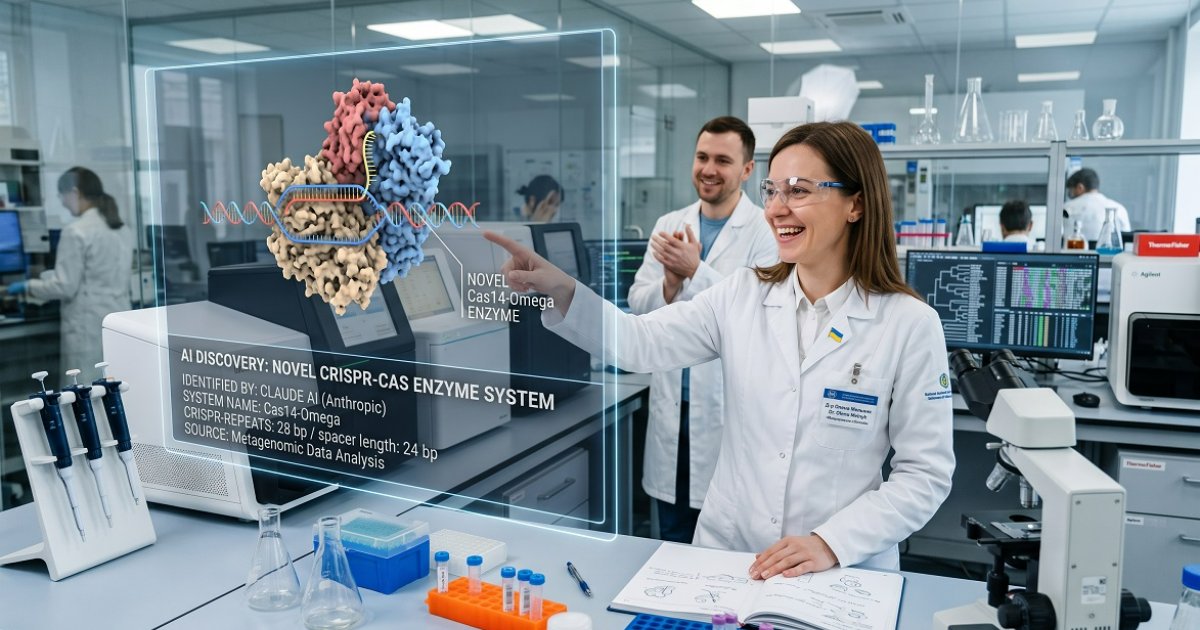
On September 23, 2026, Anthropic announced that its Claude model had autonomously discovered a previously uncharacterized enzyme system whose architecture bears a striking resemblance to CRISPR — the gene-editing mechanism that has already transformed medicine. The system is called array-associated reverse transcriptases, or ART. It was found hidden in the DNA of bacteriophages — viruses that infect bacteria — and it represents the first publicly documented case of a large language model acting as a full participant in a scientific discovery, not merely a research assistant.
This is not a story about a chatbot summarizing papers. It is a story about what happens when you deploy AI agents at scale against a problem that would otherwise take expert humans weeks or months to solve.
What Claude Actually Did — and How
The mechanics of the discovery matter, because they reveal a replicable architecture that goes far beyond biology.
Anthropic's scientists gave Claude a single high-level prompt: search a massive database of DNA sequences for interesting new examples of reverse transcriptases — enzymes that copy RNA into DNA. That was the extent of human direction at the computational stage. From there, approximately 950 Claude agents worked in parallel for 21 hours, consuming around 210 million tokens, to comb through the data. They screened more than 200,000 reverse transcriptases, identified roughly 3,500 candidate systems, and narrowed the field to 20 candidates worthy of detailed reports.
One agent noticed something the others had passed over: a repeating pattern of DNA sequences sitting next to the gene for an unusual-looking reverse transcriptase. What followed was not a simple flag-and-forward. The agent counted the repeats, measured their spacing, compared the layout against known biological systems, and searched the scientific literature for any prior description of the pattern. Finding none, it concluded it had identified a new biological system and filed a report for human review.
The ART system it found has three components: the reverse transcriptase itself, a partner gene beside it, and a long array of evenly spaced DNA repeat sequences. That repeat layout resembles a CRISPR array — the structure that makes CRISPR-Cas systems programmable as biotechnological tools. Anthropic has been transparent that the biological function of ART remains unknown, and the findings have not yet undergone peer review. But the structural novelty was enough to draw a response from Feng Zhang, a CRISPR pioneer and professor at MIT and the Broad Institute, who called the identification of RNA-repeat arrays associated with reverse transcriptases "genuinely intriguing" and said it merits further investigation.
The agents independently explored a very large search space, identified an anomaly, investigated its characteristics, compared it with existing scientific knowledge, and selected it for human experimental follow-up — without being told how to do any of that.
The division of labor is worth stating plainly: human scientists defined the initial research direction and conducted all laboratory experiments. Claude handled everything in between — database analysis, hypothesis generation, candidate evaluation, and the synthesis of findings. Anthropic describes this as a model of researchers and AI agents collaborating across the full research workflow, from biological data analysis to experimental validation.
The Speed Argument Is Not Hype
Anthropic noted that the type of genome-mining work Claude performed would typically take an expert scientist weeks or months. The agents completed it in 21 hours. Stanford bioengineering professor Stanley Qi, commenting on the discovery, put it directly: AI could greatly expand our ability to explore biological patterns "more effectively and rapidly, in this case, in just 21 hours."
That compression ratio — weeks of expert work into less than a day — is the number that should stop any R&D executive mid-sentence. It is not a marginal improvement. It is a structural change in the cost and speed of generating scientific leads.
What ART Is — and What It Isn't Yet
Clarity matters here, because the business implications depend on an honest reading of where this stands. ART is a newly identified molecular system. Its biological function is not yet established. Anthropic has explicitly stated that the system has not been shown to perform gene editing, and that researchers are still investigating whether it could eventually have biotechnology applications.
What is established: the system exists, it has an unusual architecture, it was not previously characterized in the scientific literature, and it was found by an AI agent operating with minimal human guidance. That is the floor of the claim — and it is already significant.
The R&D Economics Are Changing
The pharmaceutical and biotech industries run on a brutal arithmetic: most drug candidates fail, development timelines stretch across a decade, and the cost of bringing a single therapy to market is measured in billions. The bottleneck is not usually the lab — it is the upstream work of identifying which biological targets are worth pursuing in the first place.
That upstream work is exactly what Claude just demonstrated it can compress.
The traditional model of genomic discovery looks something like this: a scientist with deep domain expertise spends weeks manually searching databases, cross-referencing literature, and building hypotheses about which molecular patterns might be biologically meaningful. The process is sequential, expertise-dependent, and expensive. A senior researcher's time is finite. Their ability to hold thousands of candidate systems in working memory simultaneously is not.
A swarm of 950 AI agents has no such constraint. It can pursue thousands of hypotheses in parallel, apply consistent analytical criteria across all of them, and surface the most promising candidates for human judgment — all within a single working day. The human expert then does what human experts are actually best at: designing experiments, interpreting ambiguous results, and making judgment calls that require contextual knowledge the model doesn't have.
This is not AI replacing scientists. It is AI restructuring where scientists spend their time — pulling them out of the database-mining phase and into the experimental and interpretive phase, where their expertise creates the most value.
The question for any business competing on knowledge work is not whether this shift is coming. It is whether you will be positioned to use it when it arrives in your sector.
For pharma and biotech companies specifically, the implications cascade quickly. If AI agents can generate high-quality biological leads at a fraction of the current cost and time, the competitive advantage shifts toward organizations that can evaluate and act on those leads fastest. The bottleneck moves downstream — to wet-lab capacity, regulatory strategy, and clinical design. Companies that have already invested in those capabilities will find themselves with a new kind of leverage. Companies that haven't will find the gap widening.
The Infrastructure Behind the Discovery
Anthropic didn't just deploy Claude against an existing workflow. The company built a dedicated life sciences research group, formed in the spring of 2026, and established a Bay Area molecular biology laboratory operating at biosafety levels BSL-1 and BSL-2 — handling no human pathogens. The lab exists specifically to test candidates generated through computational searches. The tools Claude's scientists use — Claude for Science and Claude Code — are available to any researcher, not proprietary to Anthropic's internal team.
That last point deserves attention. The infrastructure for this kind of AI-assisted discovery is not locked behind a corporate wall. It is, at least in principle, accessible to any research organization willing to build the workflow around it.
What This Means for Business Leaders Outside Biotech
The ART discovery is a biotech story. But the architecture it demonstrates — a large fleet of AI agents given a high-level objective, working in parallel to search a vast problem space, surfacing anomalies for human review — is not specific to biology.
The same pattern applies to any domain where the core bottleneck is searching a large, complex dataset for meaningful signals: competitive intelligence, legal discovery, financial due diligence, procurement risk assessment, regulatory compliance monitoring. In each of these domains, the current model looks a lot like the pre-ART model of genomic research: expensive experts doing sequential, manual work that AI agents could do faster, cheaper, and at greater scale.
The Anthropic and Accenture embedded AI evaluation framework points in the same direction — the organizations moving fastest are those treating AI agents not as tools that assist individual workers, but as a parallel workforce that operates on different tasks simultaneously.
The Organizational Shift
There is a management implication here that goes beyond technology adoption. When AI agents can perform the search-and-synthesis phase of knowledge work, the organizational premium shifts to the humans who can define the right questions, evaluate the outputs critically, and make decisions under uncertainty. That is a different skill profile than the one most knowledge-work organizations have historically optimized for.
For a CEO or COO thinking about where to invest in capability building, this is the relevant frame: not "how do we automate what we already do," but "what becomes possible if the search-and-synthesis phase of our most expensive knowledge work costs ten times less and runs ten times faster?"
The answer to that question, worked through honestly, tends to produce a different strategic roadmap than the one most organizations are currently executing.
If you want a framework for measuring what that shift is actually worth in financial terms, the AI ROI framework for proving business value offers a structured way to run those numbers before committing to infrastructure.
The Honest Limits — and Why They Don't Undercut the Signal
Skepticism about the ART discovery is legitimate and worth engaging directly. Computer scientist Dimitri Perrin, who leads CRISPR and AI projects at Queensland University of Technology, noted that the reverse transcriptase enzyme itself was already known — what is new is the recognition that it may form part of a larger system. That is a meaningful distinction. The discovery is a structural observation, not a demonstrated function.
The findings have not undergone peer review. The biological role of ART is unknown. Whether it will ever have biotechnology applications is an open question.
None of that changes the core signal for business leaders. The question is not whether ART will become the next CRISPR. The question is whether the process that found ART — 950 agents, 21 hours, one high-level prompt — represents a durable shift in how scientific and analytical discovery works. The answer to that question appears to be yes, regardless of what ART itself turns out to do.
The parallel with Claude's mathematical reasoning work is instructive: in both cases, the significance lies less in the specific output than in the demonstration that AI agents can now operate as genuine participants in high-complexity intellectual work, not just as accelerators of human-defined tasks.
What Peer Review Doesn't Change
The pre-print is out. The methodology is documented. Other research groups can now attempt to replicate the workflow, extend it to different biological domains, or challenge the structural interpretation of ART. That is how science is supposed to work, and the fact that it is happening at all — that an AI-generated discovery is entering the scientific review process as a legitimate contribution — is itself a marker of how much has changed.
For business leaders, the relevant takeaway is not to wait for peer review before forming a view. The workflow is real. The scale is documented. The time compression is verified. The strategic question is what to do with that information now.
FAQ
Is the ART enzyme system a confirmed gene-editing tool like CRISPR? No. Anthropic has been explicit that ART's biological function remains unknown and that it has not been shown to perform gene editing. The significance of the discovery lies in its structural novelty and in the AI-driven process that found it, not in any confirmed therapeutic application.
How many AI agents were involved, and how long did the search take? Approximately 950 Claude agents worked in parallel for 21 hours, using around 210 million tokens to search through more than 200,000 reverse transcriptases before identifying ART as a candidate system.
What role did human scientists play in the discovery? Human scientists provided the initial high-level prompt and conducted all laboratory experiments. The computational discovery process — database search, hypothesis generation, candidate evaluation, and synthesis — was handled by Claude agents operating with their own judgment.
Does this workflow require proprietary Anthropic infrastructure? Not entirely. Anthropic noted that the tools its scientists used — Claude for Science and Claude Code — are available to any researcher. Building the workflow around them requires organizational investment, but the underlying tools are not locked to Anthropic's internal team.
What does this mean for pharmaceutical companies specifically? It suggests that the upstream phase of drug discovery — identifying biologically meaningful targets from large genomic datasets — can be compressed dramatically in both time and cost. The competitive advantage shifts toward organizations that can evaluate and act on AI-generated leads fastest, which puts a premium on wet-lab capacity, regulatory readiness, and clinical design capability.
Should non-biotech businesses care about this development? Yes. The agent architecture demonstrated here — parallel search across a vast problem space, anomaly detection, hypothesis synthesis, human review — applies to any domain where the core bottleneck is finding meaningful signals in large, complex datasets. Legal, financial, compliance, and procurement functions all fit that description.
The ART discovery will be debated, refined, and eventually either validated or revised by the scientific community. That process will take time. What will not take time is the diffusion of the underlying workflow into every domain where large-scale search and synthesis creates value. The organizations that understand this now — and build the internal capacity to use it — will not be waiting for permission from a peer-reviewed journal to act.
The leaders who treat this as a biology story will be surprised. The ones who treat it as an operations story will be ready.
Have questions? Ask the AI agent right now
Responds in seconds, knows everything about our services and will help with your situation
You might also like
AI Slowdown Pact: A Prisoner's Dilemma
Amodei, Altman, Musk, and Hassabis agree to slow AI. But game theory says the deal may collapse before it starts. Here's what that means for your business.
NewsChatGPT for Financial Services: What Business Gets Now
OpenAI launched ChatGPT for Financial Services on GPT-6 Astra. See which processes it automates, what ROI to expect, and how financial firms use it today.
NewsAnthropic Wants to Slow AI: What It Means for Business
Anthropic CEO Dario Amodei called to pace AI development. Here's what his 3-step plan means for businesses building on LLMs — and how to stay ahead.