
Chinese AI Models Are Capturing the US Corporate Market
Chinese AI models already account for 30-46% of US corporate API traffic. How to leverage this to reduce business costs in Ukraine.
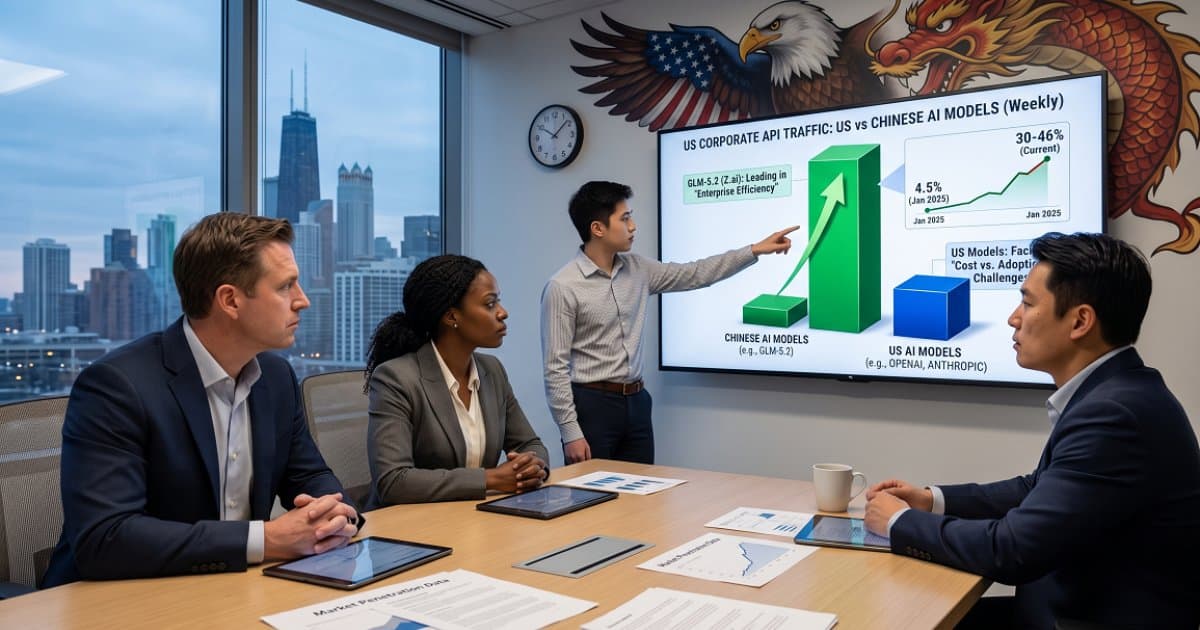
At the beginning of 2025, Chinese AI models accounted for just 4.5% of US corporate API traffic. Today — between 30% to 46% weekly. This is not a gradual market evolution — it's a leap that changes the rules of the game for businesses worldwide, including Ukraine. If you're a business owner or manager spending a significant portion of your budget on AI tools from OpenAI or Google, this article is for you. We'll break down why GLM-5.2 from Z.ai and other Chinese models are rapidly winning corporate client trust, where they're truly better than American competitors, where they still lag behind — and how Ukrainian SMB owners can benefit from this shift right now.
How Chinese AI Models Conquered 30-46% of the US Corporate Market
The numbers are truly impressive. According to analytical reports published in Q2 2025, the share of Chinese AI models in US corporate API traffic grew from 4.5% in January to stable 30-46% in weekly measurements. Among the leaders are GLM-5.2 from Z.ai (a subsidiary of Zhipu AI), as well as updated versions of Qwen from Alibaba and DeepSeek V3.
What is GLM-5.2 and why everyone is talking about it
GLM-5.2 is a large language model from Z.ai that demonstrates results comparable to GPT-4o and Claude 3.5 Sonnet on most standard benchmarks, but costs 3-8 times less when working through API. The model supports a long context window (up to 128k tokens), works well with code, data analytics, and multimodal tasks. It's precisely this "quality/price" balance that became the main argument for corporate clients.
Three Factors Behind Rapid Growth
- Price: the cost of an API request to GLM-5.2 or Qwen2.5-72B is 3-8 times lower than GPT-4o with comparable quality
- Quality on practical tasks: on many corporate tasks — classification, data extraction, code generation — Chinese models show results within 2-5% of American leaders
- Open weights: DeepSeek and Qwen publish open versions of their models, allowing local deployment and avoiding dependence on cloud providers
This is a direct response to what we discussed regarding AI model regulation by Trump administration: while American companies face increased regulatory pressure, Chinese players aggressively fill the market vacuum.
Quality vs. Price: Where Chinese Models Are Really Competitive
Before moving on to practice, it's important to honestly assess the strengths and weaknesses of Chinese AI models for business.
Where They Win
Code and data tasks. On the HumanEval benchmark (code generation), DeepSeek-Coder V2 and Qwen2.5-Coder demonstrate results that exceed GPT-4o in some categories. For businesses automating internal processes, this means: integrations, scripts, data processing — all of this can be done cheaper.
Multilingualism. Chinese models have traditionally been stronger at working with Asian languages, but recent versions of GLM and Qwen demonstrate excellent quality in European languages as well, including Ukrainian. Testing shows: for translation, rewriting, and SEO optimization tasks, the difference between GLM-5.2 and GPT-4o is minimal.
Large-scale document processing. If your business processes hundreds or thousands of documents daily — contracts, invoices, applications — the difference in API costs becomes critical. Processing 100,000 tokens per day can save $500-2000 per month compared to GPT-4o.
Where Limitations Remain
- Complex multi-step reasoning: GPT-4o and Claude 3.7 Sonnet still lead in tasks requiring deep logical analysis
- Compliance issues: for some sectors (finance, medicine), using models from Chinese companies may conflict with corporate policy or regulatory requirements
- API stability: American providers have more mature infrastructure and SLA guarantees
It's worth comparing this situation to what's happening in the American camp: the Google Gemini crisis and researcher exodus show that even tech giants are vulnerable — and competition is only intensifying.
Geopolitical Context: Risks and Opportunities for Ukrainian Business
One cannot ignore the elephant in the room. Using Chinese AI platforms carries specific risks that every Ukrainian business owner should be aware of.
Risks to Consider
Data security. Chinese law requires local companies to provide government access to data upon request. This means: any sensitive corporate data passing through Z.ai or Alibaba Cloud APIs could potentially be accessible to third parties. For businesses processing customer personal data or trade secrets, this is a serious risk.
Regulatory uncertainty. In the EU and US, restrictions on using Chinese AI models in critical infrastructure are already being discussed. If your business targets the Euro-Atlantic market, it's important to monitor these changes.
Sanctions risk. Given increased pressure on China from the US, new restrictions on API access cannot be ruled out.
How to Minimize Risks
- Use open versions of models (DeepSeek V3, Qwen2.5) with local deployment via Ollama or vLLM — data never leaves your server
- Separate tasks: for public data work (SEO texts, general FAQ answers) you can use cloud APIs; for sensitive data — only local models
- Implement a hybrid approach: combine different providers depending on task type
By the way, we detailed protection against AI threats in material about autonomous AI attacks and business protection — we recommend familiarizing yourself with it.
Practical Guide: How a Ukrainian SMB Owner Can Benefit From This Trend
Theory is good, but what specifically should you do right now? Here's a step-by-step approach for a small or medium-sized business owner in Ukraine.
Step 1. Audit Your Current AI Spending
First — understand how much you pay for AI tools and what tasks they're used for. A typical structure for SMBs looks like this:
- ChatGPT Plus or Team: $20-30/month per person
- API costs for automated processes: $100-2000/month depending on volume
- Specialized AI services (copywriting, images, voice): $50-300/month
If total budget exceeds $300/month — you're already a candidate for optimization.
Step 2. Identify Tasks for Transition to Cheaper Models
Not all tasks are equally critical. Here's a decision matrix:
Safe to transition to cheaper (Chinese or open-source) models:
- Content generation (blogs, product descriptions, email campaigns)
- Processing and classification of large text arrays
- Standard FAQ answers in chatbots
- Code generation for internal tools
- Translation and localization
Keep premium models (GPT-4o, Claude 3.7):
- Complex legal and financial analysis
- Strategic decisions based on data analysis
- Tasks requiring highest accuracy
Step 3. Test Before Scaling
Practical advice: before moving production processes to a new model, conduct an A/B test on 200-300 real examples of your tasks. Compare answer quality using blind method — often the result will surprise you.
Step 4. Consider AI Agents as a Way to Maximize Efficiency
The biggest value from AI model cost reduction — not in direct savings, but in the ability to launch AI agents for automating processes that were previously too expensive. For example, an AI agent for automating sales and customer service can now cost three times less in operational expenses if you use an optimal mix of models.
Many of our clients already use multi-agent systems, where different agents use different models depending on task complexity — and this provides significant savings without losing quality.
What's Next: AI Model Market Forecast for 2025-2026
The current situation is just the beginning of a deeper shift. Here are key trends to watch.
Commoditization of Basic AI Capabilities
What's considered "premium" today (GPT-4o level) will become standard open-source market in 12-18 months. Already now Llama 3.3 70B (Meta's open model) demonstrates results comparable to GPT-3.5 with zero licensing costs. This trend is accelerating.
Specialized Models Instead of Universal Ones
The market is moving from "one model for everything" to ecosystems of specialized models. As an example — the AlphaFold breakthrough in science, which we wrote about in material about AI revolution in science and business. This logic is spreading across all industries.
American Response to Chinese Challenge
OpenAI, Anthropic and Google aren't standing still. GPT-5.6 from OpenAI and new Anthropic models already demonstrate a leap in quality, trying to retain corporate clients. Competitive battle benefits business — prices will decline, quality will improve across all players.
Regulatory Risk as a Selection Factor
New legislative initiatives in the US and EU may significantly restrict the use of Chinese AI platforms in certain sectors. Businesses should already now plan a provider diversification strategy to avoid forced migration.
FAQ: Frequently Asked Questions About Chinese AI Models for Business
Is it safe to use GLM-5.2 or DeepSeek for working with client data?
For client data, cloud APIs from Chinese companies are not recommended due to GDPR requirements and potential third-party access risks. A safe alternative is deploying open versions of DeepSeek or Qwen on your own server, where data never leaves your infrastructure.
How much worse are Chinese AI models than GPT-4o on practical business tasks?
On most standard business tasks (content generation, document processing, FAQ answers), the difference is 2-7% in favor of GPT-4o, while the cost difference is 300-800%. For complex analysis and strategic tasks, premium models still have a notable advantage.
Can Chinese AI models be used in Ukraine without a VPN?
Yes, Z.ai, Alibaba Cloud, and DeepSeek APIs are accessible in Ukraine without restrictions. There are also aggregators (OpenRouter, Together AI) through which you can access these models with a unified API interface similar to OpenAI.
Which Chinese AI models are best for Ukrainian-language content?
The best results for Ukrainian-language tasks among Chinese models are shown by Qwen2.5-72B and GLM-5.2. DeepSeek V3 also works well with Ukrainian. For critically important Ukrainian-language content, we recommend testing the specific model on your tasks before production use.
How will the growth of Chinese AI models impact OpenAI and Anthropic pricing?
Competition has already forced OpenAI to reduce GPT-4o API prices by 50-75% during 2024-2025, and this pressure will continue. For business, this means: regardless of your provider choice, AI tool costs will continue declining, making automation increasingly accessible.
Cutting Costs Without Cutting Corners
Chinese AI models are no longer exotic or cheap alternatives "for those who can't afford quality" — they've become real competitors changing the economics of the entire AI market. For Ukrainian SMBs, this opens a concrete opportunity: reduce AI automation costs by 3-5 times without sacrificing quality on most practical tasks. The key is to act thoughtfully, considering data security risks and regulatory nuances. If you want to figure out which AI automation strategy is optimal for your specific business — reach out for a free consultation: our experts will help create an individual roadmap considering your industry and budget.
Have questions? Ask the AI agent right now
Responds in seconds, knows everything about our services and will help with your situation
You might also like
Claude Found a New Enzyme: AI Enters Science
Claude's AI agents discovered the ART enzyme system in 21 hours. What this means for pharma and biotech R&D — and why business leaders must pay attention now.
NewsAI Slowdown Pact: A Prisoner's Dilemma
Amodei, Altman, Musk, and Hassabis agree to slow AI. But game theory says the deal may collapse before it starts. Here's what that means for your business.
NewsChatGPT for Financial Services: What Business Gets Now
OpenAI launched ChatGPT for Financial Services on GPT-6 Astra. See which processes it automates, what ROI to expect, and how financial firms use it today.