
AI Advertising ROI: OpenAI Rewrites Ad Creation
OpenAI's September 2026 ad platform overhaul shows which advertising functions AI agents can own today — and what that means for your budget and team.
The Ad Industry Just Changed Its Operating System
An e-commerce advertiser achieved a 3× return on ad spend across its campaigns over 28 days on ChatGPT Ads — and more than 80% of that ad-driven traffic came from customers who had never bought from the brand before. These are not projections. They are figures OpenAI published from its own advertiser base in September 2026.
What makes those numbers worth pausing on isn't the ROAS multiple itself — it's the mechanism behind it. The platform producing those results is structurally different from anything that existed in digital advertising before. The specifics of how it works, which functions it hands to AI agents, and what that means for your budget and your team — that's what the rest of this article unpacks.
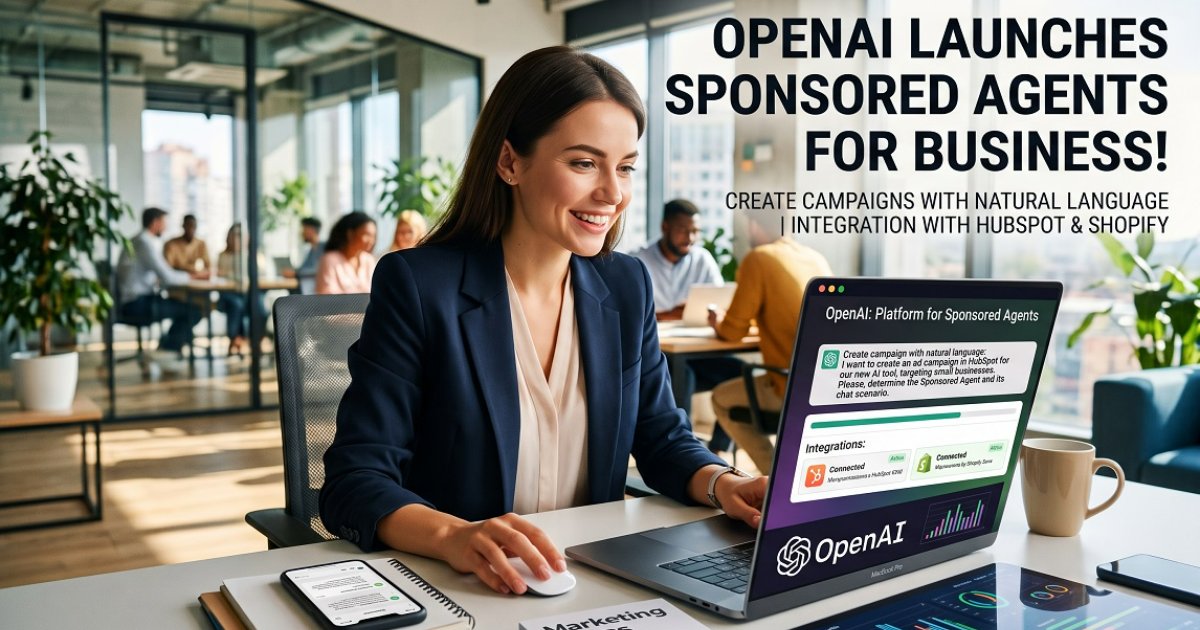
On September 16, 2026, OpenAI published a piece titled "Reimagining advertising with AI" — and the word reimagining is doing real work there, not just marketing. The announcement covered four simultaneous launches: a new conversational ad format called Sponsored Agents, natural-language campaign creation inside ChatGPT Work, upgraded AI creative tools in Ads Manager, and the platform's first integrations with HubSpot (as its first CRM partner) and Shopify (as its first e-commerce partner). Taken together, they describe a system where AI agents handle the bulk of what advertising teams used to do manually — from writing copy to managing bids to following up on leads.
For a business owner, the question isn't whether this is interesting. It's whether it changes the math on advertising spend, headcount, and time. The answer, based on what OpenAI has shipped, is yes — and the change is already measurable.
What OpenAI Actually Shipped — and Why It Matters for Your Budget
Sponsored Agents: the ad that talks back
Traditional digital ads are one-way. A user sees a banner or a search result, clicks, lands on a page, and either converts or bounces. The advertiser has no control over what happens in the gap between click and purchase decision.
Sponsored Agents close that gap. When a relevant ad appears in ChatGPT, users can choose to open a clearly labeled conversation with a business-sponsored AI agent. That agent can answer product questions, handle objections, explain specifications, and guide the user toward a purchase — all before they ever reach the brand's website. OpenAI gave the example of a shopper who spots a dining table in an ad and wants to know whether it fits their space, how many people it seats, or how to care for its finish. The agent handles all of that in real time.
The commercial implication is significant. A human sales team doing the same work — fielding pre-purchase questions at scale, 24 hours a day, across every time zone — would be prohibitively expensive for most businesses. An AI agent does it at near-zero marginal cost per conversation. The Sponsored Agent interaction is kept separate from ChatGPT's own answers and from the user's original conversation, so the experience stays transparent and the brand stays in control of its message.
The format is currently being tested with select advertisers in the United States. But the architecture it represents — AI as a real-time sales intermediary between ad impression and purchase — is the direction the entire platform is moving.
Natural-language campaign creation: the brief replaces the build
The second shift is on the advertiser side. OpenAI is making it possible to create ads by writing a few prompts in ChatGPT Work. Not filling out a campaign builder form. Not briefing a copywriter. Not waiting for a creative team to produce three variants and a headline test. Just describing what you want in plain language and letting the system generate the campaign.
Ads Manager has also been upgraded with new AI creative tools — AI-suggested ad copy, AI-generated imagery, and an opt-in setting that rewrites headlines to fit the specific conversation a user is having and translates them into the reader's language automatically.
The brief replaces the build. A campaign that used to require a week of creative production, a round of revisions, and a media planner's time can now be initiated in a single prompt session.
For a mid-sized business without a dedicated in-house creative team, this is the difference between running advertising and not running advertising. For a larger organization, it's the difference between testing ten creative directions and testing one — because the cost of iteration just dropped by an order of magnitude.
The Integration Layer: Where AI Agents Plug Into Your Existing Stack
The HubSpot and Shopify integrations are, in some ways, the most operationally significant part of the September 16 announcement — because they determine whether ChatGPT Ads becomes a standalone tool or a genuine part of how a business runs.
HubSpot: ads that feed your CRM automatically
Businesses managing their customers in HubSpot can now connect a ChatGPT Ads account and, without leaving HubSpot, create ads, monitor performance, and follow up on leads — with the work powered by their existing HubSpot context. That means ad-generated interest enters the company's existing follow-up workflows automatically. No manual export. No CSV upload. No data reconciliation between platforms.
For a sales-led business, this matters because the gap between "someone clicked an ad" and "someone talked to a salesperson" is where most leads die. When the CRM and the ad platform share the same data layer, that gap closes. The AI agent that handled the pre-purchase conversation in Sponsored Agents hands off to the HubSpot workflow that triggers the human follow-up — and the whole sequence runs without a coordinator in the middle.
Shopify: catalog-to-campaign in minutes
US-based Shopify merchants can use the new ChatGPT Ads app in the Shopify App Store to create and manage campaigns. Products are already integrated through Shopify Catalog, so merchants can start running ads and tracking performance immediately — no separate product feed setup, no pixel configuration from scratch. The app is free, developed by OpenAI, and set to expand internationally to all markets where ChatGPT Ads are available.
For an e-commerce operator, the friction that used to exist between "I want to run an ad for this product" and "the ad is live and being measured" has been compressed to minutes. That's not a marginal improvement in workflow — it's a structural change in how fast a business can respond to inventory, seasonality, or competitive pressure.
When the distance between a product in your catalog and a live, optimized ad campaign collapses to a few minutes, advertising stops being a department and starts being a capability.
This is what AI-native infrastructure actually looks like in practice: not a chatbot bolted onto an existing process, but a system where the AI agent owns the process end-to-end, from creative generation to bid management to lead routing.
Which Advertising Functions Can AI Agents Own Right Now
The honest answer to this question, based on what OpenAI has shipped and what its advertiser data shows, is: more than most businesses are currently delegating.
Here's a practical breakdown of what's already automatable within the ChatGPT Ads platform:
- Ad copy generation — AI-suggested headlines and body copy, with automatic rewriting to match the conversational context a user is in
- Image creation — AI-generated creative assets inside Ads Manager
- Campaign setup — natural-language prompt-driven campaign creation in ChatGPT Work, replacing manual form-based builders
- Bid optimization — conversion optimization with impression billing, now generally available, which optimizes for conversions from both ad clicks and ad views rather than clicks alone
- Attribution and measurement — flexible attribution windows (7-, 14-, or 30-day click windows; 0- or 1-day view windows) configurable directly in Ads Manager
- Lead routing — automatic handoff from ad interaction to HubSpot CRM workflows
- Product feed management — automatic sync between Shopify Catalog and ChatGPT Ads campaigns
- Pre-purchase customer conversations — Sponsored Agents handling objections, specifications, and product questions before the user reaches the website
What this list describes is not a set of features. It's a staffing model. Each item on it used to require a human — a copywriter, a media buyer, a CRM administrator, a creative director, a data analyst. The AI agent doesn't replace the strategic judgment those people bring. But it does replace the execution hours. And for most businesses, execution hours are where the budget goes.
For a business owner who has spent years managing the coordination overhead of an advertising operation — briefing agencies, chasing approvals, reconciling data across platforms — the feeling of watching that overhead compress is not just operational relief. It's the specific kind of calm that comes from knowing a critical process is running predictably, without requiring your attention every time something needs to move.
The Audience Side: Why ChatGPT Is a Different Kind of Ad Inventory
None of the above matters if the audience isn't there, or if the context isn't right for advertising. Both concerns are worth addressing directly.
ChatGPT's user base is large and, more importantly, intent-dense. People come to ChatGPT with goals — planning a purchase, comparing software options, researching a decision. They're not scrolling passively. They're actively trying to accomplish something. That's the context in which ChatGPT Ads appear, and it's why the platform's early ROAS numbers look different from display advertising benchmarks.
OpenAI has also expanded its advertiser ecosystem to more than 50 technology and measurement partners, and CPC and outcome-optimized bidding now account for the majority of campaigns. The platform has moved from a managed-sales model to self-serve access through Ads Manager — which means small and medium-sized businesses now represent a material share of the advertiser base, not just enterprise brands with agency relationships.
The audience itself is protected by design. Ads are clearly labeled and remain distinct from ChatGPT's independent answers. Users control how their data is used for ads. Advertisers receive aggregated performance insights without access to individual conversations. These aren't just policy commitments — they're the conditions under which the platform's trust value holds, and OpenAI has been explicit that protecting that trust is the non-negotiable constraint on everything else it builds here.
For a business evaluating whether to allocate budget to ChatGPT Ads, the relevant comparison isn't "is this better than Google Search" or "is this better than Meta." It's: where are my customers when they're closest to a purchase decision, and can I reach them there? For a growing number of categories, the answer increasingly includes ChatGPT.
If you're thinking about how AI agents fit into broader business operations beyond advertising — including procurement, analytics, and decision-support — the OpenAI Data Agent piece on analytics without a dedicated team and the framework for evaluating AI vendors under real enterprise conditions are worth reading alongside this one.
FAQ
What is ChatGPT Ads Manager and who can use it? Ads Manager is OpenAI's self-serve advertising platform, opened to small and medium-sized businesses in May 2026. It allows businesses to create campaigns, set bids, manage creative assets, and track performance directly — without going through an agency or OpenAI's managed sales team. US businesses can sign up at ads.openai.com.
What are Sponsored Agents and how do they differ from regular ads? Sponsored Agents are a new ad format being tested with select US advertisers. When a user clicks an ad in ChatGPT, they can choose to open a separate, clearly labeled conversation with an AI agent backed by that advertiser. The agent can answer product questions and guide the user toward a purchase — unlike a standard ad, which simply redirects to a landing page. The conversation is kept distinct from ChatGPT's own responses.
Can small businesses actually use ChatGPT Ads, or is it only for large brands? Small and medium-sized businesses now represent a material share of ChatGPT Ads' advertiser base, according to OpenAI. The Shopify integration (free app, catalog auto-sync) and the HubSpot integration are specifically designed to reduce the setup friction that previously made programmatic advertising inaccessible to smaller teams.
What ROAS can businesses expect from ChatGPT Ads? OpenAI has published one specific data point: an e-commerce advertiser achieved a 3× return on ad spend over 28 days. A technology partner also reported that more than 80% of ad-driven ChatGPT traffic came from new customers. These are early figures from a platform that is still scaling, and results will vary by category, creative quality, and targeting setup.
How does billing work on ChatGPT Ads? The platform supports CPC (cost-per-click) bidding and a conversion optimization model with impression-based billing — the latter optimizes for conversions from both clicks and views and is OpenAI's recommended model for maximizing performance. Flexible attribution windows (7, 14, or 30 days for clicks; 0 or 1 day for views) are configurable in Ads Manager.
Are ChatGPT Ads available outside the United States? ChatGPT Ads has expanded across Europe, and the Shopify app is set to become available internationally in all markets where ChatGPT Ads run. Sponsored Agents are currently US-only in testing. OpenAI has indicated that additional markets, formats, and buying options are part of its next phase of growth.
The advertising industry has been through several platform shifts — search, social, programmatic, mobile. Each one redistributed budget and rewarded the businesses that moved early with lower CPCs, less competition, and better data. What OpenAI shipped on September 16, 2026 is the opening of the next one. The businesses that figure out how to delegate creative production, bid management, and pre-purchase conversations to AI agents now will have a structural cost advantage over those that staff those functions with humans for the next three years.
Boards and investors increasingly distinguish between leaders who talk about AI transformation and those who show it in the unit economics. A 3× ROAS with 80% new customer acquisition is the kind of number that ends a board meeting early — in the best way.
The companies that treat AI agents as a staffing model, not a feature, are the ones that will look back on 2026 as the year their advertising became a competitive moat.
Have questions? Ask the AI agent right now
Responds in seconds, knows everything about our services and will help with your situation
You might also like
AI ROI Framework: Prove Business Value
OpenAI's framework shows how to connect AI usage to real business value. Step-by-step guide with metrics, formulas, and practical scenarios for CEOs and COOs.
Pricing & ROIGPT-6 Astra ROI: What Fewer Hallucinations Save
GPT-6 Astra cut hallucination rates by two-thirds. Here's the real dollar savings for content teams, legal, and analysts — calculated with hard numbers.
Pricing & ROIGoogle AI Mode Is Replacing Your Travel Manager
Google AI Mode now tracks flights and books hotels autonomously. Here's the real economics of replacing a corporate travel manager — calculated for 100 trips a year.