
Power AI: Why Energy Firms Are Buying Data Center Land
Power AI is rewriting the rules: energy companies are buying up land for data centers. What it means for your business, AI pricing, and the decisions you need to make right now.
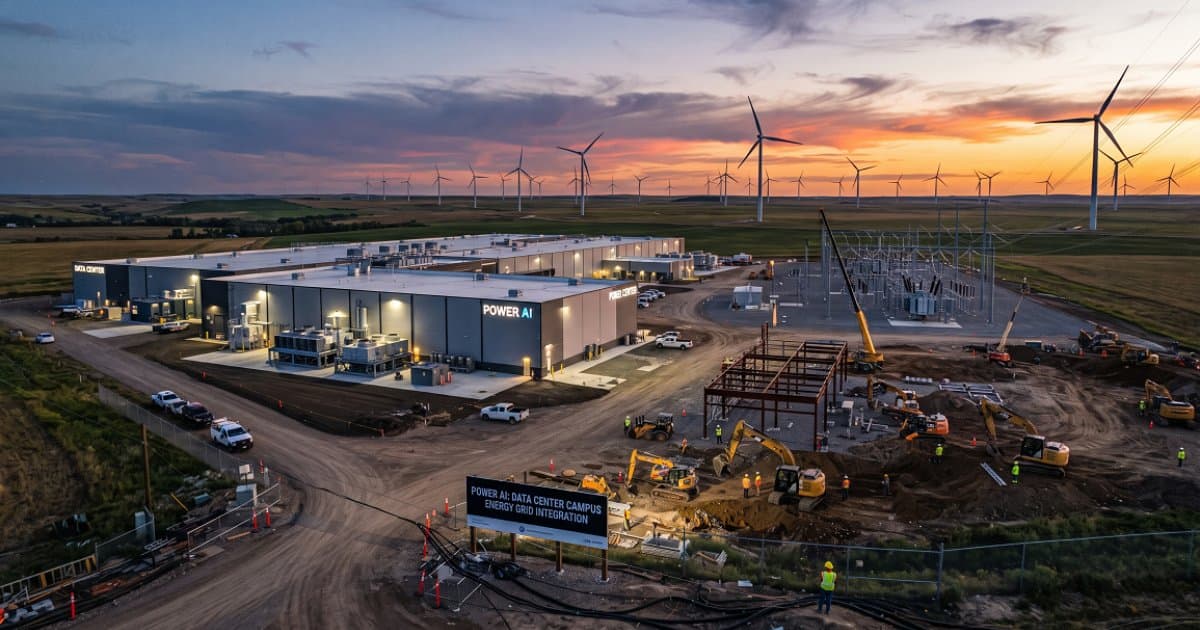
While most companies are debating which AI tools to roll out this quarter, major energy players are quietly redrawing the map of global infrastructure. Power AI — the term describing the convergence of energy and artificial intelligence — is no longer an abstraction from analyst reports. In 2024–2025, NextEra Energy, Duke Energy, and dozens of smaller regional operators went on a buying spree, snapping up land parcels adjacent to their own substations to build data centers right at the source of power. The logic is simple: whoever controls the electricity controls AI. And whoever controls AI infrastructure sets the terms for everyone else — including your business.
Why Electricity Became AI's Scarcest Resource
Training a single large language model in the GPT-4 class consumes roughly 50 gigawatt-hours of electricity — about as much as 1,700 average American households use in a year. And that's not a peak load; that's a single training run. Inference — the model's daily work of responding to billions of queries — adds even more demand that never goes away.
Data centers already account for around 2% of global electricity consumption. According to IEA projections, that share could double by 2030 driven entirely by AI workloads. The implication is clear: building a data center wherever land and permits happen to be available is no longer enough. You need guaranteed capacity, locked in years in advance.
Where the Real Shortage Is
The problem isn't a lack of electricity. The problem is that connecting to the grid at scale has become extraordinarily difficult. In Virginia — home to roughly 70% of all North American data center traffic — grid interconnection queues now stretch five to seven years. In Texas, ERCOT grid operators are fielding new connection requests that, in aggregate, exceed the state's entire installed generation capacity.
That's where energy companies spotted the opportunity. Why wait in line when you can buy land next to your own substation and enter the market as a developer? In 2024, American Electric Power (AEP) announced plans to build 10 GW of data center capacity over five years — an investment program topping $40 billion. This isn't a side business anymore. It's the new core business.
How the Logic of AI Infrastructure Siting Is Shifting
Data centers have traditionally been built where land is cheap, the climate is favorable for cooling, and local regulations are accommodating. Now a fourth, decisive factor has been added to that list: access to reliable, scalable power supply — without a queue to get connected.
That explains why Microsoft signed a deal with Constellation Energy to restart a reactor at Three Mile Island, dedicated exclusively to powering its own data centers. Amazon, Google, and Meta are pouring billions into agreements with nuclear operators and building their own solar and wind farms — not out of ESG conviction, but from the purely pragmatic understanding that without guaranteed power, the AI business simply stops.
How This Affects AI Service Costs — and Your Decisions
When an infrastructure race of this magnitude plays out at the energy level, the costs don't stay local. Sooner or later, they get passed on to end consumers of AI services — and your business is among them.
Follow the chain. A hyperscaler — say, Microsoft Azure — leases or builds a data center with guaranteed power supply. That guarantee costs considerably more than the spot market price per kilowatt-hour. Those costs get baked into the price of compute. You, as a customer using Azure OpenAI or any other cloud AI service, pay for them through API pricing.
The effect isn't immediate — there's a 12-to-24-month lag between a substation being built and an API price changing. But it's systemic.
The Regional Gap in AI Access
There's another consequence that gets less attention. The concentration of data centers in specific geographic hubs — Virginia, Texas, Ireland, Singapore — means that latency (the delay when calling an AI service) and service availability are becoming unequal across the world.
For Ukrainian businesses using AI tools through cloud platforms, this is already a live issue. The New Balance of Power in the AI Industry in 2025: Anthropic vs. OpenAI, Chinese Models, and Cyber Threats for Business — that piece shows clearly how geopolitics and the infrastructure decisions of major players directly shape which AI platforms you can — and should — work with.
GPUs as a Mirror of the Infrastructure Race
Running parallel to the land-and-energy race is a race for GPUs. Demand for NVIDIA H100s and the newer Blackwell-series chips so far outstrips supply that order lead times stretched to six to twelve months in 2024. This is no coincidence — it's the same dynamic playing out: scaling AI capacity requires chips, electricity, and physical space, all at once. Jensen Huang's Visit to Japan: What Business Leaders Need to Know About the Next GPU Cycle covers how NVIDIA and its partners are preparing for the next turn of that spiral.
New Players and Unlikely Alliances
The data center market used to be divided between specialized operators (Equinix, Digital Realty) and hyperscalers (AWS, Google, Microsoft). Now it has attracted players nobody expected.
Oil and gas companies were first movers in converting old gas fields into sites for "flare mitigation" computing — initially for cryptocurrency mining, now for AI inference. The logic is the same: surplus electricity exists where gas used to be burned off and wasted. ExxonMobil and ConocoPhillips are already piloting projects of this kind in the Permian Basin.
Railroad companies — unexpected, but logical entrants. They hold vast rights-of-way along their lines, perfectly suited for laying fiber-optic cable and building edge data centers. Union Pacific and BNSF are in talks with several data center operators.
The nuclear renaissance deserves its own mention. In 2024, Amazon Web Services acquired a data center campus adjacent to the operating Susquehanna nuclear plant in Pennsylvania for $650 million — purely for the stability and volume of its power supply. Google, in parallel, signed a deal with Kairos Power to build small modular reactors (SMRs). When tech giants start investing in nuclear energy, it's a testament to just how serious the power deficit problem has become for AI.
What's Happening with Open-Weight Models Against This Backdrop
Running alongside the hyperscalers' centralized race is a very different movement — a decentralized one. Open-weight models like Llama 3, Mistral, and Qwen 2.5 make it possible to run AI inference on your own hardware or small cloud instances, with no dependency on Microsoft or Google data centers. Open-Weight Models in 2026: How Cheap Agents Caught Up with Expensive Giants takes a closer look at this trend.
This matters: the hyperscalers' infrastructure race is making their services potentially more expensive or less stable. But at the same time, open-weight alternatives are getting stronger — and for a meaningful slice of business tasks, they're already more than sufficient.
What Businesses Should Actually Do Right Now
The corporate land-and-energy race can feel remote from the day-to-day reality of managing a team or closing out the month. But the decisions you make about your AI stack today will be felt two to three years from now — precisely when this infrastructure overhaul fully ripples through the market.
A few practical vectors for owners and leaders of mid-sized businesses.
Diversify your AI providers before you need to. Dependence on a single hyperscaler is an infrastructure risk, not just a commercial one. If your primary AI service raises prices or runs into regional availability issues from overload, you need an alternative you've already tested. See OpenAI's IPO Under Threat: How the Market Leader's Instability Is Quietly Undermining Your AI Stack — it makes a compelling case for why diversification is no longer paranoia, but basic hygiene.
Assess the real autonomy of any AI solution before you deploy it. Not every AI agent on offer actually needs a connection to the most powerful cloud models. A significant range of tasks — classification, data extraction, standard responses — can be handled perfectly well by compact local or open-weight models. That reduces both costs and platform dependency. How to Measure the Real Autonomy of an AI Agent Before Trusting It with Business Processes is a useful benchmark for making that call.
Monitor regional service availability. If your primary AI provider doesn't have a data center in or near your region, latency and availability during peak load may differ significantly from what benchmarks suggest. For critical business processes, that gap is not academic.
Automation as a Response to Rising AI Costs
As AI compute costs climb under infrastructure pressure, the efficiency of how you use that compute becomes critical. Companies running AI haphazardly — without a clear understanding of what problem is being solved, which model fits, or how to optimize request volume — end up paying far more for the same outcomes.
Well-designed AI agent automation lets you get more out of fewer tokens. Parallelizing tasks, caching intermediate results, choosing the right model size for each specific step — all of this has a material impact on the bill at the end of the month. Parallel Programming for Agents: How to Run Dozens of Tasks Simultaneously Without the Chaos is a technical but accessible guide to making it happen.
FAQ
Will the AI companies' energy race affect cloud service prices in Ukraine? A direct, immediate impact is unlikely — most cloud providers lock pricing into long-term contracts. But over a two-to-four-year horizon, the rise in hyperscaler infrastructure costs will almost certainly feed through to API pricing and cloud compute rates. Ukrainian companies that are building deep dependency on a single provider today will have fewer levers when it comes time to negotiate.
What are edge data centers, and do they matter for small businesses? Edge data centers are small compute nodes located close to end users rather than in centralized hubs. They reduce latency and improve reliability for local applications. Their direct relevance to small businesses is still limited — but they're precisely what makes AI features in your CRM or ERP run faster, as providers invest more heavily in distributed infrastructure.
Should Ukrainian businesses build their own AI infrastructure instead of using the cloud? For the vast majority of small and mid-sized businesses — no. On-premise GPU infrastructure makes sense only under very specific conditions: high and stable AI query volumes, strict data privacy requirements, and an in-house technical team to maintain it. In most other cases, the flexibility and scalability of cloud solutions win out. The exception worth watching: open-weight models on relatively modest server hardware, which is already becoming a realistic option for a growing range of tasks.
The land-and-energy race around AI infrastructure isn't background noise from the corporate newswire. It is the foundation on which the pricing, availability, and reliability of the tools your business uses every day are being built. Hyperscalers and energy companies have already placed their bets. The question is whether you're accounting for these shifts when planning your own AI stack — or whether you'll be reacting after the fact, when prices have already risen and services have already slipped.
If you want to understand how resilient your current AI strategy really is to these changes — and where the real optimization opportunities lie — book a 15-minute consultation with our team. We'll get specific: which tools you're using, where the excess spend is hiding, and where untapped automation potential is being left on the table.
Have questions? Ask the AI agent right now
Responds in seconds, knows everything about our services and will help with your situation
You might also like
Google Gemini Agentic AI: What Enterprises Get First
Google launched agentic AI in Gemini for enterprise customers first. Here's what the Gemini agent does, who's already using it, and how it compares to OpenAI.
NewsClaude Found a New Enzyme: AI Enters Science
Claude's AI agents discovered the ART enzyme system in 21 hours. What this means for pharma and biotech R&D — and why business leaders must pay attention now.
NewsAI Slowdown Pact: A Prisoner's Dilemma
Amodei, Altman, Musk, and Hassabis agree to slow AI. But game theory says the deal may collapse before it starts. Here's what that means for your business.