
Google's Tough Week: Gemini Crisis and Researcher Exodus
Google Gemini crisis, top researchers leaving for OpenAI and Anthropic, $225B loss — what it means for business in Ukraine.
Google is experiencing its toughest week in years: what it means for your business
When a technology giant, whose products support a significant portion of the world's digital infrastructure, loses approximately $225 billion in market capitalization in a single trading session — this is not just a financial news item. It is a signal that directly affects every Ukrainian entrepreneur building or planning to build AI-powered business. Google Gemini crisis — the delayed release of Gemini 3.5 Pro due to quality issues, mass exodus of leading researchers to competitors, and collapse of Alphabet shares — is reshaping the AI market faster than most analysts expected. Small and medium business owners and executives need to understand: these events directly impact which AI tools will be available, how reliable they will be, and how much they will cost over the next 12–18 months.
What happened: timeline of the Google crisis
Delayed Gemini 3.5 Pro release
The main technical event of the week was the officially confirmed delay of Gemini 3.5 Pro — Google's flagship language model, which was meant to compete with OpenAI's GPT-4o and Anthropic's Claude 3.5. The reason for the delay proved telling: internal testing revealed significant quality generation issues, including unstable results on complex analytical tasks and hallucination tendencies in specific domains.
This is not the first time Google has had to retreat under competitive pressure and its own technical difficulties. Earlier in 2024, the company was forced to suspend image generation in Gemini following a series of high-profile failures. However, the delay of the Pro version itself — a model designed for corporate clients — hits Google's reputation in the B2B segment particularly hard.
For businesses that have already integrated or planned to integrate Google Workspace AI, this means practical uncertainty: solutions that were supposed to be available in Q2 2025 are being postponed indefinitely.
Exodus of key researchers: Noam Shazeer and John Jumper
But the loudest part of the crisis was not technical problems, but personnel losses. Within days, Google lost two of the most prominent AI researchers.
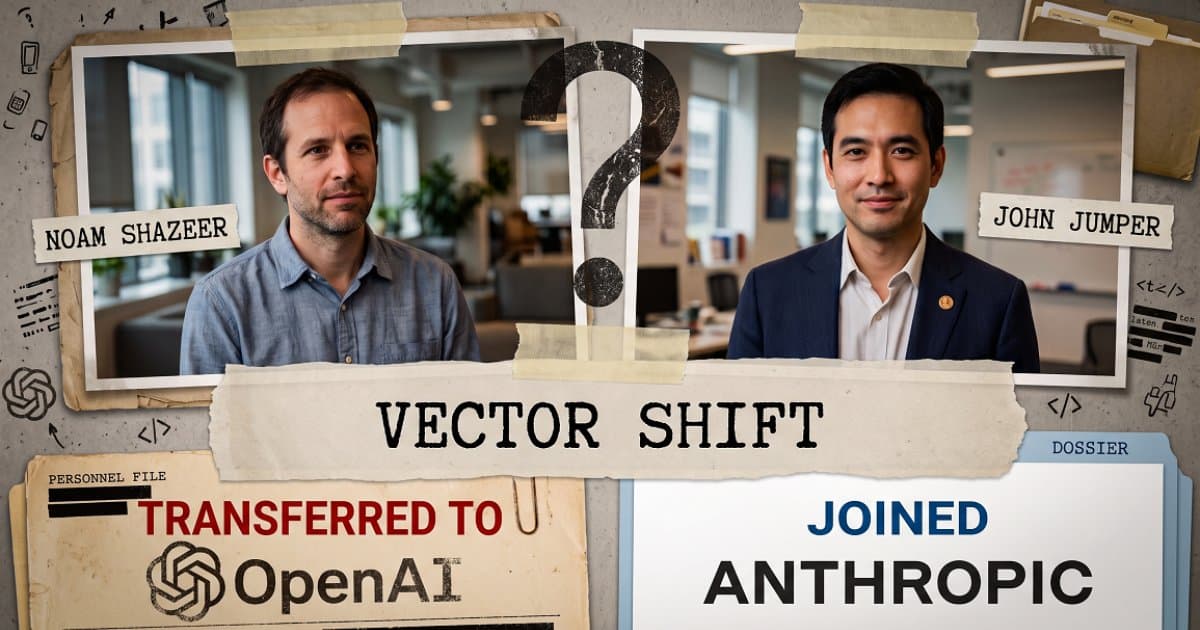
Noam Shazeer — one of the leading researchers on the Gemini team, known for his contributions to developing large language models, announced his move to OpenAI. His decision is not just a personal career move; it is a signal of internal cultural and management crisis in Google's AI division.
Even more resonant was the departure of John Jumper — the 2024 Nobel laureate in Chemistry, one of the co-authors of the revolutionary AlphaFold system that transformed the approach to protein structure prediction. Jumper moved to Anthropic, where he will lead research in biological AI. More details about the significance of Jumper's work and its impact on AI business applications can be found in our article Nobel laureate John Jumper at Anthropic: what it means for business and AI automation.
Jumper's departure is symbolically important: it represents a generation of researchers who believe that the most interesting and impactful AI work is now happening not at Google, but at smaller, more aggressive companies.
Why $225B in one day: mechanism of market reaction
What frightened investors
The Alphabet capitalization collapse of ~$225 billion in a single trading session is the market's concentrated response to the accumulation of several alarming signals simultaneously. Investors reacted not simply to the week's news, but to the convergence of a puzzle that painted a troubling picture:
- Technological lag: Gemini 3.5 Pro delay shows that Google cannot keep pace with OpenAI and Anthropic in the race for model quality
- Personnel exodus: the departure of two star researchers undermines confidence in Google's ability to retain top talent
- Competitive pressure: simultaneously, OpenAI announced new capabilities, and Anthropic continues to grow its corporate client base — read more about this in Anthropic overtakes OpenAI in revenue: what it means for business in Ukraine
- Regulatory risks: intensifying antitrust regulator attention to Google's dominance in search and advertising
What this doesn't mean
It is important to maintain sober assessments. Google remains one of the world's largest and richest technology companies with colossal infrastructure, billions of users, and access to computing resources most competitors can't even imagine. One tough week does not mean the end of Google as an AI player. But it does mean that Google's monopoly on the AI market is no longer guaranteed — and this fundamentally changes the strategic landscape for business.
What changes for the AI market and competitive environment
Strengthening positions of OpenAI and Anthropic
While Google weathered the crisis, its main competitors actively took advantage of the situation. OpenAI not only got Noam Shazeer but also received another boost to strengthen its position as market leader. Anthropic, meanwhile, continues to attract top talent and grow its corporate business — the company has already surpassed OpenAI in B2B revenue growth rates.
For Ukrainian entrepreneurs choosing an AI platform for business process automation, this means that betting exclusively on the Google ecosystem becomes riskier. Diversifying the AI stack is not just trendy language, but practical necessity. If you are now exploring possibilities of AI automation for medium business, it's worth building support for multiple providers into the architecture.
The role of Chinese AI models
Also significant context for understanding the Google crisis is the parallel trend: Chinese AI companies, particularly DeepSeek and Baidu, are actively increasing their presence in the corporate market. While American giants fight each other for talent, Asian competitors offer powerful alternatives at significantly lower prices. More details on this trend — in the article Chinese AI models capture US corporate market: what it means for your business.
Impact on AI services pricing
Competition between providers, exacerbated by the Google crisis, has one undeniably positive consequence for business: downward price pressure. When OpenAI, Anthropic, and Google compete for corporate clients, and Chinese players enter the game, entrepreneurs get more leverage to negotiate terms and API access costs.
Practical implications for Ukrainian business
Rethinking AI strategy
If your business is currently building or planning to build AI automation based on Google Cloud AI or Gemini API, now is the time to conduct a strategic audit of dependencies. This does not mean changing everything immediately — but it does mean having a Plan B.
Specific steps to consider:
- Audit current AI integrations: which business processes depend on Google AI? What is the criticality of each?
- Evaluate alternatives: for each key use case, compare Claude from Anthropic and GPT-4o from OpenAI capabilities — both providers are now strengthening their positions specifically in the corporate segment
- Multi-provider architecture: modern multi-agent systems allow building solutions that can switch between models from different providers depending on the task and availability
- Quality monitoring: regardless of chosen provider, implement quality control systems for AI output — quality issues are precisely what caused the Gemini 3.5 Pro delay
Opportunities the Google crisis opens
Paradoxically, Google Gemini crisis opens up several interesting opportunities for small and medium business:
First, intensifying competition between providers means more aggressive terms for partners and integrators. If you are currently negotiating corporate access to AI API, you have more leverage than a year ago.
Second, the exodus of talent from Google to OpenAI and Anthropic means these companies will get new ideas and approaches — and this will accelerate their product improvements over the next 6–12 months.
Third, overall market instability pushes entrepreneurs toward more considered choice of AI solutions based on real business needs rather than marketing. This is a favorable moment to focus on practical automation of specific processes — from handling customer inquiries to integrating AI with CRM and ERP systems.
Sectors with highest sensitivity to changes
Not all industries are equally sensitive to AI market turbulence. The biggest impact will affect:
- Pharmaceutical and biotech: John Jumper's move to Anthropic directly relates to the future of AI in drug development and molecular structure analysis — see our material on AlphaFold and the Nobel revolution in AI
- Technology companies and agencies: those building products based on Google AI API have the highest direct dependency
- Education and EdTech: Google Workspace is deeply integrated into educational processes, AI feature delays could impact development plans
- E-commerce and retail: search automation, recommendations, and customer support are often built on Google infrastructure
For most enterprises — from logistics companies to insurance agencies — the practical impact will be moderate if they have no direct Gemini API dependency. The main message for them: diversification is important, but panic is unnecessary.
FAQ: Most common questions about Google crisis and its impact on business
Should I stop using Google Workspace in favor of competitors right now? No, mass migration from Google Workspace is not justified now — productivity products (Gmail, Docs, Drive) remain stable and high-quality. What should be reviewed is specifically strategic investments in AI functions based on Gemini API for critical business processes where reliability is a priority.
How will the Gemini 3.5 Pro delay affect small business in Ukraine? Direct impact will be minimal for most small enterprises using ready-made AI tools. More significant impact will be felt by companies building their own AI solutions on Google API or planning integration of new Gemini features in the coming months.
What does John Jumper's move to Anthropic mean for business? In the long term, this will strengthen Anthropic's position in scientific AI, especially in biotechnology and pharmaceuticals. For most B2B companies, this is a signal to more closely monitor Claude's development as an alternative to Gemini for corporate applications.
Is there a risk Google will fall behind entirely in the AI race? Google has colossal resources, its own TPU infrastructure, and billions of users — complete lag is unlikely. However, the company may lose its position as undisputed leader and become one of several equal players, which is generally good for competition and prices.
How can I protect my business from dependence on one AI provider? The optimal strategy is to build AI automation through an abstraction layer (middleware or AI orchestrator) that allows switching between models from different providers without rewriting core logic. This increases initial complexity but critically reduces vulnerability to individual player problems.
Single-Provider Dependence Is a Risk
Google Gemini crisis — the delayed flagship model, exodus of a Nobel laureate and leading researcher, $225 billion collapse — is not a disaster for one company, but a mirror reflecting all the instability of the AI market in 2025. For Ukrainian business, the main lesson is simple: an AI strategy built on dependence on a single provider is a risk, not an advantage. If you want to understand how to build reliable and flexible AI automation for your business taking into account current market realities — contact us for a free consultation. We will help you choose the right solution architecture, regardless of what happens at Silicon Valley headquarters.
Have questions? Ask the AI agent right now
Responds in seconds, knows everything about our services and will help with your situation
You might also like
Claude Found a New Enzyme: AI Enters Science
Claude's AI agents discovered the ART enzyme system in 21 hours. What this means for pharma and biotech R&D — and why business leaders must pay attention now.
NewsAI Slowdown Pact: A Prisoner's Dilemma
Amodei, Altman, Musk, and Hassabis agree to slow AI. But game theory says the deal may collapse before it starts. Here's what that means for your business.
NewsChatGPT for Financial Services: What Business Gets Now
OpenAI launched ChatGPT for Financial Services on GPT-6 Astra. See which processes it automates, what ROI to expect, and how financial firms use it today.