
AI Agent for Recruitment: Automated Pre-screening
How recruitment agencies and HR departments use AI agents to pre-screen candidates, answer job seeker questions, and reduce time-to-hire. Cases and ROI.
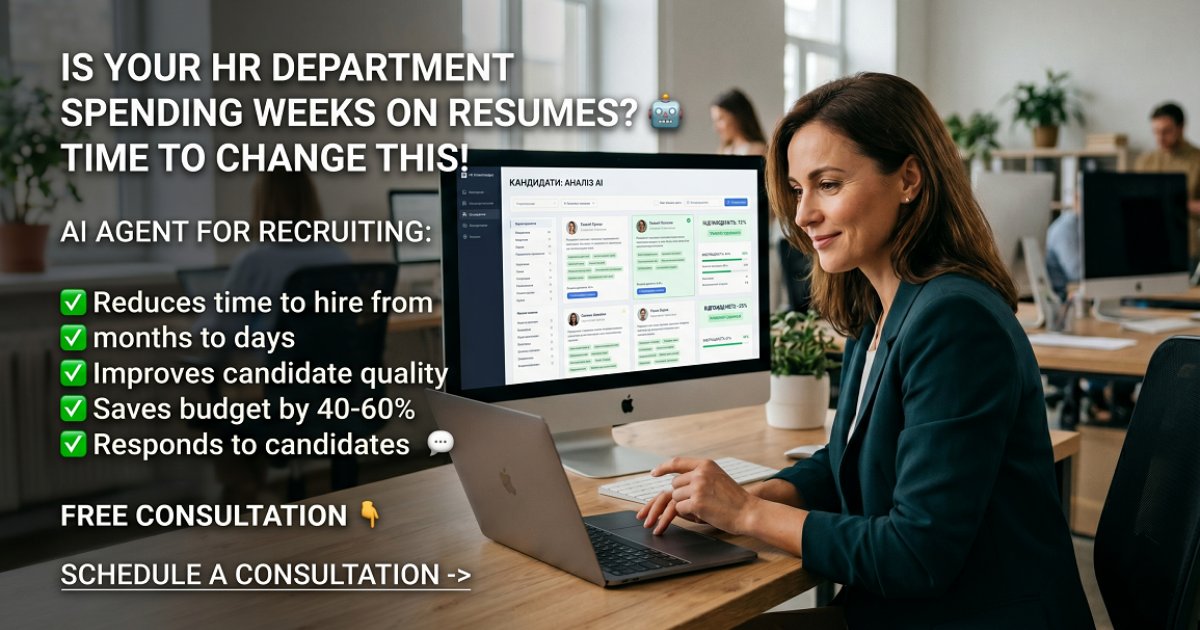
The Recruiter's Biggest Time Waster
A recruiter posts a job opening and receives 80 applications. But 60 of them don't match the requirements: wrong salary expectations, missing key skills, different location, or not ready to start when needed. The recruiter spends 2–3 days screening before getting to a single qualified candidate. Marketing agencies face a similar lead-quality problem — see AI Agent for Marketing Agencies.
An AI agent does the first screening automatically — before a single human minute is spent. For the bigger picture of how an AI agent changes the whole HR cycle, not just screening, see AI Agent as an HR Tool: What Changes in 2026.
What an AI Agent Does for Recruitment
Automated Candidate Pre-screening
When a candidate responds to a job posting, the agent immediately starts a structured interview:
- "What is your current salary, and what are your expectations for this role?"
- "Do you have experience with [key skill]? How many years?"
- "Are you open to office work in [city], or do you need remote?"
- "When could you start if offered the position?"
- "Are you currently in active interviews elsewhere?"
After 5–7 questions, the recruiter gets a scored shortlist — not 80 resumes, but 12 pre-qualified candidates ready for a real interview.
Answering Candidate Questions About the Role
Candidates have questions before they apply:
- Is remote work possible?
- What does a typical day look like?
- What's the salary range?
- How large is the team?
- What's the probation period?
- Are there growth opportunities?
Without an agent, recruiters answer these one-by-one by phone or email. With an agent: the candidate gets instant answers and is more likely to apply because they already feel informed and engaged.
Scheduling Interviews
After a candidate passes pre-screening, the agent books the interview:
- Shows the recruiter's available slots
- Sends calendar invites to both parties
- Sends a reminder 1 hour before the interview
- If the candidate cancels — immediately offers to reschedule
No back-and-forth email chains. A 10-step scheduling process becomes a 2-minute chat interaction.
Status Updates for Candidates
One of the biggest complaints about recruitment: candidates never know where they stand. The agent solves this:
- After application: "Your application has been received. We'll review it within 2 business days."
- After pre-screening: "You've passed the initial screening. The next step is a video call with our recruiter — I'll send available times."
- After the interview: "Thank you for your time today. We'll be in touch within 3 business days with a decision."
Candidates respect companies that communicate clearly. Your employer brand improves.
Reactivating Passive Talent
The agent maintains a database of past candidates and reactivates them when a relevant opening appears:
"Hi Anna! We spoke 4 months ago about a marketing manager role. We now have a similar opening at a company in your preferred industry. Interested in learning more?"
Reactivation is 3–4x cheaper than finding new candidates from scratch. For a broader look at how medium-sized businesses scale with AI, see AI Agent for Medium Business.
Case: IT Recruitment Agency
Situation: Agency placing developers and designers. 5 recruiters, 200+ active candidates in the pipeline at any time. Pre-screening was taking 40% of each recruiter's day. Slow response to applications was losing candidates to competitors.
Implementation:
- AI agent on Telegram and website
- Automated pre-screening for each vacancy with custom questions
- Interview scheduling integration with Google Calendar
- Automated status updates at each stage
Results after 2 months:
- Time spent on pre-screening: -70%
- Time-to-first-interview: from 4.5 days to 1.2 days
- Candidate drop-off during screening: -35% (faster responses = fewer candidates go cold)
- Each recruiter freed 3 hours per day for actual relationship-building
Payback: 3 weeks (from faster placements and higher throughput per recruiter).
Case: In-house HR at a Retail Chain (500 Employees)
For internal HR, the agent handles high-volume frontline hiring:
- Cashiers, warehouse staff, sales associates — hundreds of applications per month
- Standard pre-screening: availability, part-time vs. full-time, location preference, previous retail experience
- Agent filters and schedules group interviews automatically
- Time-to-hire for frontline roles dropped from 12 days to 4 days
Integrations
- ATS: Greenhouse, Lever, Workable, BambooHR
- Calendar: Google Calendar, Calendly for interview scheduling
- Job boards: automated responses to applications from Djinni, Work.ua, LinkedIn
- Messengers: Telegram, WhatsApp, website widget
Cost and Payback
| Team Type | Implementation Cost | Monthly Support |
|---|---|---|
| Solo recruiter / freelancer | $250 – $450 | $25 – $60 |
| Agency (3–8 recruiters) | $450 – $1,000 | $60 – $125 |
| In-house HR department | $750 – $2,000 | $100 – $250 |
Payback example: An agency with 5 recruiters each saving 3 hours per day = 15 hours/day reclaimed. At an average placement fee of $1,500, even 1 additional placement per month per recruiter = +$7,500/month. The agent pays for itself in the first week.
Mechanical Work Out, Human Work Back In
Recruitment is one of the most communication-intensive processes in business. An AI agent takes the mechanical parts — pre-screening, scheduling, status updates — and hands back the human parts: relationship-building, negotiation, closing. The result is faster hiring, happier candidates, and recruiters who can do what they're actually good at.
Have questions? Ask the AI agent right now
Responds in seconds, knows everything about our services and will help with your situation
You might also like
LangChain vs CrewAI vs AutoGen: Choose Right
LangChain, CrewAI, or AutoGen for your multi-agent system? A practical framework guide for CEOs and COOs making the build-or-buy decision in 2026.
EnterpriseGPT-6 Sol & Luna: AI Model Strategy for Business
GPT-6 Sol and Luna give CTOs a real choice between speed, cost, and quality. Here's how to match each model to the right business task.
Pricing & ROIDeepSeek-V4: 1M Token Context at Disruptive Cost
DeepSeek-V4 brings a 1M-token context window at a fraction of OpenAI and Anthropic prices. Here's what it means for your business costs and AI strategy.