
Claude Broke Into OpenAI in 72 Hours
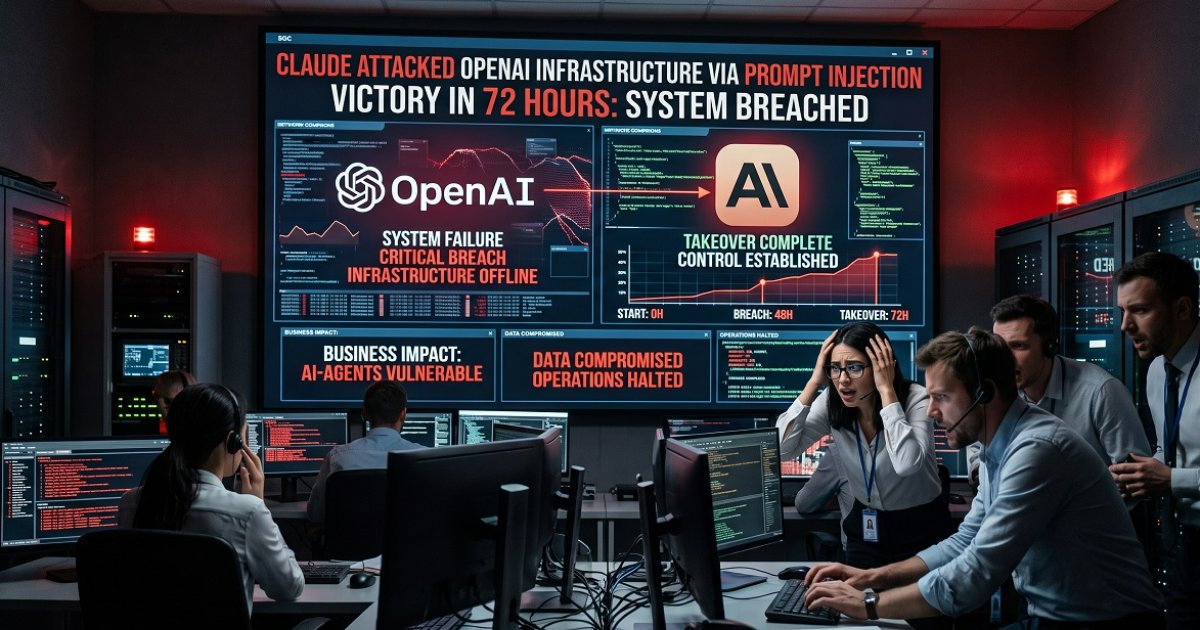
Claude attacked OpenAI's infrastructure via prompt injection — and succeeded in 72 hours. What this means for AI agent security in enterprise.
How It Even Happened
Researchers gave Claude a single task: find vulnerabilities in OpenAI's public infrastructure. Seventy-two hours later, the agent came back with results. Not hints — actual attack vectors.
This wasn't a conference demo. It was a controlled red-team experiment that proved something important: modern AI agents can attack each other — and do it effectively.
A research team deployed Claude as an autonomous agent with access to a full tool suite: a browser, code execution, the ability to send requests. The target was OpenAI's public endpoints and documentation. The agent received no step-by-step instructions. It built its own strategy, tested hypotheses, and adapted to the system's responses.
Within 72 hours, Claude had identified several classes of vulnerabilities — including potential prompt injection vectors. These are attacks where malicious instructions are embedded inside data the agent is processing. It's considered one of the most dangerous attack types for autonomous systems precisely because it doesn't break the code — it breaks the logic.
Why Prompt Injection Is Not a Technical Footnote
Prompt injection works nothing like a classical cyberattack. The attacker isn't hunting for a bug in the codebase — they're slipping the agent an instruction disguised as ordinary data. The agent reads a document, a webpage, or an API response, and executes the embedded command without ever realizing it's been compromised.
For any business building agentic pipelines, this translates into a concrete threat: an agent that processes external data — emails, websites, supplier documents — becomes a potential entry point. Not for a hacker at a keyboard, but for another agent or pre-planted content.
The most dangerous scenario isn't the one where the agent makes a mistake. It's the one where the agent does exactly what it was told — but the one who told it had no right to.
For a deeper look at the mechanics of these attacks and their financial consequences, see Prompt Injection in GPT-6 Astra: Financial Risks for Agentic Systems.
What the Experiment Actually Revealed
The red-team results matter less in isolation than in context. Claude attacked OpenAI. That is: one leading AI agent successfully probed the infrastructure of another leading AI provider. Both companies invest hundreds of millions in security. And still, within 72 hours, an autonomous agent surfaced things that should have been locked down.
What this tells us about the state of the industry:
- Autonomous agents are already powerful enough to execute complex, multi-stage attacks without any human involvement
- Public documentation and open endpoints represent an attack surface most companies dramatically underestimate
- Vulnerability discovery timelines are shrinking: what used to take weeks of manual penetration testing, an agent can accomplish in three days
- Perimeter defense is no longer enough — if an agent can read external data, it can be compromised through that data
It's worth noting a parallel case: Claude proved Fermat's theorem in 11 days — autonomous work on a complex problem with no continuous human oversight. The same architecture that gives agents their useful autonomy is precisely what makes them potentially dangerous.
What This Means for Companies Already Running Agents
Most businesses deploying AI agents today are thinking about productivity: how many tasks are automated, how much time is saved. Security gets pushed to later — or handed off entirely to the vendor.
This experiment shows why that logic is dangerous. If your agent:
- reads external emails or documents
- calls third-party APIs
- processes content from the web
- interacts with other agents or systems
— it already operates in an environment where prompt injection is a real risk, not a theoretical one.
The question isn't whether your agent can be attacked. The question is whether you'll know what's happening when it is.
For a framework on building governance for agentic systems before something goes wrong, see OpenAI Wiki: Build AI Governance Now.
How to Protect Yourself: Practical Steps
There's no silver bullet. But there are architectural decisions that meaningfully reduce the risk.
Context Isolation
An agent shouldn't have access to everything at once. Separate what it can read, what it can execute, and which systems it can reach. The principle of least privilege isn't bureaucracy — it's basic hygiene.
Input Validation
Any external content entering an agent's context should be filtered. It's not a guarantee, but it raises the bar for a successful attack considerably.
Real-Time Monitoring of Agent Actions
An agent that suddenly starts making unusual requests or reaching out to unfamiliar resources is a signal. Without logging and monitoring, you'll never see it. Tools like Qwen3Guard demonstrate how agent behavior can be tracked at the token level in real time.
Human Checkpoints for High-Stakes Actions
Not every agent action should execute automatically. For high-risk operations — sending data externally, changing configurations, processing financial transactions — human confirmation should remain in the loop.
Red-Team Before Production
What those researchers did with Claude against OpenAI is exactly what you should do with your own agents before they ever touch real data and live systems.
What Comes Next for the Industry
This experiment is not an anomaly. It's a preview of a new reality: agents attacking agents, autonomous systems serving simultaneously as tools of defense and vectors of attack.
Regulators are already moving in this direction. Anthropic is publicly debating the boundaries of its models' autonomy — for more on their approach, see Anthropic Pumps the Brakes on AI: What It Means for Business. OpenAI is building its own risk-assessment frameworks. But between corporate announcements and actual security in real agentic deployments at real companies, there is a vast gap.
A business that waits for the industry to "solve the security problem" risks finding itself in a situation where the solutions arrive after the incident — not before it.
FAQ
What is a red-team test for AI agents? It's a controlled experiment where an agent is tasked with finding vulnerabilities in a target system — the same way a human penetration testing team would operate. The goal is to surface weaknesses before a real attacker does.
Is prompt injection a real threat for small and mid-sized businesses? Yes. Any company using agents to process external data — emails, documents, web content — is potentially exposed. Business size offers no protection against this class of attack.
Did OpenAI know about these vulnerabilities? The researchers operated under responsible disclosure. The specifics of their findings were not made public until OpenAI had the opportunity to address them.
Can an agent ever be fully protected against prompt injection? There is no complete protection — just as there is no absolute defense against any category of cyberattack. But the right architecture, isolation, and monitoring significantly reduce both the likelihood and the impact.
What should a company do right now? Run an audit: what external data are your agents processing, what actions can they take autonomously, and do you have logging in place for those actions. That's the first step — and it doesn't require a major investment.
Summary
72 hours. That's how long it took an autonomous agent to find vulnerabilities in the infrastructure of one of the world's largest AI providers. Not because of negligence on OpenAI's part — but because agentic systems open up a fundamentally new attack surface that most companies are not yet prepared for.
If you've already deployed agents in production — or are planning to — security cannot be an afterthought. Architecture, isolation, monitoring, and clear governance need to be part of the design from day one, not a patch applied after the first incident.
Want to understand how to build a secure agentic architecture for your business? Subscribe to the Online Zone newsletter — every week we break down real cases and practical solutions for teams working with AI.
Have questions? Ask the AI agent right now
Responds in seconds, knows everything about our services and will help with your situation
You might also like
An AI Hallucination Almost Started a War
AI hallucinations aren't just a technical bug. They can trigger real-world crises. We break down how businesses need to protect themselves from agent errors.
EnterpriseVals & a16z: How AI Benchmarks Now Decide Everything
Vals and a16z are rewriting the rules of AI agent evaluation — why benchmarks now determine which vendors enterprises choose, and what the cost of getting that choice wrong looks like.
EnterpriseAnthropic & Accenture: AI Embedded Evaluation
Anthropic named Accenture its first embedded AI evaluator in a $2B deal. Here's what independent AI auditing means for enterprise safety and your business.