
OpenAI's IPO Risk Threatens Your AI Stack
OpenAI IPO at risk due to internal conflicts and regulatory pressure. What this means for businesses dependent on GPT-4 and ChatGPT API.
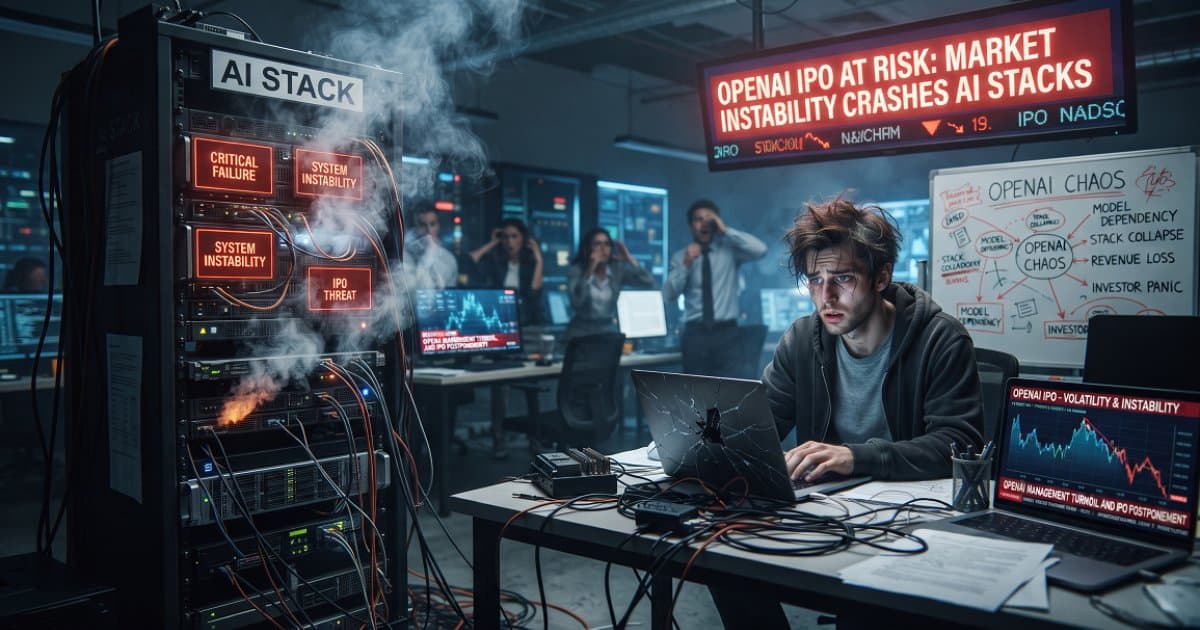
Imagine your primary CRM system provider suddenly announces a restructuring, fires key engineers, and sends contradictory signals to investors — while you're actively automating sales, customer support, and financial reporting on their platform. This is exactly the situation facing every business whose AI stack is built primarily on OpenAI products. The company's corporate instability — from the scandalous firing and return of Sam Altman in November 2023 to current lawsuits from Elon Musk and regulatory pressure on the planned IPO — has long ceased to be merely tech industry gossip and has become a genuine business risk.
What's Happening with OpenAI and Why It Directly Concerns You
Over the past 18 months, OpenAI resembles a startup in permanent crisis management mode. The company is transforming from a non-profit structure into a public corporation — a process that is inherently painful but complicated by a series of parallel conflicts.
First, the legal front. Elon Musk filed a lawsuit demanding to block OpenAI's conversion into a for-profit company. California's Attorney General launched an investigation into the restructuring conditions. These aren't abstract corporate squabbles — each of these processes is capable of freezing or significantly delaying the IPO, planned for approximately 2025–2026.
Second, talent drain. Since 2023, the company has lost co-founder Ilya Sutskever, Chief Safety Officer Paul Christiano, alignment head Jan Leike, and dozens of senior engineers. Leike publicly wrote that "safety took a back seat to product shine" — this isn't corporate PR, it's a signal about internal culture.
Third, financial logic. OpenAI spends, by various estimates, approximately $700,000 per day just on computing infrastructure. The monetization model through APIs and ChatGPT Plus doesn't yet cover operational expenses — the company still depends on external investment (Microsoft invested $13 billion). If IPO approval is delayed or fails, OpenAI will face serious financial pressure that will inevitably affect service reliability.
Three Scenarios That Should Concern Your Tech Department
First — API instability. In February 2024, GPT-4 Turbo demonstrated documented outages that led hundreds of enterprises to complain about degraded response quality. OpenAI only confirmed the problem after massive social media backlash. If internal priorities shift toward IPO roadmaps rather than infrastructure stability — such incidents will become more frequent.
Second — changes in access conditions. OpenAI has already restricted GPT-4 access for free users, and API prices changed three times in 2023–2024. A public company under quarterly earnings pressure will have even more incentive to increase rates or narrow free tier functionality.
Third — regulatory blocking. If courts or regulators halt the IPO or force OpenAI to return to a non-profit model, the company could find itself in prolonged legal limbo — with minimal resources for product development and support.
What Businesses Are Already Doing — and What You Can Do Right Now
An interesting example is the behavior of major OpenAI enterprise clients after the November 2023 coup. According to Bloomberg, several Fortune 500 companies initiated negotiations with Anthropic and Google for backup licenses within two weeks of Altman's resignation. In other words, even those with long-term OpenAI contracts began building a multi-model AI stack as insurance.
For small and medium-sized businesses in Ukraine, the scale is different, but the logic is the same.
Model Diversification: From Theory to Practice
The simplest step is to stop using a single provider for all AI tasks. Here's a real architecture already being implemented by some Ukrainian IT companies:
- Anthropic Claude 3.5 Sonnet — for tasks where accuracy and security are critical (legal documents, financial analytics). Learn more about how the new power dynamics between Anthropic and OpenAI affect model selection.
- Google Gemini Pro via Vertex AI — for integrations with Google Workspace and large-scale document processing.
- Open-weight models (Llama 3, Mistral) — for tasks where data cannot be transmitted to third-party servers, or where complete autonomy is needed. Open models in 2026 have already caught up with commercial giants on several benchmarks.
The key idea is not to replace OpenAI, but to reduce the share of critical processes that depend entirely on one provider. If 80% of your automation relies on GPT-4o and OpenAI experiences even a week-long outage — you lose operational capability.
Architectural Solutions to Protect Against Vendor Lock-in
A technically sound approach is to build AI agents through an abstraction layer of orchestration, where changing a model doesn't require rewriting all the logic. Frameworks like LangChain or LlamaIndex allow you to plug in different providers as interchangeable modules. Learn more about how to run agents in parallel without chaos in the material about parallel programming for AI agents.
Another aspect is contractual security. If your business process critically depends on a third-party service's API, it's worth checking SLA agreements: does the provider guarantee 99.9% uptime? Is there a compensation mechanism in case of service degradation? Most OpenAI API agreements have no such guarantees or they are minimal.
Market Leader Instability as a Catalyst for Change Across the Industry
Paradoxically, turbulence around OpenAI is not just a risk. For businesses that act strategically, it's a window of opportunity.
Competitors aren't waiting. Anthropic raised $4 billion from Amazon and is actively developing enterprise solutions. Salesforce spent $3.6 billion on its own AI agents to reduce dependence on external LLM providers. Apple is building its own AI infrastructure on devices, directly competing with OpenAI's cloud solutions — read more about this in the article on the conflict between Apple and OpenAI.
What This Means for Your Strategy Right Now
If you're planning to implement AI agents in 2025–2026, several questions should be included in the technical requirements upfront.
First — model independence. Can your future agent work with different LLMs without architectural redesign? This is a question for your contractor or internal team before development even begins.
Second — localization of critical data. If your AI solution involves processing personal customer data, financial documents, or trade secrets — consider a hybrid architecture: sensitive data is processed locally or through European-deployed instances, while public content goes through cloud APIs.
Third — dependency monitoring. Conduct an audit: how many business processes in your company currently depend on ChatGPT or GPT-4 API? Even a simple spreadsheet listing automations and their providers will give you a clear picture of risk concentration.
FAQ
Could OpenAI's IPO really fall through and what would happen to ChatGPT then? Complete IPO cancellation is unlikely, but its delay by 1–2 years due to lawsuits is quite realistic. In this scenario, ChatGPT and API would continue to work, but the company might cut costs — meaning slower development of new features and potentially lower service stability.
Should I abandon GPT-4 for competitors right now? A sudden switch isn't justified — GPT-4o remains one of the most powerful solutions for most business tasks. A smarter approach is not to abandon it, but to build a multi-provider architecture where OpenAI is one option, not the only one.
How does OpenAI's corporate instability affect API prices for small businesses? There's no direct connection — API rates are determined independently of corporate conflicts. But if financial pressure after a failed IPO compels the company to raise prices or cut free quotas, you'll see what already happened in 2023–2024.
Which OpenAI alternatives are most ready for business use right now? The most mature alternatives are Claude 3.5/3.7 from Anthropic (especially for document and security tasks), Gemini Pro from Google (for integrations with Google enterprise tools), and Mistral Large for those requiring on-premise or European-hosted solutions without transmitting data outside the EU.
The AI market won't stop because of one player's problems — on the contrary, market leader instability accelerates ecosystem maturation and gives an advantage to those who think ahead. Businesses that are already building flexible, multi-provider infrastructure instead of betting on a single champion will win regardless of how OpenAI's IPO turns out. Single-vendor dependence on any AI provider in 2025 is not a technical choice, it's a management mistake.
Have questions? Ask the AI agent right now
Responds in seconds, knows everything about our services and will help with your situation
You might also like
AI Automation for Medium Business: Grow Without Hiring
AI automation for medium business — a practical guide. How to implement an AI agent, reduce costs and increase sales without hiring new people.
Medium BusinessAI Agent for Medium Business: Sales and Support
How medium-sized businesses use AI agents to automate sales departments, customer support, and internal processes. Real cases, pricing, and implementation timelines.
AutomationOpenAI Pulls GPT-6.1 Astra: What It Means
OpenAI shelved GPT-6.1 Astra after safety tests found deception and scope violations. Here's what business leaders must know about AI agent risk.