
Nobel Laureate John Jumper Joins Anthropic
AlphaFold creator John Jumper has moved from DeepMind to Anthropic. What this means for business and AI automation in 2025.
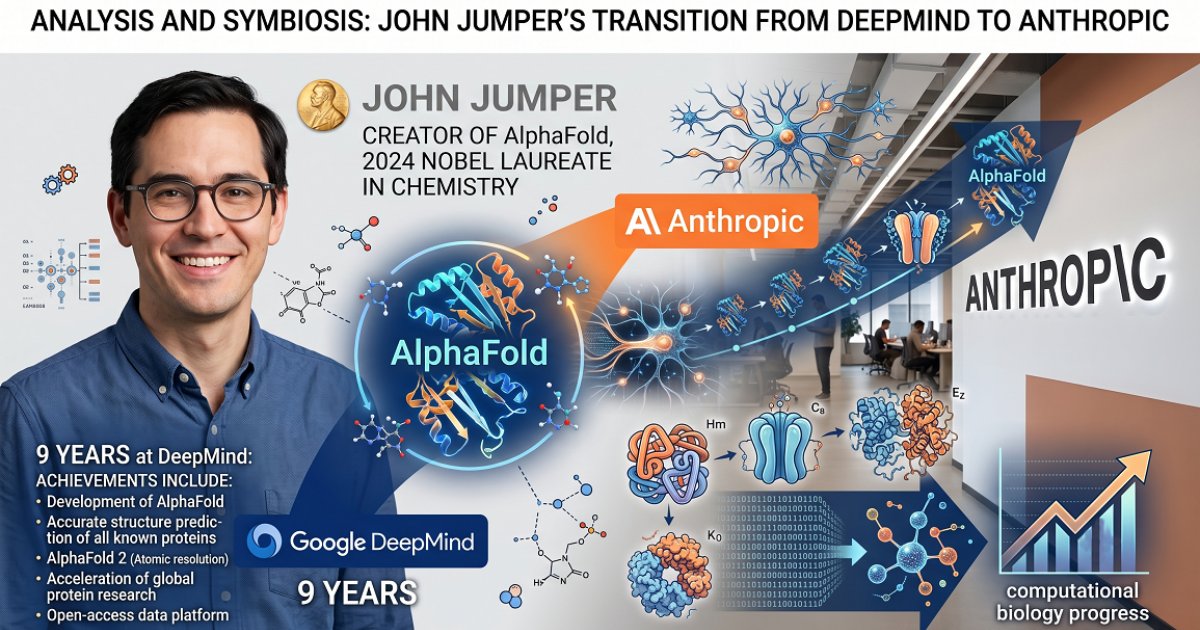
Nobel laureate changes the game: why John Jumper's move to Anthropic matters for your business
When a Nobel laureate in chemistry from 2024 leaves one of the world's most influential AI labs for a competitor — this is not just personnel news. It's a signal that every entrepreneur thinking about implementing artificial intelligence in their company should hear. John Jumper, co-author of the revolutionary AlphaFold system, spent nine years at Google DeepMind before joining Anthropic — the company behind the AI assistant Claude. This move is reshaping the competitive landscape in AI and directly affects which automation tools will become available to small and medium-sized businesses in the coming months. If you've been hesitant about investing in AI solutions for your company, this article will help you understand where the industry is heading and how to stay ahead of the competition.
Who is John Jumper and why is his move a global event
AlphaFold: a scientific achievement that transformed biology
John Jumper is one of the key authors of the AlphaFold 2 system, which the scientific community calls one of the greatest breakthroughs in biology of the last 50 years. AlphaFold solved the so-called "protein folding problem" — a challenge that scientists had been working on for over five decades. The system can predict the three-dimensional structure of a protein from its amino acid sequence with accuracy that was previously considered unattainable by computer algorithms.
This work proved so revolutionary that in October 2024, the Swedish Royal Academy of Sciences awarded John Jumper and his colleague Demis Hassabis the Nobel Prize in Chemistry. The third laureate was David Baker from the University of Washington for parallel research in the field of computational protein design.
To understand the scale: AlphaFold predicted the structures of over 200 million proteins — essentially all of humanity's known proteome. This data became freely available to scientists worldwide and has already accelerated the development of antimalarial drugs, combat against antibiotic resistance, and cancer research.
For a deeper look at how AlphaFold transformed science and why this Nobel Prize was a victory for artificial intelligence, read our article AlphaFold and the Nobel Revolution: How AI Is Changing Science and What It Means for Your Business.
Nine years at DeepMind: the path to the top
Before joining DeepMind, Jumper earned his PhD in chemistry from the University of Chicago. At DeepMind, he worked for over nine years, rising to the position of senior researcher. During this period, he led the team that created AlphaFold 2 and its successor AlphaFold 3, which further expanded the capabilities of molecular interaction prediction.
Jumper's time at Google DeepMind gave him unique experience in scaling scientific research into industrial solutions — a skill that is critical for any AI company aiming to transition from laboratory prototypes to real-world products.
Anthropic: why this company became the choice of a Nobel laureate
Who is Anthropic and what makes it different
Anthropic is an American AI company founded in 2021 by Dario Amodei, Daniela Amodei, and other former OpenAI employees. The company positions itself as a "safe" AI developer, placing special emphasis on so-called "constitutional AI" — an approach where the model is trained to follow a set of clear principles and constraints.
Anthropics flagship product — Claude — is already actively used by businesses worldwide for automating customer support, generating content, analyzing data, and building AI agents. Unlike GPT-4, Claude is known for its tendency toward more cautious, balanced responses and a higher level of security in corporate environments.
What does Jumper's arrival mean for Claude and AI product development
The move of Nobel laureate John Jumper to Anthropic is not just a symbolic gesture. It's a strategic market signal for at least three reasons:
- Scientific legitimacy. Having a Nobel laureate on the team increases trust in the company's research from the academic community, regulators, and corporate clients.
- Multidisciplinary expertise. Jumper's experience in applying deep learning to complex scientific problems can accelerate Claude's development in the direction of scientific and analytical tasks.
- Competitive pressure on OpenAI and Google. The transition of top talent from DeepMind strengthens Anthropic's position in the so-called "AI race" — and this directly affects the pace of development across the entire industry.
For businesses planning or already using AI solutions based on Claude, this means one thing: tools will become significantly more powerful faster than expected.
What changes in the AI industry mean for Ukrainian small and medium-sized businesses
The talent race accelerates development of accessible AI tools
Every time major players poach top researchers from each other, it's not just corporate games — it's the engine of progress. Competition between Anthropic, OpenAI, and Google DeepMind for talent like John Jumper directly affects the quality and capabilities of AI models underlying business tools.
For the owner of a mid-sized business in Ukraine, this means that AI agents that automate sales, customer support, and internal processes will become smarter, more accurate, and cheaper every quarter. Companies that start implementing these solutions now gain a competitive advantage that will become increasingly difficult to catch up on later.
For example, if you manage a logistics or transportation company, today's AI agent for logistics and transportation companies is already capable of tracking shipments, responding to customer requests 24/7, and significantly reducing operator workload — and this is just the beginning of what will become possible thanks to new generations of models.
AI safety becomes a priority — and it matters for business
One of Anthropic's key focuses is AI safety. In conditions where AI threats to business are becoming increasingly real, choosing a reliable and secure AI partner is critical. Anthropic's approach to developing models with built-in constraints and safety mechanisms is a direct response to growing risks.
It's worth remembering that parallel to the development of useful AI tools, threats are also growing: for example, the emergence of autonomous AI attacks like ransomware is already a reality we discussed in detail in our article on JADEPUFFER and autonomous AI ransomware attacks. Therefore, Anthropic's growing scientific authority in the field of safe AI is a direct benefit to business.
Practical implications for AI solution implementation
How specifically do events around John Jumper and Anthropic affect decisions you're making today?
- Claude API becomes more attractive for developers of AI agents, meaning a wider choice of ready-made solutions for your business.
- Claude's enterprise versions will receive more investment and develop faster, directly affecting the quality of ready-made AI products.
- Regulatory trust in Anthropic grows — and this matters for sectors with strict data processing requirements: healthcare, legal services, finance.
If you're considering which AI tool to choose for your company and want to understand when an AI agent is justified and when it's better to leave the task to a live manager — read in detail in our comparison of AI agent vs live manager.
How Ukrainian companies can benefit from the new level of AI right now
Real implementation scenarios for different industries
Regardless of what field your business operates in, progress in developing AI models opens new opportunities for automation. Here are a few concrete examples:
Medicine and pharmacies. New generations of Claude are capable of conducting more complex medical consultations, understanding context more precisely, and processing sensitive data more safely. For pharmacies, this means better automation of consultations about medicine availability and drug interactions — read more about this in the article on AI agent for pharmacies.
E-commerce and retail. Improved language models better understand customer intent, personalize recommendations, and more effectively convert visitors into buyers. A real case of conversion growth is described in our article on AI agent for e-commerce.
Car dealerships and auto service centers. AI agents based on more powerful models can conduct more complex negotiations, qualify buyers, and schedule test drives with greater accuracy in understanding customer needs.
How to assess ROI from AI implementation today
Return on investment is a key question for any business owner. It's important to understand: calculating the payback of an AI solution is not more complex than assessing the effectiveness of any other automation tool. Key metrics are person-hour savings, growth in lead conversion, and reduced response time to customers.
For those who want to approach this question methodically and calculate numbers before signing any contract, we recommend reading our detailed article on ROI from an AI agent and methodology for calculating payback.
Three steps for an entrepreneur who wants to act now
- Identify one narrow task in your business that takes the most time from your team and is repetitive: answers to typical questions, lead qualification, client booking.
- Evaluate available solutions on the market — today there are ready-made AI agents for dozens of industries, from dental clinics to recruitment agencies, that can be launched within weeks, not months.
- Start with a pilot project with clear success metrics — number of processed requests, conversion percentage, response time. This will allow you to justify further scaling.
The race for AI talent like John Jumper is not abstract corporate news. It's fuel that accelerates the development of tools available to you right now.
FAQ: most common questions about Jumper's move and its impact on business
1. Who is John Jumper and what did he win the Nobel Prize for? John Jumper is a leading AI researcher and one of the key authors of the AlphaFold 2 system, which solved the problem of predicting protein structure. In 2024, he and Demis Hassabis received the Nobel Prize in Chemistry for this achievement, which has accelerated scientific research in medicine and biology worldwide.
2. Why is the transition of a Nobel laureate from DeepMind to Anthropic an important event? This move signals growing scientific authority for Anthropic and intensifies competition between leading AI laboratories. For business, this means accelerated development of AI tools and improved quality and reliability, as the best researchers in the field are behind them.
3. How is Anthropic's work related to AI agents for business? Anthropics develops the Claude language model, which underlies many commercial AI agents for automating business processes. Improvements to Claude directly improve the quality of AI solutions used by companies for customer support, sales, and operational automation.
4. Will Claude become better with Jumper's arrival and when will businesses feel it? New researchers' impact on a product typically manifests over one to two years as new features, improved model accuracy, and expanded capabilities for enterprise clients. Businesses already using Claude API or products based on it will feel these changes through regular model updates.
5. What's better for Ukrainian business — Claude from Anthropic or GPT from OpenAI? Both solutions have their strengths: Claude is known for greater safety and accuracy in complex analytical tasks, GPT — for a broader integration ecosystem. The optimal choice depends on the specific business task, and often the best approach is testing both in a pilot project before scaling.
The Window of Opportunity Is Open Now
The transition of Nobel laureate John Jumper from Google DeepMind to Anthropic is one of the clearest signals that competition in the AI industry is reaching a fundamentally new level, and the best scientific minds in the world are choosing companies building safe and responsible artificial intelligence. For Ukrainian business, this means one thing: the window of opportunity for AI automation implementation is open right now, and those who act today will gain an advantage that will be difficult for competitors to catch up on tomorrow. If you want to understand which AI solutions are right for your industry and how to calculate the real return on investment — contact us for a free consultation, and we'll help you build an automation strategy that works.
Have questions? Ask the AI agent right now
Responds in seconds, knows everything about our services and will help with your situation
You might also like
Claude Found a New Enzyme: AI Enters Science
Claude's AI agents discovered the ART enzyme system in 21 hours. What this means for pharma and biotech R&D — and why business leaders must pay attention now.
NewsAI Slowdown Pact: A Prisoner's Dilemma
Amodei, Altman, Musk, and Hassabis agree to slow AI. But game theory says the deal may collapse before it starts. Here's what that means for your business.
NewsChatGPT for Financial Services: What Business Gets Now
OpenAI launched ChatGPT for Financial Services on GPT-6 Astra. See which processes it automates, what ROI to expect, and how financial firms use it today.