
Multi-Agent Systems: The Next Level of Automation
Multi-agent systems for business — what they are, how Multi-Agent Orchestration works, and why it's the next level of AI automation.
When One AI Agent Is No Longer Enough
Imagine: your business is growing, there are more processes, and you've already implemented one AI agent — say, for customer responses. It's handling things. But then it turns out that in parallel you need to qualify leads, update your CRM, send reports to managers, and monitor inventory. One agent can't handle all this — it will either become "overloaded" or simply won't know what to do with such variety of tasks.
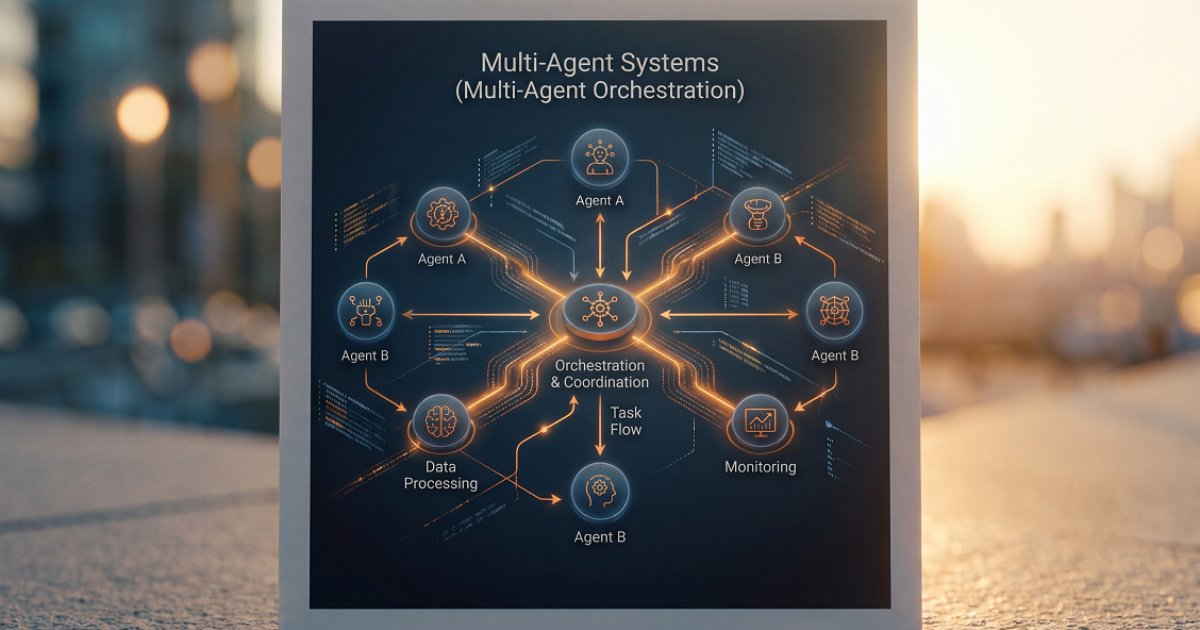
This is where multi-agent systems come into play — or Multi-Agent Orchestration. It's an approach where several specialized AI agents work together, each performing their own role, while a separate "conductor" coordinates their actions. Sounds complicated? Actually, it's how successful teams of people have been working for a long time. Now this logic has been transferred to AI.
In this article, we'll break down what multi-agent systems are in simple terms, how they're structured, who they're right for, and how to start implementing them in your business.
What Are Multi-Agent Systems and How Do They Work
Multi-agent system (Multi-Agent System, MAS) — is an architecture where several AI agents interact with each other to perform complex tasks. Each agent specializes in something specific: one communicates with customers, another analyzes data, a third updates the database, a fourth sends notifications to the team.
The Orchestrator and Executors: Who Is Who
At the center of such a system is the orchestrator — the main coordinating agent. It receives a task, breaks it down into subtasks, and delegates each one to the appropriate executor. It's like a project manager who distributes work among specialists.
Executors are narrowly specialized agents:
- Communication Agent — communicates with the customer via chat or phone
- Analytics Agent — processes data, builds reports
- Integration Agent — transfers information to CRM, ERP, spreadsheets
- Notification Agent — informs managers about important events
- Quality Agent — checks the results of other agents
Synchronous and Asynchronous Operations
An important feature of Multi-Agent Orchestration is that agents can work in parallel. While one is talking to a customer, another is already updating the CRM, and a third is preparing a report for the manager. This dramatically reduces the time it takes to complete complex processes.
Asynchronous mode allows agents to "wait" for responses from external systems (for example, from a database) and continue working when the response arrives. No downtime, no delays due to the human factor.
How Multi-Agent Systems Differ from a Regular AI Agent
This question arises in most business owners when they first hear about Multi-Agent Orchestration. Let's compare honestly.
One Agent: A Strong Solo Player
A single AI agent handles linear tasks well: respond to a request, book a client for an appointment, provide product information. If you're just starting automation — this is a great entry point. For example, AI agent for beauty salons and barbershops or AI agent for dentistry and medicine — these are exactly the kinds of solutions that solve a specific, clearly defined task.
But a single agent has limitations:
- it cannot efficiently perform several fundamentally different tasks simultaneously
- as complexity increases, it starts to "get confused" and make mistakes
- it's difficult to scale without reworking the entire logic
Multi-Agent System: Teamwork
Multi-agent system — is the next level. It's suitable when:
- the process includes more than 3-4 different types of actions
- parallel processing of multiple information streams is needed
- different parts of the process require different "expertise"
- there's a need for mutual verification of results
Simple example: a customer contacts a logistics company with a question about cargo. A single agent would answer the question. A multi-agent system will do more: the first agent communicates with the customer, the second in parallel checks the status in the tracking system, the third notifies the responsible manager, and the fourth records the inquiry in the CRM — and all this happens in seconds. This is exactly the approach used in complex solutions for AI agent for logistics and transport companies.
Real Use Cases in Small and Medium Business
Theory is good. But let's talk about how this looks in practice for Ukrainian businesses.
Marketing Agency: From Inquiry to Onboarding
Imagine a marketing agency. Dozens of incoming inquiries arrive every day through various channels. A multi-agent system here looks like this:
- Qualifier Agent receives the inquiry, asks clarifying questions, determines budget and task
- Analyst Agent checks the client's business, website, competitors
- Manager Agent assigns a responsible person from the team and passes the data
- Communicator Agent sends the client personalized emails with next steps
This approach is described in the material about AI agent for a marketing agency — and it shows how much you can accelerate the processing of incoming flow.
Recruitment Company: Screening at Scale
Recruiting is another ideal case for Multi-Agent Orchestration. The first agent posts vacancies and collects responses. The second conducts initial text or voice screening. The third ranks candidates by criteria. The fourth schedules interviews and sends confirmations. The HR manager receives a ready shortlist instead of manually reviewing hundreds of resumes.
E-commerce: Automating the Entire Sales Cycle
For an online store, a multi-agent system can cover the entire cycle: order receipt → inventory check → payment confirmation → warehouse task generation → delivery tracking → feedback collection after receipt. Each agent is responsible for their own area, and no process "hangs" due to human delays.
Educational Platform: From Registration to Retention
An online school or courses platform is also a great example. One agent consults with potential students and closes the sale. The second conducts onboarding after payment. The third monitors activity and "wakes up" those who stopped logging in. The fourth collects feedback and passes it to the content team. This approach is discussed in detail in the article about AI agent for education and online courses.
How to Implement a Multi-Agent System: A Step-by-Step Approach
Most often, business owners say: "Sounds great, but where do I start?" Here's a practical approach we recommend.
Step 1: Map Processes, Not Technologies
First and foremost — describe your key business processes. What tasks repeat daily? Where does your team spend the most time? Where do delays and errors occur? Don't think about AI yet — just document how things are now.
Step 2: Identify "Bottlenecks" for Automation
Don't try to automate everything at once. Find 2-3 processes that:
- are well-structured and have clear rules
- take up a lot of people's time
- have a measurable result (so you can later evaluate the effect)
Step 3: Design the Agent Architecture
Now you can think about agents. For each identified process, define:
- what specific task each agent solves
- what data it needs on input
- what result it should produce
- which systems it should interact with
Step 4: Start with MVP, Then Scale
Multi-Agent Orchestration doesn't have to be fully implemented from day one. Start with 2-3 agents that cover the most painful point. Test, adjust, get results — and then add new agents.
Step 5: Integrate with Existing Tools
Agents must work with the systems you already have: CRM, messengers, spreadsheets, telephony. If you use Ukrainian tools, it's worth familiarizing yourself with how AI agent for KeyCRM is built — it's a good example of native integration with a popular CRM.
Step 6: Measure and Optimize
After launch — measure everything. Time to process inquiries, number of errors, customer satisfaction, team workload. Multi-agent systems respond well to optimization if you have the data.
Risks and Limitations to Know About
We would be dishonest if we only talked about benefits. Multi-agent systems are a powerful tool, but with nuances.
Implementation Complexity
Setting up a system with several interacting agents is more complex than launching a single bot. You need to carefully think through the interaction logic, error handling, "what if" scenarios. Without experience, it's easy to make mistakes.
Need for Quality Data
Agents are only as good as the data they receive. If your processes are poorly documented or data is scattered across different systems — you need to put things in order first.
Control Issues
The more complex the system, the more important it is to have monitoring tools. You need to see what each agent is doing, where failures occur, what decisions are being made. This isn't scary, but it needs to be planned in advance.
Cost and ROI
Multi-agent systems cost more than single solutions. But the effect from them is correspondingly higher. If you want to understand pricing guidelines, there's a detailed material about Custom AI Agent Development Cost. The main thing is to calculate return on investment, not just costs.
FAQ: Frequently Asked Questions About Multi-Agent Systems
What is Multi-Agent Orchestration in simple terms?
Multi-Agent Orchestration is an approach where several AI agents work together under the leadership of a main coordinator. Each agent performs their own narrow task, and the orchestrator combines their work into a single process. It's like a well-coordinated team of specialists, only instead of people — AI.
Are multi-agent systems suitable for small businesses?
Yes, but with a condition: your business must have processes that truly require parallel or complex automation. If you have a small stream of customers and simple tasks — one agent is quite sufficient. A multi-agent system pays for itself when there's real complexity or high volume.
How much does it cost to implement a multi-agent system?
Cost depends on the number of agents, complexity of integrations, and amount of configuration. Basic solutions can start from a few thousand dollars, complex enterprise systems — much more. It's important to calculate not just expenses, but also team time savings and income growth after implementation.
How does a multi-agent system interact with CRM and other tools?
Agents integrate with external systems through APIs or ready connectors. They can read and write data in CRM, send messages to messengers, update spreadsheets, trigger events in other services. The more structured data you have — the more effective the integration.
Is it safe to trust AI agents with critical business processes?
With proper configuration — yes. It's important to set clear rules, limits on each agent's authority, and definitely leave "control points" where a person checks the result. Multi-agent systems don't fully replace people — they take over routine work, leaving strategic decisions to your team.
When One Agent Is No Longer Enough
Multi-agent systems are not a distant future, they're something that's already being actively implemented in businesses around the world, and Ukraine is no exception. If your business has outgrown the capabilities of one AI agent or you feel that automation is "stalling" due to process complexity — Multi-Agent Orchestration could be the next logical step.
Want to understand what architecture is right for your business? Contact us for a free consultation — together we'll analyze your processes and suggest a solution that actually works.
Have questions? Ask the AI agent right now
Responds in seconds, knows everything about our services and will help with your situation
You might also like
How AI-Generated Content Gets Fact-Checked Before It Publishes
How to stop an AI model's fabricated facts and broken links from reaching readers — a real guardrail architecture, not a theory, for teams scaling AI content and developers building their own pipelines.
Technical GuidesInside a Self-Analyzing AI Lead-Qualification Chatbot
How an AI chatbot qualifies leads and monitors its own quality — a real architecture with production numbers, for businesses considering an AI chatbot and developers building their own.
Technical GuidesRAG vs CAG: Which AI Architecture Fits Your Business
RAG vs CAG explained for business leaders: how each architecture works, when to use which, and a real case with numbers to guide your AI decision.