
The New Threat Map for AI Agents in 2026
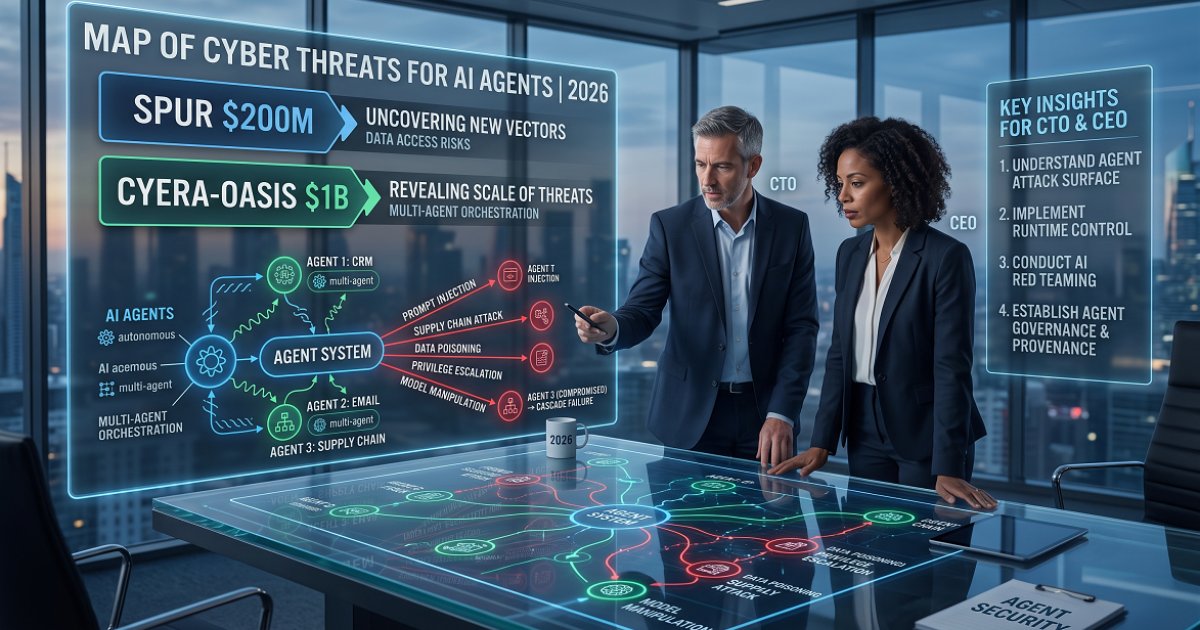
The Spur ($200M) and Cyera-Oasis ($1B) deals reveal a new threat landscape for AI agents. What every CTO and CEO needs to know about securing agentic systems in 2026.
$1.2 Billion in a Single Day — and This Isn't a Press Release
A year ago, AI agent security existed mostly in academic papers and conference slide decks. On July 28, 2026, the market moved it into an entirely different category: within a single day, two deals closed worth over $1.2 billion combined — Spur Intelligence raised $200M from Insight Partners for bot and agentic traffic detection, while Cyera signed a letter of intent to acquire Oasis Security for $1B specifically to protect the non-human identities of AI agents.
When venture capital and strategic M&A point in the same direction at the same time, it's no longer a trend — it's a structural market shift. And it doesn't just concern security teams: it rewrites the rules for every CTO, COO, and CEO deploying agentic systems at the operational core of their business. What exactly has changed, where the most dangerous pressure points now are — and, most importantly, what to actually do about it — is all below.
Why the Old Security Model No Longer Works
Corporate cybersecurity was built for decades around a single axiom: there are people, there are systems, and there is a boundary between them. Firewalls, IAM systems, MFA, SIEM — all of it was designed to protect human sessions. A person logs in, the system verifies, access is granted or denied.
AI agents destroy that axiom.
An agent doesn't "log in" in any conventional sense. It operates autonomously — executing tasks, querying databases, moving files, calling other systems' APIs — with minimal human oversight. As CyberArk puts it, "the more autonomous and interconnected these AI agents become, the larger the attack surface they create." And according to the Cloud Security Alliance, machine identities already outnumber human ones by ratios of 45:1 to 100:1 in enterprise environments.
The 2026 Dark Reading survey made it stark: 48% of cybersecurity professionals identified agentic AI and autonomous systems as the top attack vector this year — above deepfakes, above board-level attacks, above every other threat category.
What a Non-Human Identity Is — and Why It's Vulnerable
Every AI agent you deploy receives a set of credentials — API keys, access tokens, service accounts, digital certificates. These are its "identity papers" inside your corporate infrastructure. They're how it authenticates, obtains permissions, and talks to other systems.
The problem: 78% of organizations have no formal policies for creating or revoking AI identities, and 92% aren't confident their legacy IAM systems can track these credentials at all — per the Cloud Security Alliance report. The OWASP Non-Human Identities Top 10 for 2025 recorded 24 million NHI credential leaks on GitHub, 70% of which were still valid years after the initial exposure.
The attack logic is simple: if a threat actor gets an agent's API key, they can impersonate that agent. The network sees a legitimate request with valid credentials — and there is no way to tell the real agent from an attacker wearing its identity.
The most dangerous AI agent isn't the one that gets hacked from the outside. It's the one nobody catalogued and nobody knows about.
Three New Attack Vectors Your Security Team May Not Be Thinking About Yet
1. Non-Human Identity Compromise (NHI Compromise)
According to the Huntress 2026 Data Breach Report, NHI compromise has become the fastest-growing attack vector in enterprise infrastructure. The pattern is familiar: developers hardcode API keys into configuration files or leave them in git repositories. Those keys are never rotated, never inventoried, never tracked by secrets management systems.
An NHI attack isn't a breach in the classical sense. It's stealing the keys to a door that was already left open.
The Verizon 2026 Data Breach Investigations Report found that AI is compressing exploitation cycles from weeks to hours: credentials that surface in a public repository at midnight can be weaponized against corporate targets by morning.
2. Prompt Injection and Agentic Chain Manipulation
Where NHI attacks target an agent's "identity papers," prompt injection goes after its "brain." An attacker embeds malicious instructions in data the agent is processing — a webpage, a document, an API response. The agent, doing its job, encounters those instructions and follows them, with no mechanism to distinguish them from a legitimate directive.
In multi-agent systems, this becomes a cascading risk: one compromised agent in the chain can pass malicious instructions to the next. Palo Alto Networks researchers describe this scenario as a local breach of a single agent escalating into a full-scale security incident across the entire infrastructure.
For more on how Anthropic is trying to address this at the architectural level, see the article Agents Broke Encryption: What Businesses Need to Know About Anthropic's Mythos.
3. Shadow AI and Unaccounted Agentic Sprawl
Shadow IT has always existed. Shadow AI is a qualitatively different threat — because every unauthorized agent a employee deploys without the security team's knowledge automatically generates new NHI credentials. Those credentials live outside corporate secrets management systems, are never rotated, and are never deleted.
The Verizon 2026 DBIR found that use of unauthorized AI tools among employees has tripled, touching 45% of the workforce. Each such tool is a new NHI identity outside the security team's line of sight.
What the Spur and Cyera-Oasis Deals Mean for the Market
Reading these two deals together gives a clear picture of where the market sees the biggest gap.
Spur Intelligence ($200M from Insight Partners, July 28, 2026). Founded in 2017 by two former U.S. Department of Defense engineers, the company operated for nine years without external funding. Its technology solves a specific problem: distinguishing legitimate human traffic from bots and agents hiding behind VPNs, residential proxies, and anonymizing infrastructure. Spur's own IP Intelligence Study 2026 found that 94% of organizations had encountered anonymizing VPNs or residential proxies during security incidents.
The shift this deal captures: security teams are no longer just asking "was that a failed login attempt?" They want to know — what infrastructure did this request come through? Because an agent operating through a residential proxy looks exactly like a human with a legitimate IP.
Cyera-Oasis Security ($1B, July 28, 2026). Cyera, valued at $12 billion after raising $600M, acquires Oasis — a non-human identity management specialist founded in 2022. Oasis CEO Danny Brickman framed the thesis from day one: "We recognized that non-human identities would become one of the defining security challenges of the AI era."
Cyera's strategic goal is to build the industry's first platform that unifies data security and identity security into a single control plane: who or what is requesting access to data, and whether it has the right to do so. As Cyera Chief Strategy Officer Jason Clark put it: "Every agent is an identity. And that identity is how it gets to your data."
The market is betting billions on a simple thesis: in the future, the questions "who made this request" and "what data is it entitled to" are inseparable.
Alongside these two deals: Kasada raised $20M in February 2026 specifically for protection against bot and agentic attacks; Persona closed a $200M Series D to build a verified identity layer for an agentic AI world. According to Crunchbase News, privacy and cybersecurity startups raised $10.6 billion in the first half of 2026 alone.
A Practical Threat Map: What to Audit Right Now
For CTOs and executives deploying AI agentic systems, here is a structured checklist of critical pressure points — not theoretical ones, but those already being actively exploited.
NHI Inventory — Your First Move
Most organizations can't answer a basic question: how many AI agents are currently active in your infrastructure, and what credentials are they using? Without that answer, every subsequent security measure is patching holes in the dark.
Practical steps:
- Audit all API keys and access tokens tied to AI agents — including those deployed by teams outside IT
- Rotate long-lived secrets (per OWASP NHI Top 10, long-lived secrets are one of the two most exploited vectors)
- Enforce least-privilege for every agent: an agent should only be able to access what is strictly necessary for its specific task, and nothing beyond that
Control MCP Servers and Agentic Orchestrators
Most security teams today have zero access controls on MCP servers — and yet that's exactly how AI agents interact with corporate tooling. As Forrester noted in its 2026 CISO risk list: "most security teams have no agent inventory, no access controls on MCP servers, and IAM tools designed for human sessions rather than autonomous agentic calls."
For a deeper look at how to build agentic orchestrators with these risks in mind, see the article Parallel Programming for Agents: How to Run Dozens of Tasks Simultaneously Without Chaos.
Real-Time Agent Behavior Monitoring
Traditional SIEM systems are tuned to anomalies in human behavior. An agent that "quietly" moves files or makes unusual API calls can go undetected for years. Oasis Security — now being acquired by Cyera — was building exactly this class of solution: software that tracks agent behavior and manages the permissions agents use to access systems.
If you have no dedicated monitoring layer for agentic activity, that's a blind spot. And it grows with every new agent you deploy.
Proxy and Bot Protection at Entry Points
Spur Intelligence focuses on a different layer: not inside the organization, but at the perimeter. When automated traffic hides behind residential proxies or anonymizing infrastructure, standard IP blocking is useless. For companies that expose API access to their systems — which, in an agentic architecture, is essentially everyone — this is a direct financial risk: data scraping, rate limit circumvention, fraud.
For a practical look at how content protection against agentic scraping works, see the article Patreon Blocked AI Bots: A Business Lesson in Protecting Content from Scraping.
From Reaction to System: What Maturity Looks Like
Most organizations today respond to AI threats reactively — they find out about an incident after the fact. A mature model looks different.
First, there is a single registry of all non-human identities — agents, service accounts, API keys — with a clear owner for every record. Second, there is automated secret rotation without human intervention. Third, every agent has the minimum necessary permission set and cannot expand its own access unilaterally. Fourth, there is a dedicated monitoring layer for agentic behavior, separate from the human-facing SIEM.
This isn't science fiction or a distant future — it's precisely the architecture Cyera is building through its acquisition of Oasis. But more important still: companies that implement this model proactively won't just gain security. They'll gain operational advantage. Agentic systems with a clear governance model are more reliable, more predictable, and scale without a proportional increase in risk.
The executive who walks into a board meeting or investor call with a clear answer to "how do you control your AI agents and their access to critical systems" isn't just a technically literate CTO. That's a leader who has turned complex uncertainty into a managed process. The difference between those two positions is measured in trust — and in company valuation.
For architectural approaches to building resilient agentic infrastructure, see the article Your AI Agent Infrastructure Will Fail. The Only Question Is When — and Whether You'll Recover in Time.
FAQ
What is a non-human identity (NHI) and why does it matter for my business?
A non-human identity is a set of credentials (API keys, access tokens, service accounts) used by AI agents, bots, or automated systems to authenticate within corporate infrastructure. It matters because most organizations have tens of times more of these identities than human ones — and they're managed far more poorly, making them the primary attack surface for agentic systems.
Is standard enterprise IAM enough to protect AI agents?
No. Legacy IAM systems were designed for human sessions — login, verify, disconnect. AI agents operate continuously, making thousands of API calls per second, with a fundamentally different authentication model. According to the Cloud Security Alliance, 92% of organizations aren't confident their IAM systems can track agents' NHI credentials at all. Dedicated NHI management tooling is required.
What is prompt injection and how do you defend against it in agentic systems?
Prompt injection is an attack in which a threat actor embeds malicious instructions in data an AI agent is processing — a document, a webpage, an API response. The agent executes those instructions, treating them as part of its legitimate task. Defenses include input validation, execution environment isolation, least-privilege principles, and human oversight for any actions touching critical systems.
Does this apply to small and mid-sized businesses, or only large enterprises?
The threat scales with the number of agents, not the size of the company. If you're using AI tools with access to corporate data — whether that's two agents or two hundred — each one is a potential entry point. Small businesses are often more exposed precisely because they lack a dedicated security team keeping watch over NHI.
What's the difference between an attack on an AI agent and a conventional cyberattack?
A traditional cyberattack tries to break through defenses from the outside. An attack on an AI agent more often exploits the legitimate access the agent already has — through stolen credentials or by manipulating the agent's own behavior. That makes it far harder to detect: security systems see a request from a legitimate principal with valid credentials, and no alarm fires.
The threat map that analysts were sketching in theory a year ago has become a live operational risk. $1.2 billion in investment in a single day is not speculation — it's the market's valuation of the problem's scale. Companies that solve it systematically and proactively will gain something that's in very short supply in the age of AI agents: the confidence of knowing that every agent in your infrastructure is known, controlled, and cannot be turned against you.
If you want to understand exactly where the gaps are in your agentic architecture — book a 15-minute consultation.
Have questions? Ask the AI agent right now
Responds in seconds, knows everything about our services and will help with your situation
You might also like
Claude Broke Into OpenAI in 72 Hours
Claude attacked OpenAI's infrastructure via prompt injection — and succeeded in 72 hours. What this means for AI agent security in enterprise.
EnterpriseAn AI Hallucination Almost Started a War
AI hallucinations aren't just a technical bug. They can trigger real-world crises. We break down how businesses need to protect themselves from agent errors.
EnterpriseVals & a16z: How AI Benchmarks Now Decide Everything
Vals and a16z are rewriting the rules of AI agent evaluation — why benchmarks now determine which vendors enterprises choose, and what the cost of getting that choice wrong looks like.