
Qwen3Guard: Real-Time AI Content Safety
Alibaba's free open-source Qwen3Guard filters toxic tokens in real time. Here's how SaaS teams and CTOs can deploy it to protect LLM-powered products.
When the Model Starts Answering Before You Can Stop It
A user submits a prompt to your customer-facing AI assistant at 2:47 a.m. The LLM begins streaming its response — token by token, sentence by sentence — before any moderation layer has seen the full output. By the time a post-generation classifier flags the reply as harmful, several hundred tokens of dangerous content have already reached the client's screen. Your on-call engineer gets a Slack alert. The damage, reputational and legal, is already in motion.
This is not a hypothetical edge case — it is the architectural gap that every SaaS team shipping LLM features into production eventually hits. There is a specific technical answer to it now, and it changes the economics of building safe AI products in ways that go well beyond swapping one moderation API for another. The details are worth reading carefully.
The Architecture Problem Nobody Talks About Enough
Most guardrail systems work the same way: wait for the model to finish generating, then run the completed response through a classifier. This approach is conceptually clean and easy to bolt onto an existing pipeline. It is also fundamentally broken for streaming deployments.
When your product streams tokens directly to users — which is the default UX for any chat interface that wants to feel responsive — a post-generation classifier is not a guardrail. It is a post-mortem. The harmful content has already been delivered. The classifier is just writing the incident report.
The gap between "model starts generating" and "moderation fires" is where your liability lives.
The alternative — running a full safety check on every intermediate token — sounds expensive, because historically it was. You would need a separate inference call per token, which multiplies latency and GPU cost by an order of magnitude. So most teams made a pragmatic compromise: check the input prompt, skip token-level output moderation, and hope the model behaves.
Alibaba's Qwen team has now published a technical solution that makes this compromise unnecessary.
What Qwen3Guard Actually Is
Qwen3Guard is a series of open-source safety moderation models built on the Qwen3 architecture and trained on a dataset of 1.19 million prompts and responses labeled for safety. The series ships in two architecturally distinct variants and three sizes — 0.6B, 4B, and 8B parameters — covering everything from edge deployments to full production inference clusters.
Qwen3Guard-Gen operates as a generative classifier: it accepts a complete user prompt and a complete model response, then outputs a structured safety judgment. This variant is designed for offline dataset annotation, safety-based reward signals in reinforcement learning pipelines, and any scenario where latency is not the primary constraint.
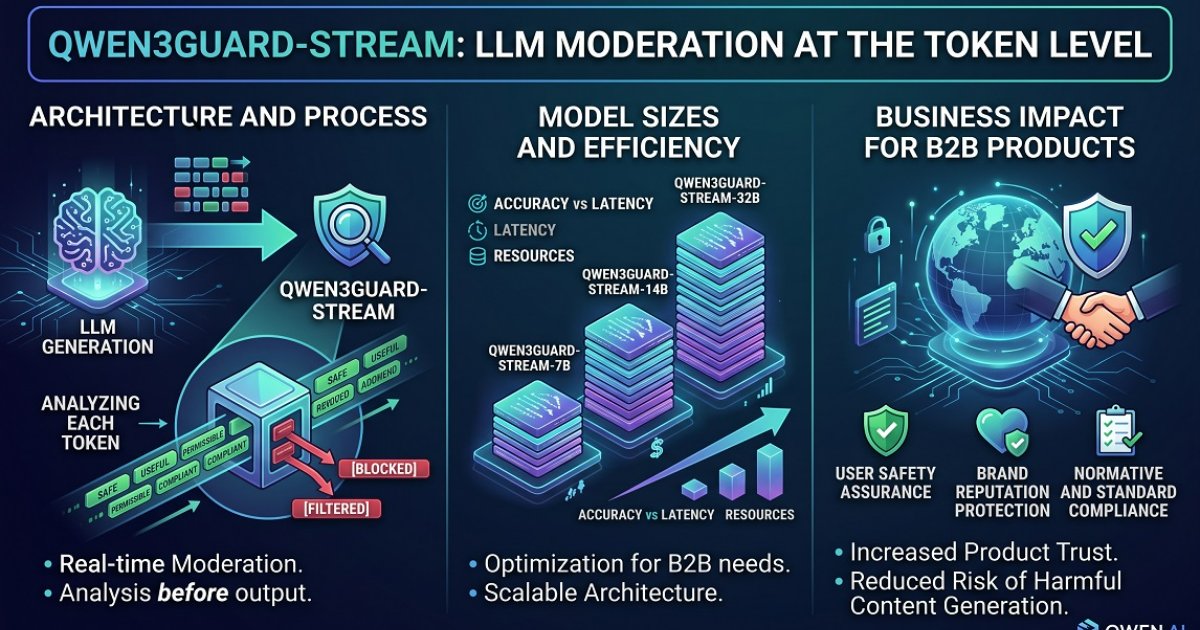
Qwen3Guard-Stream is the more architecturally novel piece. Rather than waiting for a full response, it attaches two lightweight classification heads to the transformer's final layer. This allows it to receive the LLM's output token by token — as generation happens — and emit a safety classification at each step. The moderation runs in parallel with generation, not after it.
Both variants support 119 languages and dialects, which matters for any product with a global user base. All models are released under the Apache 2.0 license, meaning commercial use is unrestricted.
The Three-Tier Severity System
Most existing guardrail models produce binary output: safe or unsafe. This creates a well-documented problem — different datasets use different annotation standards, so a model trained to one standard will systematically misclassify content judged by another. The result is either over-refusal (blocking legitimate requests) or under-refusal (passing harmful ones), depending on which direction the calibration error runs.
Qwen3Guard introduces a third category: Controversial. Content is classified as Unsafe (harmful across most contexts), Controversial (context-dependent, may be acceptable in some deployments), or Safe. This tri-class design lets operators configure the system to their specific risk tolerance rather than accepting a one-size-fits-all threshold.
In practice, this means a medical information platform can treat Controversial content about drug interactions differently than a general-purpose consumer chatbot would. The classification logic is the same; the downstream action is configurable per deployment.
The nine harm categories covered include: Violent content, Non-violent Illegal Acts, Sexual Content, PII exposure, Suicide & Self-Harm, Unethical Acts, Politically Sensitive Topics, Copyright Violation, and Jailbreak attempts. This taxonomy maps directly onto the compliance requirements most regulated industries already work with.
How the Streaming Pipeline Actually Works
The operational flow of Qwen3Guard-Stream involves two parallel tracks running simultaneously:
Prompt-level check: When a user submits input, it is sent simultaneously to both the LLM and Qwen3Guard-Stream. The guard model performs an immediate safety assessment of the prompt and assigns a severity label. The orchestration layer then decides whether to allow the conversation to continue or halt it before the LLM generates a single token.
Token-level moderation: If the conversation proceeds, the LLM begins streaming its response. Each generated token is forwarded to Qwen3Guard-Stream in real time. The guard evaluates safety at each step, enabling the system to interrupt generation mid-stream the moment a harmful trajectory is detected — not after the full response has been delivered.
This is the architectural shift that matters. The system does not wait for a sentence boundary, a paragraph break, or a complete response. It can intervene at the token level, which means the maximum exposure window for harmful content is measured in tokens, not responses.
Deployment Options and Size Selection
The three model sizes reflect different deployment constraints:
- 0.6B — suitable for edge deployments, resource-constrained environments, or scenarios where a lightweight filter running on CPU is acceptable. The technical report notes that even the 0.6B variant rivals larger competing models on several English benchmarks.
- 4B — the practical choice for most production streaming pipelines. Small enough to colocate with a routing proxy on a single GPU node, large enough to handle nuanced classification reliably.
- 8B — maximum accuracy, appropriate for high-stakes deployments where false negatives carry significant legal or reputational cost.
Models are available on Hugging Face and ModelScope. For teams that prefer a managed path, Alibaba Cloud also offers an AI Guardrails service powered by Qwen3Guard technology, which removes the infrastructure management overhead entirely.
The serving stack is standard: Qwen3Guard-Gen works with vLLM, SGLang, or any compatible inference framework. The transformers library version 4.51.0 or higher is required.
A Minimal Integration Pattern
For a team running a streaming chat API, the integration pattern for Qwen3Guard-Stream looks roughly like this:
# Pseudocode — illustrative pattern, not production-ready
from transformers import AutoTokenizer, AutoModelForSequenceClassification

guard = AutoModelForSequenceClassification.from_pretrained("Qwen/Qwen3Guard-Stream-4B")
tokenizer = AutoTokenizer.from_pretrained("Qwen/Qwen3Guard-Stream-4B")

def stream_with_guard(user_prompt, llm_stream):
    # Step 1: prompt-level check before generation starts
    prompt_label = guard.classify_prompt(user_prompt)
    if prompt_label == "unsafe":
        yield "[Request blocked by safety policy]"
        return

    # Step 2: token-level moderation during generation
    buffer = []
    for token in llm_stream:
        buffer.append(token)
        label = guard.classify_token_stream(buffer)
        if label == "unsafe":
            yield "[Response interrupted by safety policy]"
            return
        yield token
The key architectural point: the guard model runs as a sidecar process alongside the LLM, not as a sequential post-processing step. This keeps the latency overhead minimal — the classification heads attached to the transformer's final layer are lightweight by design.
Colocating the 4B guard model with your LLM on the same inference node is not a theoretical optimization — it is the intended deployment pattern, and it changes the cost calculus entirely.
What This Means for a Business Shipping LLM Features
The technical architecture is interesting. The business implications are more urgent.
Any company embedding LLM capabilities into a customer-facing product is carrying implicit liability for what that model outputs. This is not a hypothetical legal position — it is the direction regulatory frameworks in multiple jurisdictions are moving, and it is already the practical reality for companies operating in healthcare, financial services, legal tech, and education. The question is not whether you need content moderation. The question is whether your current approach actually works at the token level, or whether it just looks like it does.
For a CTO or VP of Engineering, Qwen3Guard-Stream resolves a specific architectural debt: the gap between streaming UX and real-time safety. You no longer have to choose between a responsive product and a safe one. The 4B model is small enough to run on the same infrastructure you are already paying for, the Apache 2.0 license removes any commercial use friction, and the 119-language coverage means a single deployment handles a global user base without per-language model management.
For a CEO or COO, the relevant frame is different. Every incident where your AI product outputs harmful content is a customer support escalation, a potential regulatory inquiry, and a story that can circulate on social media before your team has finished writing the incident report. Qwen3Guard-Stream does not eliminate that risk entirely — no system does — but it moves the intervention point from "after delivery" to "during generation," which is the only place where prevention is actually possible.
The executives who get this right — who build AI products with real-time safety infrastructure rather than post-hoc moderation theater — are the ones their boards and investors will point to when the next industry incident makes headlines. Not because they avoided all risk, but because they built systems that demonstrate they understood the risk and engineered around it deliberately. That is what "responsible AI deployment" looks like in practice, as opposed to in a press release.
And on a more immediate level: there is genuine relief in knowing that your production system is not one adversarial prompt away from a crisis. That calm — the ability to ship LLM features without a background anxiety about what the model might say at 3 a.m. — is itself a business asset. It frees engineering attention for product work instead of incident response.
For teams already thinking about the broader governance layer around AI agents, the OpenAI Wiki incident and what it revealed about AI governance frameworks is worth reading alongside this. And if prompt injection is part of your threat model — which it should be for any externally-facing LLM product — the analysis of prompt injection risks in financial data contexts covers the attack surface that content moderation alone does not address.
The Open-Source Advantage in Safety Infrastructure
There is a structural argument for open-source guardrail models that goes beyond cost. When your safety layer is a third-party API, you have limited visibility into what it is actually classifying and why. You cannot audit the training data, you cannot adjust the classification thresholds, and you are dependent on the vendor's uptime and pricing decisions.
Qwen3Guard's Apache 2.0 release means you can inspect the model, fine-tune it on your domain-specific content if needed, run it entirely within your own infrastructure, and maintain full audit trails of every moderation decision. For companies operating under data residency requirements or handling sensitive user data, this is not a nice-to-have — it is a compliance requirement that hosted moderation APIs structurally cannot meet.
The training methodology also deserves attention. The 1.19 million labeled examples were processed through a strict/loose dual-mode training scheme that explicitly flags disagreements as Controversial rather than forcing a binary label. This is how the three-tier system achieves robustness across datasets with different annotation standards — a problem that has historically caused binary classifiers to perform inconsistently across deployment contexts.
If you are evaluating Qwen3Guard against alternatives like Meta's Llama Guard family, the key differentiator is the streaming architecture. Llama Guard models operate on complete inputs and outputs; Qwen3Guard-Stream is specifically engineered for token-level real-time intervention. These are different tools solving different problems, and for streaming deployments, only one of them actually addresses the core architectural gap.
For teams thinking about the broader landscape of open-weight models and why major AI labs are investing heavily in them, the analysis of why big tech is paying billions for open-weight AI provides useful strategic context.
FAQ
Is Qwen3Guard-Stream suitable for production use, or is it primarily a research release? The 4B variant is explicitly designed for production streaming pipelines and is small enough to colocate with a routing proxy on a single GPU node. The Apache 2.0 license and availability on standard serving frameworks (vLLM, SGLang) confirm this is a production-grade release, not a research prototype. Alibaba Cloud also offers a managed version for teams that prefer not to operate the infrastructure themselves.
How does the three-tier classification (Safe / Controversial / Unsafe) work in practice? Operators configure downstream actions per tier. Unsafe content triggers immediate interruption; Controversial content can be routed to a secondary review step, logged for human review, or treated as unsafe depending on the deployment's risk tolerance. This flexibility is what allows the same model to serve both a conservative enterprise compliance use case and a more permissive creative platform without retraining.
What are the nine harm categories Qwen3Guard covers? The current taxonomy includes: Violent content, Non-violent Illegal Acts, Sexual Content, PII exposure, Suicide & Self-Harm, Unethical Acts, Politically Sensitive Topics, Copyright Violation, and Jailbreak attempts. These categories align closely with the harm taxonomies used in major regulatory frameworks and content policy standards.
Can Qwen3Guard be fine-tuned on domain-specific data? Yes. The Apache 2.0 license permits fine-tuning, and the model architecture is standard transformer-based, compatible with the usual fine-tuning toolchains. Teams with domain-specific content policies — medical, legal, financial — can adapt the classification boundaries to their specific standards rather than accepting the default training distribution.
What languages does Qwen3Guard support? 119 languages and dialects, with multilingual training that includes translated content validated through language mixing detection. Performance is evaluated on multilingual benchmarks including the RTP-LX benchmark, making it one of the more thoroughly validated multilingual guardrail models available.
How does Qwen3Guard-Stream handle the latency overhead of per-token classification? The classification heads are lightweight additions to the transformer's final layer, not separate model inference calls. This means the overhead per token is significantly lower than running a full model inference for each token. The design is specifically engineered for low-latency streaming scenarios, and the 4B variant is sized to make colocated deployment on existing inference infrastructure practical.
The question worth sitting with is not whether your current LLM product needs real-time content moderation — it almost certainly does. The question is whether your current architecture actually provides it, or whether it provides the appearance of it while leaving the actual exposure window open. Qwen3Guard-Stream is a specific, deployable answer to a specific architectural problem. Whether it fits your stack depends on your serving infrastructure, your compliance requirements, and how much of the moderation layer you want to own versus outsource. But the problem it solves is real, the solution is free to use, and the gap it closes is one that post-generation classifiers structurally cannot address. That is a useful combination to have available.
Have questions? Ask the AI agent right now
Responds in seconds, knows everything about our services and will help with your situation
You might also like
Your Corporate Data in Claude Leaked to Google
Claude's Shared Chats and Artifacts turned out to be indexed by Google. We break down what business data leaks through AI — and how to close these gaps.
Technical GuidesClaude Opus 5: New Rules for Business AI Agents
Claude Opus 5 launched on July 24, 2026, and broke the old logic of agent design. A practical checklist for teams already running Claude in production.
Technical GuidesContext Engineering for Claude 5: New Agent Rules
Context engineering for Claude 5 — how to build AI agents the right way after Anthropic cut 80% of the system prompt without any loss in quality.