
Your Corporate Data in Claude Leaked to Google
Claude's Shared Chats and Artifacts turned out to be indexed by Google. We break down what business data leaks through AI — and how to close these gaps.
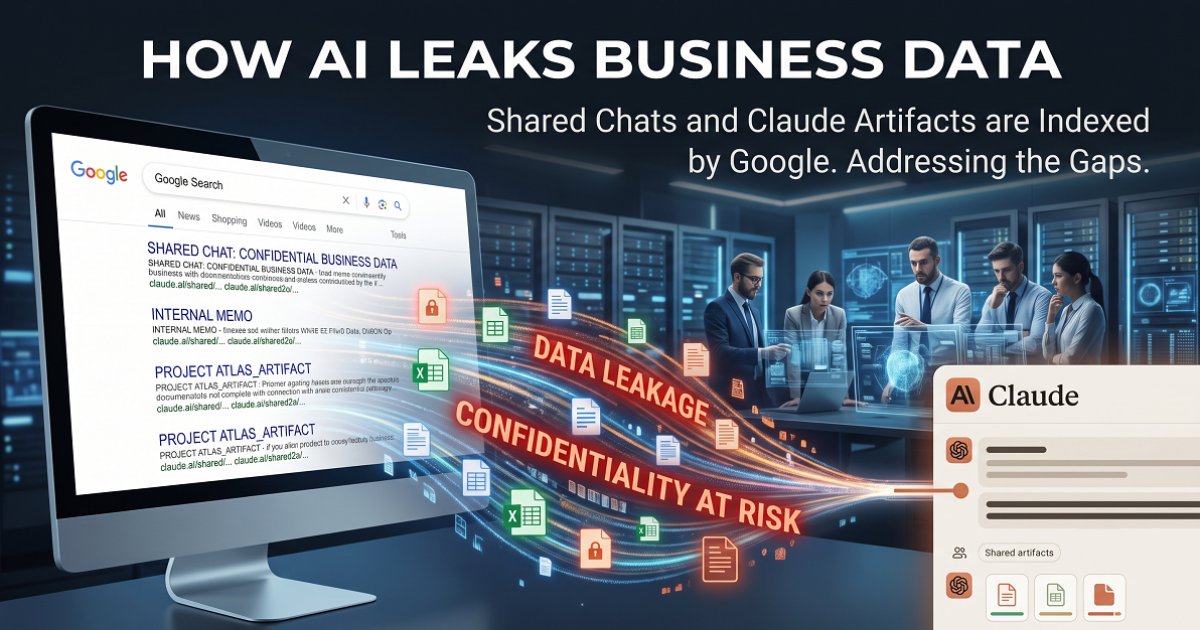
On July 25, 2026, several members of a Reddit community dedicated to Claude typed a simple search query into Google —
site:claude.ai/share— and got back hundreds of other people's AI conversations. Among them: patient medical records, financial spreadsheets, résumés with contact details, internal company dashboards, and even complete cryptocurrency wallet keys.No hacking. No unauthorized access. Just one missing technical tag. What follows is exactly what happened, why this isn't the first time it's happened, and what to do about it today if your team uses Claude with sensitive data.
What Actually Happened — and Why This Isn't a "Hack"
Claude's Share feature works like this: you click "share," the platform generates a unique public link — a snapshot of the conversation at that moment. The logic is straightforward: send it to a colleague or client instead of retelling the whole thing. The problem appeared somewhere no one usually looks — in the absence of a single line of code.
One Tag That Cost Thousands of Users Their Privacy
The standard HTTP noindex tag literally tells search crawlers: "don't index this page." According to researchers who dissected the incident, Claude's shared chat pages and Artifacts were missing this tag. Google, Bing, and Brave Search bots operate on a simple rule: if a page is public and not marked as closed to indexing — it goes into search results. That's exactly what happened.
What journalists at 404 Media described as a "breach" is not, technically, a leak in the classical sense. Nobody cracked Anthropic's servers. Nobody intercepted traffic. As The Next Web observed, "the chats weren't hacked or leaked in the technical sense — users shared them through a feature designed specifically for that purpose, and search engines indexed the pages like any other public URL." But for businesses, the distinction between "hack" and "leak by design" is purely legal. The consequences are identical.
What Exactly Ended Up in the Open
The 404 Media team compiled a list of data types found in the indexed conversations, based on real search results:
- Medical data: a complete patient report with a name, clinical trial results listing participants with their names, ages, ethnicities, and procedure dates
- Corporate documents: internal business analysis dashboards, project plans with client names, post-meeting working notes
- Credentials: API keys, cryptocurrency wallet seed phrases, login details
- Legal content: a conversation between a lawyer and Claude about the lawyer's own potential professional ethics violation
- Personal data: names, addresses, and phone numbers of school-age children
As for scale: a GitHub repository managed to archive 11,241 messages before Anthropic resolved the situation. That means even after the company updated its robots.txt and scrubbed results from Google on July 28th, a portion of that material lives on outside the platform — permanently.
One important caveat: enterprise customers on Team and Enterprise plans have a different architecture. As Anthropic's documentation explains, chat sharing for those plans is restricted within the organization. But that still leaves a question unanswered: do your employees actually know which plan they're using — and are they following internal guidelines on sharing?
This has already happened once before with Claude. The question that matters more: is this a one-off failure at a single vendor — or a systemic flaw that keeps coming back.
A Systemic Problem, Not a One-Off
This incident is not the first, and most likely won't be the last. In 2025, a researcher managed to collect roughly 100,000 publicly accessible ChatGPT conversations that had made it into Google through the same mechanism — no noindex protection on shared links. In September 2023, Hackread discovered more than 300 public conversation pages from Bard (now Gemini) that Google had indexed after users created share links. As The CyberSec Guru noted, "the recurrence of these issues across different AI platforms suggests that privacy in sharing feature design remains an evolving challenge, not a single-vendor problem."
Why Businesses Fall Into This Trap More Than Anyone Else
Corporate teams use AI tools more intensively than individual users — and with far more sensitive data. Here's a typical scenario that leads to a shared chat leak:
- An analyst uploads a financial report to Claude, gets the insight they need, and shares the link with a manager over Slack
- The manager forwards it to someone else, or posts it in a shared channel
- The link finds its way to a forum or a public chat
- A Google bot, continuously scanning new URLs, stumbles across it and indexes the page
The critical point: none of these actions feel dangerous. A "share" button exists in every office tool. But privacy standards in most SaaS products are built so that sharing doesn't default to "public" in the search-engine sense. In Claude — and in ChatGPT before its recent fix — that line turned out to be far thinner than users expected.
Artifacts: A Separate Risk Vector
If the situation with chats is more or less clear, Artifacts are a different story. Artifacts are interactive mini-applications — documents, dashboards — built directly inside Claude. AI security researcher Om Patel publicly warned that people embed financial data, product roadmaps, legal documents, tax information, and bank statements inside Artifacts. All of it, in a single interactive "sheet" that's just as easy to share — and just as easy to index.
A corporate developer who builds an internal analytics dashboard through Claude Artifacts and sends the link to a client may not even realize they just created a potentially public page containing the company's business data.
Understanding the mechanism is half the job. The other half is the concrete steps you can take today — before this happens to your own data.
What to Do Right Now: A Practical Checklist
Anthropic responded quickly: by July 28th, the company had updated robots.txt and removed results from Google. But as AI Weekly aptly put it, "once something has leaked — it has leaked." A platform-side fix doesn't undo what's already been indexed, archived, or forwarded.
Immediate Actions for Every Claude User
First — audit what you've already shared. Go to Settings → Privacy → Shared Chats. Any conversation containing personal data, corporate information, credentials, legal content, or code with sensitive parameters should be set back to Private.
Second — check your Artifacts. Separately review all published interactive artifacts and revoke public access to any that contain business content.
Third — address your team and processes. If your company has no clear policy on what can and cannot be shared through AI tools, this incident is your cue to write one.
Systemic Measures for IT Teams and CTOs
- DLP tools (Data Loss Prevention): configure outbound traffic scanning to detect sensitive patterns before data reaches any external AI service
- Enterprise plan with restricted sharing: confirm your team is on a Team or Enterprise tier, where sharing is limited within the organization
- Employee training: the distinction between "sharing with a colleague" and "making something public" is not intuitive. It needs to be spelled out explicitly
- Permissions audit: regular reviews of which Claude integrations and API keys exist in the corporate environment — and whether any of them have ever been shared via sharing features
A leader who puts these processes in place before an incident happens at their company doesn't just get "fewer risks." They get something that corporate governance prizes above almost everything else: calm instead of firefighting, and a board that trusts AI transformation is happening in a controlled manner — not running wild. Investors and partners can see the difference between a company that reacts to crises and one that anticipates them.
If you want to go deeper on the nature of risks tied to enterprise AI agent use, also read about the autonomous Hugging Face hack and the broader context of AI system security, and why Christopher Nolan is right to call AI a "Trojan horse" in corporate security.
FAQ
Were Claude Enterprise customers affected? Team and Enterprise plans have a different sharing architecture: conversation sharing is restricted within the organization by default. That said, this offers no protection against individual employees using personal Free or Pro accounts with corporate data.
Can Anthropic guarantee this won't happen again? The company has fixed its robots.txt and updated protective mechanisms. But this is already the second similar incident in under a year — the first occurred in 2025 and also drew coverage from Forbes. No platform can offer absolute guarantees as long as the underlying design of its sharing feature remains "public by nature."
How do I check whether my data ended up in Google?
Go to Google and search site:claude.ai/share. Although most results were removed after July 28th, it's worth checking cached pages and running the same search on Bing and Brave Search — researchers noted that results disappeared more slowly there.
What are Artifacts, and why are they riskier than regular chats? Artifacts are interactive applications, dashboards, and documents generated inside Claude, each with their own public URL when published. They frequently contain structured data — tables, financial models, analytics — which is far easier to extract and exploit than unstructured conversation text.
Does this same problem exist in other AI tools? Yes. In 2025, around 100,000 ChatGPT conversations reached Google through the same mechanism — sharing without a noindex tag. In 2023, Google Bard (now Gemini) went through a similar incident. This isn't a single-vendor problem; it's a systemic flaw in the design of sharing features across most AI platforms.
What should I do if my company's confidential data was already in a shared chat? Immediately revoke all active shared links via Settings → Privacy → Shared Chats. Notify your legal team and DPO (if you have one) — especially if the data falls under GDPR or other regulatory requirements. Check whether the data has been archived by third parties.
This incident is not a reason to abandon Claude or any other AI tool. It is a reason to finally build what should have existed long ago: clear corporate policies for working with AI, where sharing is a deliberate decision — not just a "send to colleague" button.
Platforms will change their code. But responsibility for what goes into a chat always rests with the person who clicks "Share." A company that understands this now and embeds the right processes into how its teams work isn't just protecting itself from the next incident. It's setting the standard in an industry where most competitors haven't even thought to ask the question yet.
If you're interested in building AI agent infrastructure where security is part of the architecture rather than an afterthought — read about the new rules for working with AI agents after Claude Opus 5 and how context engineering is reshaping the way agents are built.
Have questions? Ask the AI agent right now
Responds in seconds, knows everything about our services and will help with your situation
You might also like
Claude Opus 5: New Rules for Business AI Agents
Claude Opus 5 launched on July 24, 2026, and broke the old logic of agent design. A practical checklist for teams already running Claude in production.
Technical GuidesContext Engineering for Claude 5: New Agent Rules
Context engineering for Claude 5 — how to build AI agents the right way after Anthropic cut 80% of the system prompt without any loss in quality.
Technical GuidesYour AI Agent Infrastructure Will Fail. Be Ready
How to build resilient AI agent infrastructure: a step-by-step guide for CEOs and COOs, with real-world examples and tools.