
Satya Nadella's Warning: Diversify Your AI Stack
Nadella coined the term "Reverse Information Paradox": companies are paying for AI twice. What multi-agent architecture is — and how it protects your business.
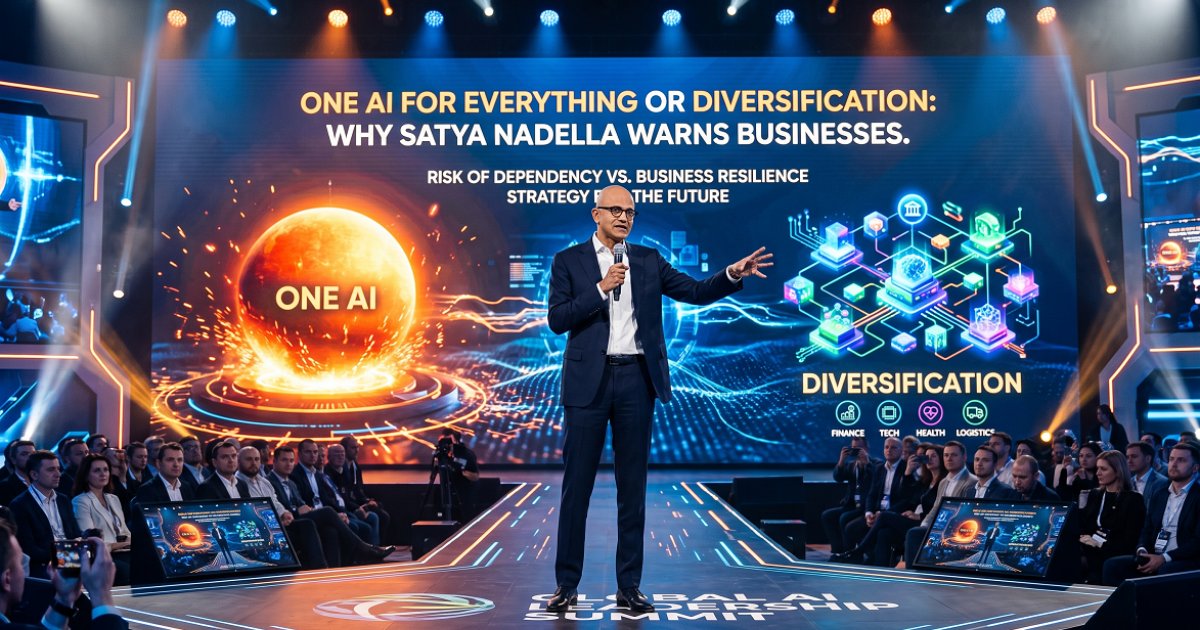
The Warning That Costs More Than a GPT Subscription
Companies that rely entirely on a single AI provider for their needs will ultimately not survive — so declared Satya Nadella, CEO of Microsoft, in a public CNN appearance in July 2026. He introduced the concept of the "Reverse Information Paradox": every time your team uses someone else's model, they're not just getting answers — they're giving a competitor a free education in exactly how your business makes decisions.
For a business owner or CEO, this isn't an abstract threat from a tech podcast. It's a question of who actually owns your company's intellectual capital — and what happens when a single provider disappears, rewrites its terms, or simply decides to enter your market with a product it trained on your own data. What to do about it — and which architecture gives you real control — is laid out in detail below.
You're Paying Twice — and You Don't Even Know About the Second Bill
Conventional business logic says: you pay for a subscription, you get a tool. Nadella showed that in the AI era, that model is broken.
In a post published on X on July 12, 2026, he named the problem the "Reverse Information Paradox." The mechanics are simple and ruthless: every time an employee corrects a model's mistake, refines a prompt, or rates a response, they're digitizing years of corporate experience. These corrections aren't trivial. They reveal how your finance team interprets exceptions, how your operations team diagnoses failures, which cases your organization considers genuinely hard. That's knowledge a competitor couldn't buy at any price.
According to Nadella, the company "pays for intelligence twice": the first payment is the subscription; the second is the institutional knowledge that slowly seeps to the model provider through daily interactions.
The most valuable asset isn't the model itself. It's the private learning loop that forms around it — prompts, corrections, agent traces, and operational logic that together encode the real DNA of your business.
Nadella also put a clear time horizon on the risk: once an AI lab accumulates enough understanding of your industry across thousands of clients, nothing stops it from launching its own competing service. It's the same danger the startup world has discussed for years — what's stopping a model provider from simply copying your product?
Why This Isn't Just a Big-Corporation Problem
Mid-sized businesses are actually at greater risk than enterprise. A large company has a legal team that will read the fine print, and a CTO who will build an isolated environment. At a company of 50–200 people, those decisions often get made on the basis of "we plugged it in because it was convenient" — and within a year, all the operational logic has ended up in someone else's hands.
What's Wrong With the "One AI for Everything" Approach
Think of a company's operational stack as an electrical grid. If the entire building runs off a single breaker — any outage cuts power to everything. That's exactly how single-provider AI dependency works.
Nadella described a concrete scenario: a company uses the bundled tools of one AI lab — the model, the context, the memory, the coding harness — all from one vendor. It's convenient, for now. But the moment that provider changes its terms, raises prices, or simply discontinues support for a specific tool, the company finds itself with no fallback, no accumulated context of its own, and no way to switch to an alternative quickly.
He stated the solution plainly: "By separating the harness from the model, and the context and memory from the model, you can use multiple models according to their strengths. Any one model can disappear — and you keep control of your own destiny."
There's also a knowledge dimension to the problem. Companies that have embedded all their operational logic into a single AI stack aren't just technologically vulnerable — they're losing the ability to learn. The tools a business uses every day should be enriching the company's internal knowledge base, not the provider's external one.
Vendor Lock-In, Reinvented
The technology industry has been through this before — with cloud providers, with CRM systems, with ERP. But AI dependency cuts deeper: you're not just handing over data, you're handing over your logic of thought. A cloud provider doesn't understand how your business makes decisions. An AI model provider learns to.
Multi-Agent Architecture: From Concept to Competitive Advantage
The answer to mono-dependency isn't diversification for its own sake — it's structured diversification through multi-agent architecture.
According to Gartner, the number of enterprise inquiries about multi-agent systems grew by 1,445% between Q1 2024 and Q2 2025. By the end of 2026, an estimated 40% of enterprise applications will incorporate specialized AI agents — compared to fewer than 5% just two years earlier.
The core of the architecture is straightforward: instead of one "all-knowing" AI trying to handle every task, you build a network of specialized agents. A planning agent breaks down the task. A research agent gathers information. An execution agent runs the processes. A verification agent checks the output. A compliance agent monitors regulatory adherence.
Multi-agent architecture is not merely a technology decision. It's an organizational structure where every agent has a defined role, and no single provider holds all the strings.
Each agent can run on a different model — whichever one performs best for that specific task. Claude might be exceptional at analyzing legal documents. GPT-4o might excel at generating marketing copy. A specialized open-source model deployed locally might handle sensitive financial data without sending it anywhere outside your walls.
Three Levels of a Multi-Agent Strategy
Level one — AI Gateway. A central gateway through which all AI model interactions pass. It logs metadata, stores prompts and traces within the company's own infrastructure — not the provider's. Nadella was insistent on this point: every interaction with a model must leave a footprint in your environment, not someone else's.
Level two — Decoupled memory and context. Context and memory are stored independently of any specific model. That means if your current provider disappears tomorrow or quintuples its prices, you switch to a different model without losing the accumulated corporate knowledge.
Level three — Task-based specialization. Different models for different jobs. Regulated processes — compliance, legal analysis, financial calculations — run on locally deployed or privately hosted models with full audit control. Creative and communication tasks go to the best available frontier models. Routine classification and routing runs on lightweight, low-cost models that don't demand heavy compute.
This approach delivers not only protection from vendor lock-in but measurable operational advantage: multi-agent systems reduce execution time on complex tasks through parallel processing. Instead of a single agent sequentially searching, analyzing, and verifying — several agents do this simultaneously, then synthesize the results.
Navigating the architecture of such a system requires an understanding of parallel programming for agents — without it, coordinating across dozens of agents becomes chaos rather than an advantage.
A Practical Roadmap: Moving From Mono-Dependency to a Resilient Architecture
The transition doesn't have to be radical. Companies that already have AI infrastructure can move incrementally — but they need to move deliberately.
Step 1: Audit Your Current Dependencies
The first step is mapping. Which processes currently depend on a single AI provider? Where is your context and memory stored in someone else's infrastructure? Which workflows would stop functioning if a provider changed its terms or shut down its service?
The answers to these questions often surprise even technical directors: the dependency turns out to be far deeper than it appeared.
Step 2: Isolate Critical Data
The most sensitive data — operational logic, process exceptions, decision-making patterns — must be handled in a controlled environment. This could mean a privately deployed open-source model, or a closed enterprise environment with guarantees that your interactions are not used to train someone else's models.
This issue connects directly to how resilient AI agent infrastructure is designed: fault tolerance and data control are two sides of the same decision.
Step 3: Deploy an AI Gateway
An AI Gateway is the central element of any multi-agent strategy. It serves several functions simultaneously: routing requests to the appropriate models, logging all interactions within your own infrastructure, enabling performance comparisons across different models on real tasks, and providing an audit trail for compliance.
Without a gateway, every AI interaction is a black box. With one, it becomes a source of data for decision-making.
Step 4: Progressively Specialize Your Agents
You don't need to build a full multi-agent system in a single quarter. The practical approach: start with one process where the benefit of specialization is obvious. For example, separate the contract analysis agent from the communications agent — and measure the difference in quality and speed.
Understanding how to calculate the break-even point for an AI agent gives a CEO a clear financial argument for making the transition — no gut calls, just numbers.
Those who build a diversified AI architecture today gain more than technological resilience — they accumulate a private learning loop that grows more valuable as a balance-sheet asset with every passing month.
Risks That Won't Resolve Themselves
Multi-agent architecture is not a silver bullet. A more complex system carries its own risks: coordinating between agents demands quality orchestration, more entry points mean a wider attack surface, and a growing roster of models makes auditing harder.
Researchers are already documenting risks specific to multi-agent systems: when an orchestrator agent directs executor agents, questions arise about accountability for decisions and how to verify that the system behaves predictably. This is explored in more depth in the piece on autonomous hacking and AI agent risks.
The answer isn't to abandon agent autonomy — it's to build it with the right guardrails. McKinsey's 2025 global survey found that 88% of organizations regularly use AI in at least one business function, but only 23% are already scaling agentic AI — meaning most are still building with minimal visibility into what's happening inside the system.
What "Token Capital" Is — and Why CEOs Should Care
Nadella introduced the concept of "token capital" — proprietary AI capabilities that layer on top of a company's human expertise rather than replacing it. The idea is that a company should be building its own AI assets: fine-tuned models trained on its own data, internal knowledge bases enriched through AI interactions, agentic workflows that encode unique business processes.
This is the next-level competitive advantage: not "we use ChatGPT too," but "our AI system understands our business as deeply as our best managers do."
A leader who builds that kind of system gains not just operational efficiency — they gain an asset that's genuinely hard to replicate. Boards and investors are increasingly asking not "do you have AI?" but "do you have an AI strategy that protects your IP and scales without proportionate growth in risk?" The answer to that question is what separates a leader who's seen as chasing a trend from one who's building a predictable, defensible business.
Frequently Asked Questions
What is multi-agent architecture, in plain language? It's an approach where, instead of a single AI tool trying to do everything, a company builds a network of specialized agents, each responsible for a specific task. They can run on different models, work in parallel, and interact with one another through an orchestrator. The result is a system where one component failing doesn't bring down the whole thing, and every part is optimized for its own job.
Why is Nadella warning against dependence on a single AI provider? Because a company locked into one model is at risk on two dimensions: operationally — if the provider changes its terms or disappears; and strategically — because daily AI interactions transfer operational know-how to an outside party. Nadella called this the "Reverse Information Paradox": you're paying for AI in money while simultaneously training a foreign model to understand your business.
Where do you start building a multi-agent strategy? Start with a dependency audit: which processes are fully tied to one provider, and where is your context stored in someone else's infrastructure. Then isolate your most sensitive data in a controlled environment and deploy an AI Gateway for centralized interaction logging. Build the full multi-agent system gradually, starting with the one process where the benefit is most obvious.
Does a multi-agent approach work for mid-sized businesses, not just enterprise? Yes — and mid-sized businesses are actually at greater risk, precisely because they less frequently have the legal and technical resources to protect against vendor lock-in. A basic AI Gateway and isolation of critical processes are achievable even on a limited budget. A concrete ROI calculation is an important argument for making that decision at the CEO level.
What frameworks are used to build multi-agent systems? As of 2026, the mature, production-ready options include LangGraph and CrewAI for agent orchestration, Microsoft Semantic Kernel for enterprise integrations, and Google ADK and the OpenAI Agents SDK. The choice depends on requirements: LangGraph offers maximum control and flexibility through graph-oriented workflows; CrewAI is more intuitive for team-oriented scenarios.
Nadella said publicly what the industry had only been whispering: AI dependency is the new form of corporate risk, and companies that fail to build their own controlled AI stack will, at some point, find that their most valuable asset has long since passed into someone else's hands. Multi-agent architecture is not a technology trend. It's an answer to a concrete strategic question: who controls the intelligence of your business — you, or your vendor? Companies that answer that question now and build the corresponding infrastructure are laying a foundation that will be very hard for competitors to close the gap on.
Have questions? Ask the AI agent right now
Responds in seconds, knows everything about our services and will help with your situation
You might also like
Claude Broke Into OpenAI in 72 Hours
Claude attacked OpenAI's infrastructure via prompt injection — and succeeded in 72 hours. What this means for AI agent security in enterprise.
EnterpriseAn AI Hallucination Almost Started a War
AI hallucinations aren't just a technical bug. They can trigger real-world crises. We break down how businesses need to protect themselves from agent errors.
EnterpriseVals & a16z: How AI Benchmarks Now Decide Everything
Vals and a16z are rewriting the rules of AI agent evaluation — why benchmarks now determine which vendors enterprises choose, and what the cost of getting that choice wrong looks like.