
AI Agent in the Taxpayer's Cabinet: How to Prepare
AI agent in taxpayer's personal cabinet is no longer science fiction. What the state is preparing, what risks await business, and how not to fall behind.
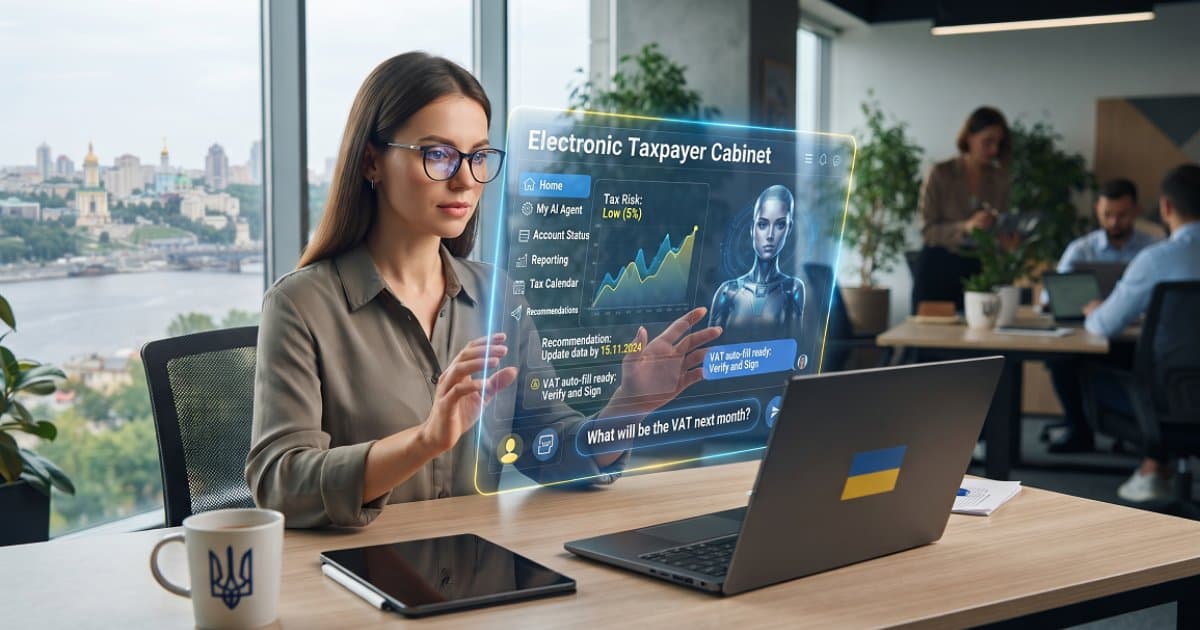
Most businesses will encounter the AI tax agent unprepared — and that's their own choice
If you still believe that an AI agent in the taxpayer's personal cabinet is something from the distant future, I have bad news for you: the future is already knocking on the STS door. While some entrepreneurs wait for an official order "from above," others are already testing pilot integrations, automating reporting, and learning to communicate with government systems in the language of APIs.
The question is not whether AI will appear in business-tax interaction — it's already appearing. The question is whether your company will be ready when it becomes the standard. Small and medium business owners in Ukraine are used to reacting to changes after the fact: first panic, then emergency implementation, then fines during the transition period. This time you can play it differently — if you start thinking about it now.
In this article, we'll break down what's actually happening with STS digitalization, what opportunities and risks the AI agent for taxpayers brings, and how small and medium businesses can not just survive in the new reality, but use it as a competitive advantage.
What's already happening: STS digitalization and first steps toward AI
Taxpayer's Personal Cabinet: where we are now
The taxpayer's personal cabinet has existed in Ukraine since 2017, but only in the last two years has it transformed from an inconvenient portal into a full-fledged ecosystem. Today, through it you can submit declarations, receive statements, check your settlement status with the budget, register tax invoices.
But this is only the foundation. The STS is actively moving toward intelligent automation: the risk system for tax invoice registration (SMKOR) already uses machine learning algorithms to detect suspicious transactions. This is the direct predecessor of the AI agent that will communicate with you instead of an inspector.
What "AI agent" means in the context of STS
An AI agent in the state taxpayer's cabinet is not just a chatbot that answers typical questions. It's an autonomous system that can:
- Analyze your financial reporting in real time
- Identify discrepancies between declared data and information from counterparties
- Automatically generate requests for explanations or initiate inspections
- Provide personalized recommendations on advance payments
- Warn about future obligations based on analysis of operational activities
According to the Ministry of Digital Transformation, by 2026 it's planned to integrate AI analytics elements into the taxpayer's cabinet for automatic pre-filling of declarations based on data from cash registers, bank statements, and customs declarations. This isn't a press release — it's already included in the Dia.Biznes roadmap.
The provocative truth: an AI tax agent might be better than a human one
Here most entrepreneurs expect me to write about threats, pressure, and surveillance. But there's a flip side that few people discuss openly.
Why automating control is not just a threat
The human factor in tax — this is corruption, subjectivity, unpredictability, and plain incompetence of individual inspectors. An AI agent doesn't take bribes. It has no "own" inspectors. It applies the same rules to everyone — large holdings and sole proprietors alike.
For small and medium businesses operating honestly, this potentially means:
- Fewer selective inspections based on personal connections
- Transparency of risk criteria: if the system shows why you were selected — you can fix it
- Faster VAT refunds: automatic verification without waiting for "the right" companies
- Predictability: an algorithm is not a bureaucrat's mood
Of course, there's a dark side. An algorithm trained on data from a corrupt system will reproduce bias in digital form. This is a real risk that needs to be discussed publicly. But burying your head in the sand and ignoring the transformation is an even worse option.
International experience: where AI in tax authorities already works
Estonia has automated over 95% of tax declarations — an entrepreneur simply confirms a pre-filled form. Portugal implemented an AI system to detect shadow economy, analyzing the gap between declared income and consumer patterns. Australia uses AI to automatically match employer and employee data.
Ukraine is moving in the same direction — just with characteristic delays and turbulence.
How the AI agent will change the daily work of accountants and entrepreneurs
Three scenarios of business interaction with the AI cabinet
Scenario 1: Passive monitoring. The AI agent analyzes your transactions in the background. If it detects an anomaly — it sends an automatic message to your cabinet. You have 10 business days to explain. This is already partially implemented through SMKOR.
Scenario 2: Proactive assistant. You ask the AI agent: "How much VAT should I pay next quarter if my revenue stays at this level?" — and you get an answer based on your company's real data, not general tables.
Scenario 3: Autonomous audit. The STS AI agent independently matches your data with counterparty data, customs, banks. If it detects a discrepancy — it automatically generates an act. A human inspector is involved only for the final decision. That's where we're headed.
What will change for accounting departments
Accountants who currently spend 60% of their time on manual data entry and reconciliation face a choice: learn to work with AI automation tools or give way to those who already can. This is not a catastrophe — it's evolution of the role. The accountant of the future is an analyst and consultant, not a 1C operator.
By the way, if you're interested in how AI is already changing not just accounting, but other internal company processes — look at a real case of AI agent implementation in HR with automated onboarding. The patterns are very similar.
How to prepare your business: a practical 6-month plan
Step 1: Digital readiness audit (months 1-2)
The first thing you need to do is honestly assess where you are now:
- Do you have a single accounting system with current data, or is data scattered across Excel spreadsheets and paper folders?
- Are your cash register data synchronized with the accounting system in real time?
- Do your counterparties have current details and are primary documents properly executed?
- Does your accountant use the taxpayer's personal cabinet regularly, not just once a quarter?
If the answer to three of the four questions is "no" — you're already in the risk zone, even without the STS AI agent.
Step 2: Data centralization (months 2-4)
Without a unified database you won't be able to either automate interaction with government systems or protect yourself from algorithmic inspections. Investment in a proper accounting system is no longer a luxury, it's hygiene.
Important: the system must support API integration with external services. Most connections with government registries and the taxpayer's cabinet will be built through APIs. If your accounting software from 2008 doesn't support this — it's time to think about migration.
Also, it's worth studying how AI automation helps medium business grow without increasing staff — the principles of data centralization are described there in detail.
Step 3: Team training and implementation of AI tools (months 3-6)
This is the most important and most underestimated step. Most entrepreneurs think of AI as a "button" you press and everything works. In reality, implementing AI agents is about changing processes and team thinking.
Specific actions:
- Train your accountant and financial director to use the expanded functionality of the taxpayer's personal cabinet — most of them don't use even 30% of available features
- Implement an internal AI tool for pre-checking declarations before submission — such solutions are already on the market
- Set up automatic alerts about legislative changes — AI agents for monitoring regulatory base cost from a few hundred hryvnias per month
- Test automatic data matching with your counterparties quarterly, before the STS does it
On how important it is to correctly assess the limits of AI automation and not fall into extremes, well written in the article about partial vs full automation and the role of AI agents in 2026.
Step 4: Legal preparation
The STS AI agent is a new party to your legal relationship with the state. And this raises questions that the legal community hasn't even fully formulated yet:
- Who is responsible for an algorithm error?
- How do you appeal a decision made by AI without human involvement?
- What are business rights in automated audits?
Advice: consult with a lawyer now about updating internal regulations for document retention. In the era of AI inspections, evidence is digital data, not paper.
Risks no one talks about: the dark side of AI in government
Algorithmic bias and small business
AI systems learn from historical data. If that data reflects corrupt practices of "manual" risk management — the algorithm will reproduce this bias at scale. Small businesses without resources for legal protection may become easy targets for automated fines.
This is a real threat, and business associations should demand transparency of algorithms and public audits of STS risk management systems. Silence here equals consent.
Cyber threats for business in the era of AI integrations
The more your business is integrated with government systems through APIs — the wider the attack surface. Malicious actors are already trying to compromise accounts in the taxpayer's cabinet to manipulate VAT. With the advent of AI agents that will have more autonomous powers, the stakes will rise.
On how to protect your business from new generation AI threats, read in the material about autonomous AI attacks and business protection methods.
Dependence on a single technology provider
If the state chooses one provider of AI solution for the taxpayer's cabinet — that's a monopoly with all its consequences: vulnerability to failures, lack of competition for quality, risk of abuse. Business must advocate for open standards and the right to independent audit.
FAQ: Most common questions about AI in taxpayer's cabinet
Will an AI agent replace a live tax inspector in Ukraine? Not completely and not in the near future. The AI agent automates routine inspections and communication, but complex cases, appeals, and court proceedings will require a person. A realistic horizon for partial replacement of routine functions is 3-5 years.
When exactly will the STS implement a full-fledged AI agent in the taxpayer's cabinet? There are no official dates, but the STS digitalization roadmap provides for AI analytics elements already in 2025-2026. Some functions (automatic risk management, form pre-filling) are already partially implemented or being tested in pilot mode.
Is it safe to give the AI agent access to a company's financial data? It depends on the system architecture and security level. The state is obligated to ensure compliance with cybersecurity requirements, but business must independently ensure two-factor authentication, access restrictions, and regular API connection audits.
How should small business (sole proprietor 2-3 group) prepare for AI inspections? First priority — synchronize cash register data or software cash register data with the accounting system and verify the relevance of all counterparty details. Even small data gaps become noticeable to an algorithm that doesn't care whether you're a sole proprietor or a corporation.
Can the STS AI agent automatically block accounts without a court decision? Under current law — no. Account blocking requires either a court decision or a decision of the controlling authority in clearly defined cases. But legislation changes, so it's important to monitor changes to the Tax Code regarding automated decisions.
Whoever Prepares Today Wins Tomorrow
An AI agent in the taxpayer's personal cabinet is neither a threat nor salvation in itself. It's a tool whose effectiveness depends on how well a business is prepared to work in a digital environment. Companies that are already investing in data centralization, team training, and building AI-automated processes will meet the new reality as an opportunity — not as a fire to put out.
Don't wait for an official order. Preparing for AI interaction with the state is a strategic decision that's made now, with results felt in a year or two. If you want to figure out where to start in your specific business — get a consultation: together we'll identify vulnerabilities and build a digital readiness roadmap.
And now an honest question for you: do you see the AI tax agent as a threat or a chance for a business operating honestly? Do you have experience interacting with automated STS systems — positive or negative? Write in the comments — this discussion is important, and your experience can help other entrepreneurs make the right decision.
Have questions? Ask the AI agent right now
Responds in seconds, knows everything about our services and will help with your situation
You might also like
AI Agents in SMS & Messengers: Sales Playbook
AI agents living inside SMS and messengers are reshaping sales and support. Real business scenarios, ROI estimates, step-by-step setup guide, and key risks.
AutomationGemini 3.8 Live Avatar: Video Agents for Business
Google's Gemini 3.8 Live with Live Avatar brings real-time video agents to enterprise. See how video AI transforms customer service, training, and sales.
AutomationHow to Choose an AI Agent Vendor: Business Checklist
A practical checklist for CEOs and COOs on how to choose an AI agent development vendor — with red flags, key criteria, and a real case with numbers.