
Ringostat Voice AI Agent: Automating Thousands of Calls
Ringostat voice AI agent — a step-by-step guide for Ukrainian businesses: setup, CRM integration, real case studies, and ROI from call automation.
Why Your Call Center Is Already Struggling — and What to Do About It
Imagine: Monday, 9:00 AM. 47 waiting customers on hold, three operators juggling calls simultaneously, and the queue isn't shrinking. By noon, your company loses 15–20% of potential sales simply because people couldn't wait for an answer. This is exactly the pain point that made most Ukrainian entrepreneurs curious about Ringostat's voice AI agent.
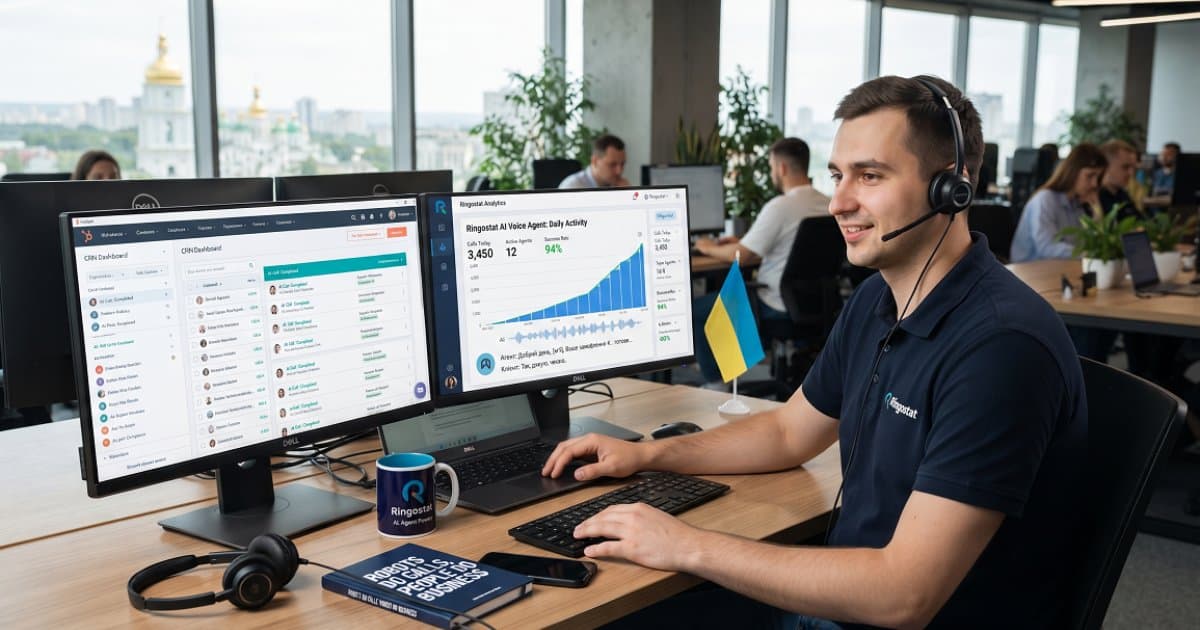
Ringostat is a well-known Ukrainian telephony and call analytics tool that significantly expanded its AI capabilities in 2024–2025. Now, on top of your standard PBX, you can deploy a full-fledged voice AI agent that conducts conversations in natural language, answers questions, qualifies leads, and records data directly into your CRM — without human operator involvement. In this article, we'll walk through step-by-step how to implement this solution in small and medium-sized businesses in Ukraine, what results to expect, and what to pay attention to during setup.
What Is a Voice AI Agent and How Does It Differ from Traditional IVR
From Tone-Based Menus to Full-Fledged Dialogue
Traditional IVR (Interactive Voice Response) is a set of recorded phrases and branches: "Press 1 if you are a new customer." It's rigid, limited, and frustrating. A voice AI agent is a fundamentally different class of technology.
Architecturally, it consists of three components:
- STT (Speech-to-Text) — converts the customer's speech to text in real time
- LLM (Large Language Model) — understands context, generates responses according to a given scenario and knowledge base
- TTS (Text-to-Speech) — voices the response in a natural-sounding voice
The entire cycle takes 1–2 seconds, so the conversation feels natural. The customer can interrupt, ask clarifying questions, change topics — the agent adapts.
Key Differences from Chatbots and IVR
| Criterion | IVR | Chatbot | Voice AI Agent |
|---|---|---|---|
| Channel | Voice | Text | Voice |
| Scenario Flexibility | Low | Medium | High |
| Context Understanding | None | Partial | Complete |
| CRM Integration | Limited | Yes | Yes |
| Scalability | Yes | Yes | Yes |
For a business where customers are accustomed to calling (and in Ukraine that's the majority of sectors — from healthcare to automotive), a voice agent becomes a natural extension of the familiar communication channel. You can learn more about how AI agents are already embedded in popular business tools to understand the scale of this trend.
Ringostat AI Agent: Platform Architecture and Capabilities
How the System Works Inside
Ringostat provides telephony infrastructure — phone numbers, PBX, call recording, analytics. On top of this layer, an AI agent is connected that processes incoming or makes outgoing calls. The platform allows you to:
- Customize the agent's unique voice and tone (professional, friendly, neutral)
- Upload a knowledge base — price lists, FAQs, delivery terms, sales scripts
- Set up conversation scenarios with conditional branches
- Transfer calls to a live operator in complex cases (escalation)
- Automatically record call results in CRM (Bitrix24, HubSpot, Pipedrive, and others)
What the Agent Can Do in Practice
Here are specific tasks the Ringostat voice AI agent solves without human involvement:
- Incoming calls: answering typical questions (price, availability, hours, delivery terms)
- Lead qualification: determining budget, timeline, and needs before handoff to a manager
- Order confirmation: automated callback reminders for delivery or appointment booking
- Feedback collection: NPS surveys after purchase or contact
- Customer reactivation: outbound calls with personalized offers based on your database
This isn't science fiction — similar approaches are already being used at scale in AI automation for medium-sized businesses across Ukraine.
Step-by-Step Implementation Plan for Ringostat Voice AI Agent
Step 1. Audit Your Current Telephony and Identify Priority Scenarios
Before automating anything, you need to understand what's taking the most time from your operators. To do this:
- Export call statistics for the last 30 days from Ringostat or your PBX
- Categorize topics: price inquiries, order status, returns, appointment booking, etc.
- Select 2–3 categories accounting for >40% of time — start with those
Rule: automate repetitive, predictable scenarios first. Save complex, emotional situations for human operators.
Step 2. Prepare Your Knowledge Base and Scripts
This is the most important and most underestimated step. 80% of the agent's performance depends on the quality of the knowledge you upload.
What you need to prepare:
- FAQ in structured format — question + answer (minimum 50–100 pairs to start)
- Current price list in text or table format
- Main scenario script — how the agent greets, what it asks, how it responds to refusals
- Escalation triggers list — which phrases or situations should switch to a human operator
Practical tip: record 20–30 real calls from your best managers. Listen carefully, highlight their most successful phrases and structure — that's the basis for your script.
Step 3. Technical Setup in Ringostat
The setup algorithm in the platform interface:
- Enable the AI module in settings (available on plans with AI features)
- Select voice and language — Ringostat supports Ukrainian and Russian
- Upload your knowledge base — through the built-in editor or API integration
- Configure SIP routing: incoming calls to number → AI agent → (if needed) operator
- Set the agent's working hours: 24/7, only after-hours, or in parallel with operators
- Configure CRM integration: which fields to fill after a call, which tags to apply, which lead status to assign
Step 4. Testing Before Launch
Never launch your agent on all calls at once. Use a phased approach:
- Week 1: internal testing — team members call as "customers," note errors
- Week 2: pilot on 10–20% of real incoming calls (separate number or night hours)
- Week 3–4: analyze metrics, refine knowledge base, expand coverage
Key metrics to track at the start:
- Percentage of calls completed without escalation
- Average call duration
- Satisfaction level (NPS after the call)
- Conversion: how many leads qualified by the agent became deals
Step 5. Optimization and Scaling
After the first month of operation, you'll have enough data to optimize. Most common improvement areas:
- New questions not in the knowledge base — agent transferred to operator
- Unclear phrases — customers say things differently than you anticipated in the script
- Unnecessary escalation — agent being overly cautious where it could have answered
Regularly (every 2 weeks) review 30–50 conversation transcripts and make corrections. After 2–3 months, the agent becomes significantly more effective.
Real Case Studies: How Ukrainian Companies Use Voice AI Agents
Case 1. Electronics E-commerce — 800+ Incoming Calls Per Day
A chain of electronics stores with 12 locations across Ukraine faced a classic problem: 60% of calls were "Do you have an iPhone 15 Pro with 256 GB?" or "How much is shipping to Kharkiv?" After implementing a voice agent:
- 72% of incoming calls handled without operator involvement
- Response time reduced from 3–4 minutes to instant
- Operators freed up for complex consultations and sales
- ROI in the first 3 months — 340% (personnel savings + increased conversion)
Case 2. Medical Clinic — 24/7 Appointment Booking
A private clinic with 5 doctors couldn't afford a night receptionist, but patients called after 6 PM. The AI agent took on:
- Appointment booking (integration with medical system via API)
- Appointment reminders 24 hours before (outbound calls)
- Answers to typical questions about prices and procedure preparation
Result: +34% bookings because the clinic stopped losing evening and night traffic. A similar approach is detailed in our article about AI agent for pharmacies: medication availability, consultations, and online inquiries 24/7.
Case 3. Car Dealership — Lead Qualification Before Test Drive
A car dealership received 200–250 calls per week, but managers spent up to 40% of their time on "cold" leads who were just curious about prices without intent to buy. The voice agent qualified customers using 3 criteria: budget, purchase timeline, and trade-in availability. Only "hot" leads reached the manager.
Read more about automation in this sector in the article AI agent for car dealerships: buyer qualification and test drive booking.
Cost and Payback Timeline: ROI Calculation
Cost Structure
When planning your budget, account for three components:
1. Ringostat License with AI Features Cost depends on the selected plan and call volume. Basic AI features are available from mid-tier plans — approximately $100–200/month for small businesses.
2. Setup and Integration If you configure it yourself — 20 hours of your team's work. If through an integrator — $500–2000 depending on scenario complexity and CRM integrations.
3. Support and Optimization 2–4 hours per month to update the knowledge base and review transcripts.
ROI Calculation Formula
Use this simple formula:
Savings = (Number of Automated Calls × Average Call Duration in Hours × Operator Hourly Rate)
Example for a company with 500 calls/day:
- 70% automated = 350 calls
- Average call = 4 minutes = 0.067 hours
- Operator rate = 150 UAH/hour
- Daily savings = 350 × 0.067 × 150 = 3,517 UAH
- Monthly savings ≈ 105,000 UAH
With implementation costs of 30,000–50,000 UAH, payback happens in 2–4 weeks.
To understand how similar solutions scale in large companies, check our analysis of Salesforce spent $3.6 billion on AI agents — it shows market development trends well.
FAQ: Most Common Questions About Ringostat Voice AI Agent
1. Will the AI agent understand Ukrainian with regional accents or surzhyk? Modern STT models handle regional Ukrainian variants well. Ringostat uses leading speech recognition engines trained on diverse samples. For critical scenarios, we recommend testing the agent with representatives of your target audience before full launch.
2. What happens if a customer gets angry or starts yelling? The agent is configured to recognize emotionally tense conversations and transfer them to a human operator — this is called "escalation." You define the triggers yourself: specific words, raised tone, repeated complaints. The human touch is preserved where it truly matters.
3. How long does full implementation of a voice agent take? With a ready knowledge base and clear scenario, technical setup takes 3–7 business days. The complete cycle from audit to stable operation typically takes 4–6 weeks, including testing and initial optimization.
4. Can the Ringostat AI agent completely replace an entire call center? Partially — yes, but full replacement isn't the goal. The agent effectively closes 60–80% of typical inquiries, freeing operators for complex, emotional, and sales-focused conversations. A hybrid "AI + human" model delivers better results than either extreme.
5. How do I protect customer data if an AI processes calls? Ringostat, as a business platform, complies with data protection standards. It's important to sign an appropriate DPA (Data Processing Agreement), configure record storage according to your privacy policy, and avoid uploading unnecessary personal information to the agent's knowledge base. Learn more about AI security threats in our article on JADEPUFFER and autonomous AI attacks.
Quick Payback and Lasting Edge
Ringostat's voice AI agent is not a distant future but an accessible tool that's already helping Ukrainian companies process hundreds and thousands of calls without increasing headcount. When implemented correctly, it pays for itself in mere weeks and becomes a competitive advantage that's hard to replicate. If you want individual consultation on implementing a voice agent specifically for your business — contact our team, and we'll help select the optimal scenario and calculate real ROI for your niche.
Have questions? Ask the AI agent right now
Responds in seconds, knows everything about our services and will help with your situation
You might also like
AI Agents in SMS & Messengers: Sales Playbook
AI agents living inside SMS and messengers are reshaping sales and support. Real business scenarios, ROI estimates, step-by-step setup guide, and key risks.
AutomationGemini 3.8 Live Avatar: Video Agents for Business
Google's Gemini 3.8 Live with Live Avatar brings real-time video agents to enterprise. See how video AI transforms customer service, training, and sales.
AutomationHow to Choose an AI Agent Vendor: Business Checklist
A practical checklist for CEOs and COOs on how to choose an AI agent development vendor — with red flags, key criteria, and a real case with numbers.