
AI Agents for Month-End Close: Cases and Risks
AI agents for month-end close: real cases, financial risks, and automation benefits for Ukrainian small and medium-sized businesses.
Why Month-End Close is Every Accountant's Headache
Every owner or manager of a small or medium-sized business knows: the last three to five working days of the month are chaos. Accountants don't sleep, financial analysts double-check statements, and managers wait for reports that are delayed by days. Automating month-end close using AI agents becomes the answer to this systemic problem that costs businesses thousands of person-hours annually.
According to McKinsey, finance departments spend up to 40% of their working time on routine data reconciliation, account matching, and report preparation. In Ukrainian reality, this figure is even higher — due to fragmented accounting systems, manual data entry, and a shortage of qualified staff. AI agents are capable of taking on this burden, acting autonomously, around the clock, and with minimal errors. But should you trust them with business-critical financial processes? This article covers specific cases, real benefits, and the risks that are usually kept silent about.
What is an AI Agent in the Context of Financial Close
From Chatbot to Autonomous Financial Assistant
AI agent is not just a chatbot that answers questions. It's a software system capable of independently executing a sequence of actions: collecting data from various sources, analyzing it, making decisions within set rules, and delivering results further — without constant human intervention.
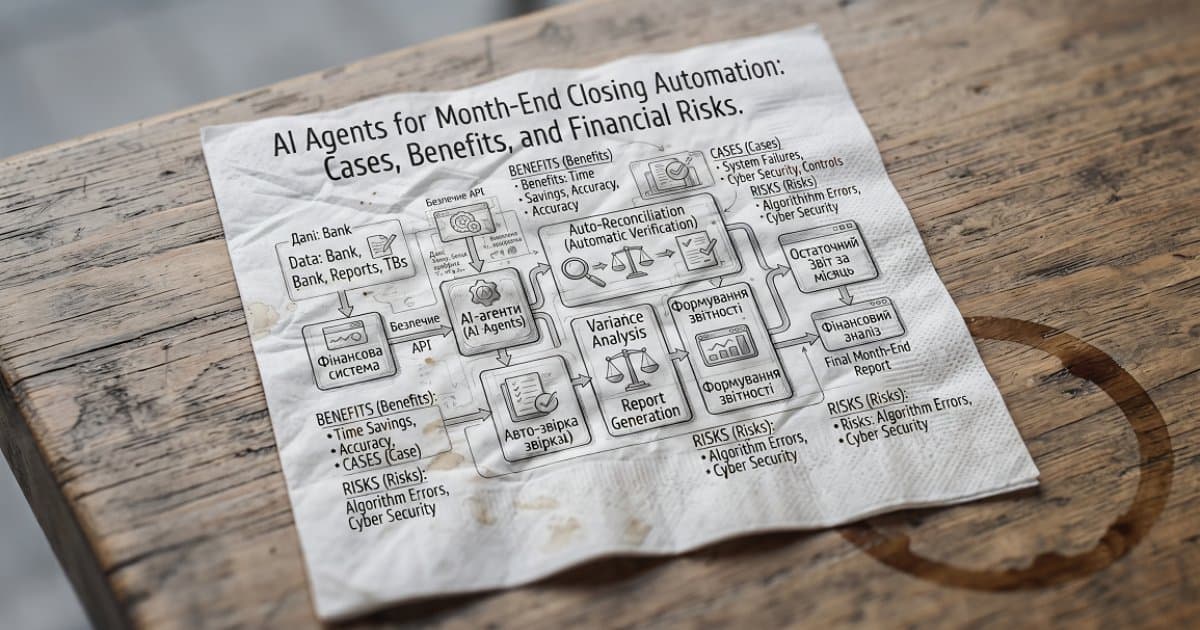
In the context of month-end close, an AI agent can perform the following tasks:
- Automatic account reconciliation — comparing data from bank statements, CRM, ERP, and accounting systems
- Discrepancy detection — the agent itself marks transactions that don't match and creates a list for review
- Report generation — P&L, balance sheet, cash flow — automatically, by template or in dynamic format
- Accruals and provisions — calculating deferred income and expenses without manual entry
- Team communication — sending reminders, requesting confirmations, escalating exceptions
To understand how autonomous a particular agent actually is before trusting it with financial processes, it's worth familiarizing yourself with the material how to measure the true autonomy of an AI agent before trusting it with business processes.
How the Agent Integrates with Existing Systems
The most common fear of managers: "We already have 1C, Excel, and online banking — an AI agent just won't fit." In reality, modern agents integrate through APIs, webhooks, or RPA connections with virtually any system. They can work on top of SAP, QuickBooks, Xero, BAS, or even structured Excel spreadsheets.
It's important to understand: an AI agent doesn't replace an accounting system — it becomes an orchestrator that coordinates data flows between existing tools. You can read more about which agents are already built into popular business tools in the article Notion, Wrike, SAP Joule: which AI agents are already built into the tools you use.
Real Cases: How Businesses Automate Month-End Close
Case 1. Wholesale Trading — Cycle Reduction from 7 to 2 Days
A Kyiv-based wholesale building materials company (85 employees, ~$4M annual turnover) implemented an AI agent to automate supplier reconciliation and management reporting. Before implementation, the close cycle took 6–7 working days and involved three accountants working overtime.
After agent setup:
- Reconciliation with 40+ suppliers automated at 90%
- Close cycle reduced to 2 days
- Errors in primary documentation decreased by 67%
- ~120 person-hours freed up monthly
The project ROI paid back in 4 months.
Case 2. IT Outsourcing — Multi-Currency Reporting Without Delays
For an IT company with 200+ team members working with clients in 12 countries, month-end close was particularly painful due to multi-currency transactions, different fiscal requirements, and the need to generate reports in three formats simultaneously.
The AI agent was configured for:
- Automatic currency conversion at NBU and ECB rates on transaction date
- Expense categorization by projects and clients
- Parallel generation of management P&L, investor reports, and fiscal statements
Result: reporting that previously took 5 days is now ready in 18 hours.
Case 3. Retail Network — Automation of Accruals and Provisions
A network of 12 clothing stores faced a classic problem: store managers submitted cash register reports with delays, some goods invoices "went missing" before close, and accounting manually accrued rent, utilities, and sole proprietor payments monthly.
The AI agent took on:
- Automatic data collection from POS terminals every evening
- Alert generation when supplier invoice is missing
- Automatic accrual of regular expenses based on contracts
As a result, the number of "open issues" at close dropped from 47 to 6 on average.
Benefits of AI Automation for Month-End Close for SMB
Speed and Predictability
The main benefit is that the close cycle is reduced 2–4 times. Instead of a stressful week, your team gets results in 1–2 days. This is not just comfort — it's a strategic advantage: management gets current data faster and can make decisions based on real figures, not forecasts.
Reduced Operating Costs
According to Deloitte calculations, automation of financial close allows reducing costs for this process by 30–50%. For Ukrainian SMB, this could mean freeing up 1–2 positions or reallocating accountants to more analytical work instead of routine data entry.
Reduced Human Error
AI agents don't get tired, don't make mistakes due to inattention at 11 PM, and don't forget to apply exchange differences. The accuracy of structured data processing in agents reaches 99.2–99.8% — compared to 95–97% in humans doing routine operations (Ernst & Young data, 2024).
Scalability Without Additional Hiring
If your business grows, the agent processes a larger volume of transactions without increasing headcount. This is especially relevant given the shortage of qualified accountants in Ukraine. Read more about how to grow without increasing staff with AI in the article AI automation for medium business: how to grow without increasing staff.
Audit Trail and Transparency
Every action of an AI agent is logged. This means that during an audit or inspection, you have a complete journal: who initiated the transaction, when the agent processed it, which rules it applied. This significantly simplifies interaction with auditors and tax authorities.
Financial Risks: What AI Solution Sellers Keep Silent About
Risk 1. Garbage In — Garbage Out
An AI agent is only as good as the quality of data it works with. If your accounting system has incorrectly closed previous periods, has duplicate counterparties, or has an incorrectly configured chart of accounts — the agent will automate chaos, not order. The first step before implementation should always be a data quality audit.
Risk 2. Hallucinations in Financial Context
Modern LLM models can "make up" figures or misinterpret unstructured documents. For financial reporting, this is critical. Solution: use agents based on hybrid RAG architecture, which ties answers to real documents and minimizes hallucinations. More details on this technology in the article hybrid RAG architecture: accurate document search and protecting AI agents from hallucinations.
Risk 3. Compliance and Responsibility
Who is responsible if an AI agent makes an error in financial reporting? Legally — always the person or company that signed the report. This means that automation doesn't eliminate control — it changes its form. A financial director or chief accountant should approve final figures even in a fully automated process.
Risk 4. Dependency on a Single Vendor
If your AI agent is built on a single cloud platform — you depend on its availability, pricing policies, and decisions to discontinue service. For Ukrainian businesses in wartime, this is especially relevant. Recommendation: choose solutions that can be deployed locally or have multi-cloud architecture.
Risk 5. Financial Data Cybersecurity
An AI agent that has access to bank accounts, ERP, and accounting systems is an extremely attractive target for cybercriminals. You must ensure encrypted connections, the principle of least privilege (the agent only has access to what's needed for the task), and regular permission audits.
How to Implement an AI Agent for Month-End Close: Practical Plan
Step 1. Map the "As Is" Process
Before automating — document. Describe each step of current close: who does what, which systems they use, where delays occur. This will take 1–2 weeks but will save months of failed implementation.
Step 2. Identify Priority Sub-processes
Don't try to automate everything at once. Start with the most routine and least risky operations: automatic bank statement reconciliation, regular expense accruals, standard report generation. Leave complex analytical operations for later.
Step 3. Choose Architecture Based on Scale
For SMB with simple processes, one specialized agent is sufficient. For companies with complex holding structures or multiple legal entities, consider a multi-agent architecture, where each agent is responsible for its own area and is coordinated by an orchestrator. More details on this in the article multi-agent systems: how Multi-Agent Orchestration is changing business automation.
Step 4. Test on Real Data from Previous Periods
Before launching in "combat" mode, run the agent through data from two or three previously closed months and compare results with what your team did manually. This will identify system errors before they touch actual reporting.
Step 5. Parallel Work and Gradual Delegation
For the first 1–2 months, it's recommended to run a parallel process: both agent and team prepare reports independently, then results are compared. Only after confirming accuracy should you fully delegate the process to the agent while maintaining final human approval.
FAQ: Frequently Asked Questions About AI Automation of Month-End Close
How much does it cost to implement an AI agent for month-end close for SMB? Costs depend on the complexity of integrations and level of customization: from $2,000–5,000 for basic solutions based on ready-made platforms to $15,000–30,000 for custom development with deep ERP integration. Most SMB projects pay back in 4–8 months through reduced operating costs and freed-up team time.
Can an AI agent replace a chief accountant? No — at least not in 2025–2026. An AI agent automates routine operations but doesn't replace analytical thinking, interpretation of atypical situations, and legal responsibility. The chief accountant transitions to a controller and analyst role rather than data operator.
How does an AI agent interact with Ukrainian accounting systems like BAS or M.E.Doc? Modern agents can integrate with BAS through APIs or RPA connections, and with M.E.Doc — through automatic XML/JSON file exchange. Integration typically takes 2–4 weeks depending on system version and documentation availability from your IT department or 1C partner.
What are the risks to financial reporting when using AI agents? The main risks are: poor input data quality, model "hallucinations" when working with unstructured documents, integration errors, and cybersecurity threats. All these risks are minimized by proper architecture, regular audits, and mandatory final human approval.
Do I need to completely transition to new accounting to implement an AI agent? No. The AI agent works on top of existing systems and doesn't require replacing them. However, before implementation, you need to audit data quality and eliminate systematic errors in current accounting — otherwise the agent will automate incorrect processes.
A Systematic Path to Faster Close
Automating month-end close using AI agents is not the future but a real tool already used by progressive Ukrainian companies to reduce reporting cycles, lower operating costs, and minimize human error. The key is to approach implementation systematically: start with a data audit, automate in stages, and maintain human control at the final level. If you want to understand which approach is right for your business — contact our experts for a free consultation, and we'll build a roadmap for automating your financial close together.
Have questions? Ask the AI agent right now
Responds in seconds, knows everything about our services and will help with your situation
You might also like
AI Agents in SMS & Messengers: Sales Playbook
AI agents living inside SMS and messengers are reshaping sales and support. Real business scenarios, ROI estimates, step-by-step setup guide, and key risks.
AutomationGemini 3.8 Live Avatar: Video Agents for Business
Google's Gemini 3.8 Live with Live Avatar brings real-time video agents to enterprise. See how video AI transforms customer service, training, and sales.
AutomationHow to Choose an AI Agent Vendor: Business Checklist
A practical checklist for CEOs and COOs on how to choose an AI agent development vendor — with red flags, key criteria, and a real case with numbers.