
How to Choose an AI Agent Vendor: Business Checklist
A practical checklist for CEOs and COOs on how to choose an AI agent development vendor — with red flags, key criteria, and a real case with numbers.
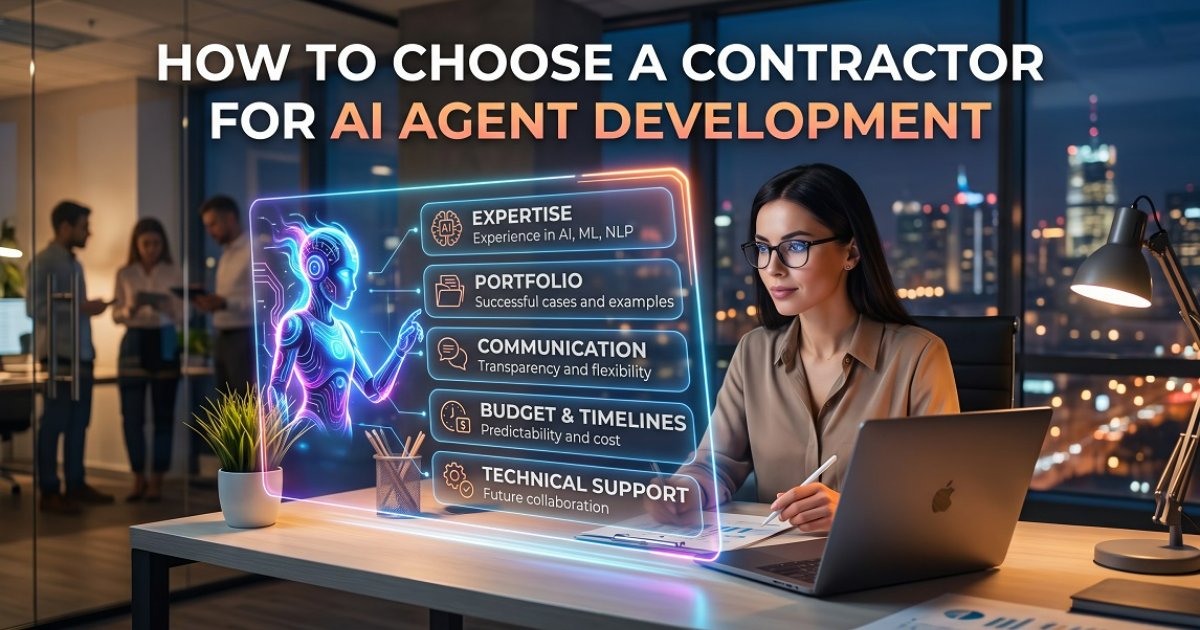
Most Companies Pick the Wrong AI Agent Vendor — and Only Find Out After Go-Live
The vendor who wins the demo almost never wins in production. A polished pitch deck, a live prototype that runs flawlessly on the vendor's own data, a confident promise of "seamless integration" — none of that predicts whether the agent will still be working six months after launch, when your ERP has been updated, your compliance team has raised a flag, and the original project manager has left. The AI agent market is flooded with vendors who are excellent at selling and mediocre at delivering.
What follows is a structured checklist built from real procurement failures and real production wins. There's a case inside with hard numbers — not a vendor's commissioned study, but a documented deployment — that illustrates exactly what separates a contractor worth hiring from one that will cost you twice the budget and half your patience.
Why the Standard Vendor Evaluation Process Fails Here
Buying an AI agent is not like buying enterprise software. With a CRM or an ERP, you're evaluating a finished product. With an AI agent, you're evaluating a team's ability to build something that doesn't fully exist yet — a system that will reason, make decisions, and act inside your specific operational environment.
That distinction matters enormously. Most procurement teams apply the same criteria they'd use for SaaS: feature checklist, pricing, references, security certifications. Those criteria are necessary but nowhere near sufficient. A vendor can check every box on a standard RFP and still deliver an agent that hallucinates on edge cases, locks you into a proprietary model you can't replace, or breaks every time your API changes.
The evaluation process needs to shift from "what does this product do?" to "how does this team build, test, and maintain systems that act autonomously in unpredictable environments?" Those are fundamentally different questions — and most buyers never ask the second set.
The real risk isn't that the vendor lies. It's that they genuinely don't know what they don't know — and neither do you, until the agent is in production.
The Demo Trap
Vendors optimize for demos. They build a clean, happy-path scenario on sanitized data, with no ambiguous inputs, no conflicting business rules, no legacy system quirks. The agent looks brilliant. Then it meets your actual procurement workflow — with its seventeen exception types, its three approval tiers, its mix of PDF invoices and handwritten forms — and the cracks appear immediately.
The fix is simple but rarely used: require the vendor to run a proof of concept on your data, in your environment, against your actual edge cases. Not a sandbox. Not a simulation. Your real messy inputs. Any vendor who resists this is telling you something important.
The Checklist: Six Criteria That Actually Predict Production Success
1. Architecture Depth, Not Feature Count
Ask the vendor to explain how their agent handles the following: model selection and replacement, retrieval-augmented generation (RAG) or context management, state persistence across multi-step workflows, and tool orchestration. If they can't walk you through each layer clearly — or if they describe it as a "black box that just works" — that's a hard stop.
A production-grade agent is not a single model with a prompt. It's a system with components: a reasoning layer, a memory layer, a tool-use layer, and an orchestration layer that coordinates them. Vendors who've built real agents can describe this architecture in plain language. Vendors who haven't will pivot to talking about the underlying model (GPT-4, Claude, Gemini) as if the model itself is the product.
For a deeper look at how these architectural choices affect your business outcomes, the comparison of LangChain vs CrewAI vs AutoGen is worth reading before your first vendor call — it gives you the vocabulary to ask sharper questions.
What to ask: "Show me the architecture diagram. What happens when the primary model is deprecated or becomes too expensive? How do you replace it without rebuilding the agent?"
2. Integration Quality — The Strongest Single Predictor of Success
Integration quality is consistently the factor that separates agents that scale from agents that stall. An agent that can't reliably connect to your CRM, your ERP, your document storage, and your approval workflows is not an agent — it's an expensive chatbot.
Ask for the vendor's connector list in writing. Then test the two integrations that matter most to your workflow during the proof of concept — not in isolation, but in sequence, the way the agent will actually use them. A vendor who supports only one "happy-path" integration will slow down the moment your stack gets complicated.
Specifically probe: how does the agent authenticate to your systems? How does it handle token expiration, rate limits, and API failures? What happens when a downstream system is unavailable — does the agent fail gracefully, escalate to a human, or silently produce a wrong output?
3. Human-in-the-Loop Controls — Tiered, Not Binary
Every serious AI agent deployment needs human oversight. The question is not whether oversight exists, but how it's structured. A vendor who treats human-in-the-loop (HITL) as a single on/off switch hasn't thought carefully about production risk.
What you need is tiered approval logic: low-stakes, reversible actions (drafting a document, pulling a report) run autonomously; medium-stakes actions (sending an external communication, updating a record) trigger a notification; high-stakes, irreversible actions (financial commitments, compliance filings, contract execution) require explicit human authorization before the agent proceeds.
Without this tiering, HITL becomes either a bottleneck — where humans approve everything and the agent adds no value — or a liability, where the agent acts on consequential decisions without a check. Ask the vendor to show you how approval gates are configured, logged, and audited.
4. Security, Compliance, and Data Governance
This is table stakes, but the details matter. At minimum, require SOC 2 Type II certification. Depending on your industry, you may also need GDPR compliance, HIPAA controls, or PCI-DSS alignment. Ask explicitly: where does your data go when the agent processes it? Is it used to train the underlying model? Where is it stored, and in which jurisdiction?
Beyond certifications, probe the vendor's approach to prompt injection — a class of attack where malicious inputs manipulate the agent into taking unintended actions. Any vendor building agents that interact with external data sources (emails, documents, web content) needs a documented approach to adversarial input handling. If they look blank when you raise this, they're not ready for production.
Require that all audit-trail and data-governance commitments appear in the contract, not just in the sales deck. Marketing promises don't bind. Contract clauses do.
5. Vendor Viability and Exit Conditions
The AI agent market has hundreds of vendors who are six months or less from demo to production. Many are pre-revenue, running on design-partner arrangements, and not yet procurement-ready for businesses under board scrutiny. Before signing, verify: how long has the vendor been running agents in production? How many paying customers do they have, and can they name at least three publicly?
Equally important: what happens to your agent if the vendor is acquired, pivots, or shuts down? Do you own the code? Can you run it independently? Is there a documented exit and data-return process? These questions feel premature during a sales conversation — they feel urgent the moment the vendor stops returning calls.
6. Ongoing Support, Monitoring, and Model Drift Management
An AI agent is not a piece of software you deploy and forget. Models drift. APIs change. Business rules evolve. The vendor's job doesn't end at go-live — it begins there.
Ask specifically: who monitors agent performance after launch? What metrics do they track — task completion rate, escalation rate, error rate, latency? How do they detect when the agent's accuracy has degraded? What's the SLA for incident response, and what constitutes an incident?
A vendor who can't answer these questions with specifics is selling you a launch, not a system. The cost breakdown of custom AI agent development is worth reviewing here — it helps you understand what you're actually paying for in a long-term engagement versus a one-time build.
A Real Case: What Happens When You Skip the Checklist
Klarna, the buy-now-pay-later company, deployed an AI customer service agent built on OpenAI in early 2024. Within its first month of live operation, the agent was handling roughly 2.3 million customer service conversations — the equivalent workload of 700 full-time employees. Response times dropped from an average of 11 minutes to under 2 minutes. Repeat contact rates fell by 25%. The estimated annual profit impact: $40 million.
That result didn't happen because Klarna got lucky with a vendor. It happened because the deployment was built on a clear architecture, integrated deeply with existing systems, and had defined escalation paths for cases the agent couldn't resolve. The agent knew what it could handle and what it couldn't — and that boundary was engineered deliberately, not left to chance.
Contrast that with the pattern that plays out repeatedly across mid-market companies: a vendor is selected based on a compelling demo, the proof of concept is skipped to save time, integration is treated as an afterthought, and the agent goes live with no monitoring framework. Six months later, the agent is handling 30% of the intended volume, the rest is falling through to humans anyway, and the business has spent twice the original budget trying to patch the gaps.
The difference between those two outcomes is almost entirely in the evaluation process — specifically, in whether the buyer asked the right questions before signing.
Choosing the right vendor is not a procurement task. It's a strategic decision that determines whether automation becomes a competitive advantage or an expensive lesson.
Red Flags: Walk Away When You See These
Not every signal requires a deep investigation. Some patterns in vendor behavior are reliable enough to treat as automatic disqualifiers:
- The vendor can't explain failure modes. If you ask "what happens when the agent encounters an input it can't process?" and the answer is vague or optimistic, the agent has no graceful degradation. In production, that means silent errors.
- Audit trail is described as "confidence scores." A confidence score is not an audit trail. It tells you how certain the model was — not what it did, why, or what data it used. Regulated environments require the latter.
- Contractual commitments are absent from the contract. If the governance, data residency, and performance commitments exist only in the pitch deck, they don't exist.
- The vendor resists a proof of concept on your data. This is the single clearest signal that the demo environment and the production environment are not the same thing.
- No named production references. Pre-revenue vendors and design-partner-only arrangements are not procurement-ready for businesses with real operational stakes. Require at least three named customers who are running the agent in production today.
How to Structure the Evaluation Process
A well-run vendor evaluation for an AI agent engagement doesn't need to be long — but it needs to be structured. A realistic timeline runs eight to twelve weeks from initial RFP to vendor selection: roughly two weeks for vendors to respond, two weeks for internal scoring, two weeks for focused demos on the strongest responses, and two weeks for a proof of concept on your actual data.
That last phase — the proof of concept — is where most evaluations collapse. Buyers skip it to accelerate the timeline, or vendors negotiate it away. Don't let either happen. The POC is the only moment before contract signature when you can see how the agent actually behaves in your environment. Everything before that is theater.
During the POC, measure four things: task completion rate on your real inputs, escalation rate (how often the agent correctly identifies that it needs human help), error rate on consequential actions, and integration stability under realistic load. Those four numbers will tell you more than any demo ever will.
When the evaluation is done right — when you've pressure-tested the architecture, run the POC, verified the references, and locked the governance commitments into the contract — something shifts. You stop managing the chaos of manual approvals and fragmented tools, and you start operating with actual visibility into what's happening across your business. That's not a small thing. That's the difference between running a company reactively and running it with confidence.
And when the board asks how you're managing operational risk at scale, the answer isn't "we hired more people." It's "we built a system." That's the kind of answer that changes how investors and leadership teams see you — not as someone keeping up, but as someone who's already three moves ahead.
FAQ
How long does it typically take to evaluate and select an AI agent vendor? A structured evaluation — from RFP to vendor selection — typically runs eight to twelve weeks. Rushing this timeline, particularly by skipping the proof-of-concept phase, is one of the most common and costly mistakes in AI procurement.
What's the difference between an AI agent and a standard chatbot or RPA tool? A chatbot follows a fixed script and handles predefined inputs. An RPA tool executes rule-based sequences on structured data. An AI agent reasons across ambiguous inputs, uses tools dynamically, maintains state across multi-step workflows, and can make decisions — including the decision to escalate to a human. The evaluation criteria are correspondingly more demanding.
Should we require the vendor to own the code, or is a managed service acceptable? Both models can work, but the risk profile differs. With a managed service, you're dependent on the vendor for continuity — if they're acquired or shut down, your agent may stop working. With code ownership, you retain the ability to maintain and evolve the system independently. At minimum, require a documented exit process and data-return guarantee regardless of the model you choose.
What security certifications should we require as a baseline? SOC 2 Type II is the baseline for most enterprise deployments. Depending on your industry, you may also need GDPR compliance documentation, HIPAA controls, or PCI-DSS alignment. ISO 42001 — the emerging standard for AI management systems — is increasingly relevant for vendors building agents in regulated environments.
How do we measure whether the agent is actually working after go-live? Track four core metrics: task completion rate (what percentage of intended tasks the agent completes without human intervention), escalation rate (how often it correctly identifies cases requiring human review), error rate on consequential actions, and response latency. Chat satisfaction scores are useful context but not sufficient on their own.
Can a small or mid-sized business realistically deploy a custom AI agent? Yes, but the build-vs-buy decision matters more at smaller scale. Pre-built agent platforms can be operational in six to eight weeks and require less internal technical capacity. Custom development gives you more control and competitive differentiation but demands a more rigorous vendor evaluation — the checklist in this article applies fully regardless of company size.
The Klarna numbers — $40 million in annual profit impact, 700 FTE equivalents, significantly faster response times — are real. But they're also the outcome of a deployment that was built correctly from the start, not rescued after a failed launch. Before you sign with a vendor, run through the six criteria above and ask yourself honestly: have I tested this in my environment, or have I only seen it in theirs? The answer to that question will determine which side of the outcome distribution you end up on.
If you want to map your current situation against what a well-structured AI agent deployment actually looks like, start a conversation with us — bring your use case, your stack, and your constraints, and we'll tell you what's realistic.
Have questions? Ask the AI agent right now
Responds in seconds, knows everything about our services and will help with your situation
You might also like
AI Agents in SMS & Messengers: Sales Playbook
AI agents living inside SMS and messengers are reshaping sales and support. Real business scenarios, ROI estimates, step-by-step setup guide, and key risks.
AutomationGemini 3.8 Live Avatar: Video Agents for Business
Google's Gemini 3.8 Live with Live Avatar brings real-time video agents to enterprise. See how video AI transforms customer service, training, and sales.
AutomationApple Locks macOS Full Disk Access: AI Agent Fix
Apple tightened macOS Full Disk Access controls due to AI agent risks. Here's which business workflows break, what to audit now, and how to adapt your automation.