
Kog's Inference Engine: Cutting Your AI Agent's GPU Cost
Kog's GPU inference engine promises up to 30x speed gains on existing hardware. Here's how small and mid-sized businesses can cut AI compute costs right now.
The Bill Nobody Budgeted For
Until recently, the assumption was simple: if your AI agents were slow or expensive, you bought more GPUs. Hardware was the answer, and the only question was how many. Then a Paris-based startup called Kog published a technical demo in May 2026 that landed on the front page of Hacker News — and quietly dismantled that assumption. Their Kog Inference Engine (KIE) demonstrated up to 30x faster LLM inference on the same standard datacenter GPUs enterprises already own, without touching a single piece of hardware.
What makes this more than a benchmark curiosity is what it implies about the money you're spending right now. The gap between what your GPUs are capable of and what your inference stack actually extracts from them isn't a rounding error — it's a structural cost that compounds with every AI agent you add. The specifics of how deep that gap runs, and what the most effective levers are to close it, are worth reading carefully before your next infrastructure decision.
Why AI Inference Became the Fastest-Growing Line Item in Your Budget
For most businesses that moved past the pilot stage, AI inference — the process of a trained model receiving a prompt and generating a response — has quietly become the dominant and least predictable component of total AI spend. Training a model happens once. Inference happens every single time a user, a workflow, or an agent makes a request. At scale, that distinction is everything.
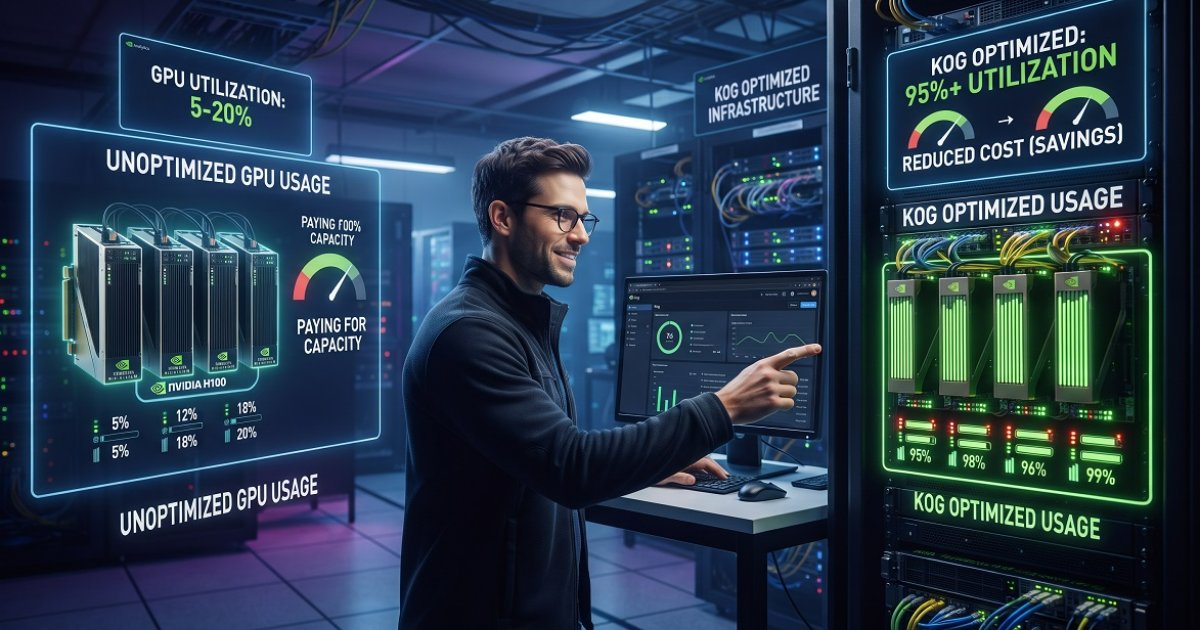
The structural problem is utilization. Without deliberate optimization, production inference workloads typically run at 5% to 20% GPU utilization while the business pays for 100% of allocated capacity. The hardware sits mostly idle between requests, but the billing clock doesn't pause. For companies running agentic workflows — where an AI might generate code, execute it, analyze results, revise its approach, and iterate multiple times — the idle periods are even longer, because each step creates waiting time as the system processes intermediate results.
This is precisely the inefficiency Kog is targeting. Founded in 2023 by Gaël Delalleau, an École Polytechnique engineer whose background spans solid-state physics and offensive cybersecurity (including four DEFCON capture-the-flag finals), Kog operates from Paris with a team of eleven, including ten engineers and researchers, five of whom hold PhDs. Delalleau's approach to GPU optimization draws directly from his security background: reverse-engineer the system down to assembly and binary code, then repurpose it for goals it wasn't originally designed for.
The result is a software layer that rethinks how inference workloads get scheduled, batched, and executed at the level of physical hardware constraints — on standard datacenter GPUs like the AMD MI300X and Nvidia H200 that enterprises already have deployed. After the Hacker News demo, Kog's CEO reported 200 tangible business leads. The market signal was clear: the problem is real, widespread, and expensive.
The question isn't whether your inference costs are too high. At current utilization rates, they almost certainly are. The question is which optimization layer gives you the fastest return on the least engineering effort.
Three Optimization Layers That Work Right Now — Without New Hardware
You don't need to wait for Kog's engine to reach general availability to start cutting costs. The optimization stack has multiple layers, and the highest-leverage moves are available today.
Layer 1: Fix Your Workload Architecture Before You Touch Infrastructure
The single most impactful change most businesses can make has nothing to do with GPUs. It's about which model handles which task.
A GPT-4-class model costs approximately 10 to 20 times more per token than a 7-billion-parameter model, according to publicly available API pricing as of mid-2026. In a well-designed pipeline, 70% to 80% of subtasks — intent classification, safety checks, simple acknowledgments, formatting — can be handled by smaller models. The aggregate cost per interaction drops by 80% to 95% compared to routing everything through a single frontier model.
This isn't a theoretical optimization. It's the approach that allowed one consumer AI application to scale to one million users in 19 days without the inference bill making the company insolvent — by restructuring how the stack processed each conversation, not by switching to a worse model or cutting features.
The practical implementation: build a routing layer (tools like LiteLLM or LangChain handle this well) that classifies each request by complexity and routes it to the cheapest model capable of handling it reliably. Reserve frontier model calls for genuinely ambiguous, high-stakes, or high-value tasks. A flat architecture where every request hits the most capable model leaves significant money on the table.
Layer 2: Quantization and Batching — The Two Levers Most Teams Underuse
At the runtime level, two techniques consistently deliver measurable gains with low implementation risk.
Quantization reduces the numerical precision of model weights, shrinking memory footprint and increasing throughput. FP8 quantization on H100-class GPUs — natively supported by vLLM — delivers a 1.3x to 2x throughput gain over FP16 at under 2% quality loss on instruction-tuned models. For standard conversational AI, summarization, and code generation tasks, that quality difference is not perceptible in production. On newer B200 hardware, FP4 via TensorRT-LLM adds a further 1.5x to 2x gain on top of FP8.
Adaptive batching addresses the utilization problem directly. Fixed batch sizes are brittle: they inflate latency during low traffic and waste efficiency during high traffic. Adaptive batching adjusts dynamically based on queue depth, latency targets, and model characteristics — when traffic increases, batches grow; when it slows, they shrink to preserve responsiveness. This is one of the core mechanisms Kog's engine optimizes at the hardware level, but it's also configurable in standard inference servers like vLLM and Triton today.
The combined effect of these techniques is documented in production deployments. NVIDIA has reported that Snap's Screenshop achieved approximately 3x throughput and an estimated 66% cost reduction using TensorRT, while Amdocs reduced tokens consumed by up to 60% in preprocessing and 40% in inferencing while cutting query latency by roughly 80%.
Layer 3: Prompt Caching and Context Discipline
In multi-turn conversations and agentic workflows, each new message re-feeds the full conversation history back into the model. Context windows balloon. Token counts compound. This is one of the fastest ways an AI budget escapes control.
Prompt caching — storing and reusing the computed state of repeated context — reduces costs by 50% to 90% on workloads with significant repeated context, such as system prompts, document references, or shared instructions across many requests. Most major API providers now support some form of prompt caching; the implementation effort is low relative to the savings.
Context discipline is the complementary practice: auditing what actually needs to be in the context window versus what's there by default or habit. Long system prompts, verbose chain-of-thought outputs, and uncompressed conversation histories all push token counts up without proportional quality gains. Trimming aggressively — and measuring the quality impact — is often the fastest optimization available.
Infrastructure choices amplify everything above. Dedicated GPU compute can cost $5 per GPU-hour versus $11 per GPU-hour on major cloud providers at equivalent specs — a difference that compounds significantly at high utilization. The optimization stack isn't one decision; it's a sequence of decisions, each with independent savings potential.
What Kog's Approach Changes for Businesses Scaling AI Agents
Kog's specific contribution sits at a layer below what most optimization tools address. Rather than working within existing inference frameworks, the KIE rethinks how workloads get scheduled and executed at the level of GPU hardware physics — what Delalleau describes as going deeper than hardware-agnostic software approaches, closer to the work done by research labs like Stanford's Hazy Research group.
The practical implication for agentic workflows is significant. Current inference frameworks treat agentic workflows like complicated single queries. They're not. An agent that generates code, runs it, waits for results, and iterates creates a fundamentally different utilization pattern than a single prompt-response exchange. Kog's approach involves predicting when those waiting periods occur and packing multiple agentic workflows onto the same GPU — swapping tasks in and out to keep processors consistently fed with work. It's the same principle modern operating systems use for multitasking, applied to the specific patterns of AI inference.
For businesses deploying AI agents at scale — in procurement, compliance, customer operations, or development workflows — this matters because the cost structure of agentic AI is qualitatively different from simple API calls. The idle time between agent steps is where the waste accumulates, and it's where software-level optimization has the most headroom.
Kog is currently running a Design Partner Program for teams building coding agents, app-generation systems, or other agentic workflows where iteration speed is already a competitive bottleneck. For businesses in that category, early engagement with infrastructure-level optimization — whether through Kog or through the runtime-level techniques described above — is worth prioritizing now, before usage scales further and the cost structure hardens.
To understand how AI agent costs fit into a broader ROI framework, the analysis in How to Calculate the Break-Even Point of an AI Agent vs. Hiring a New Employee provides a structured starting point. And if you're thinking about how AI agent infrastructure holds up under real production load, Your AI Agent Infrastructure Will Fail. The Only Question Is When covers the resilience dimension that cost optimization alone doesn't address.
The executives who get this right — who can walk into a board meeting and show cost-per-resolved-ticket trending down while agent throughput scales up — are the ones whose AI investments read as operational leverage rather than experimental spend. That's not a soft benefit. It's the difference between a budget that gets protected and one that gets questioned every quarter.
When you implement these optimizations and the numbers start moving in the right direction, something shifts beyond the spreadsheet. The constant background anxiety of watching an unpredictable infrastructure bill scale with usage gives way to something more useful: a clear model of what each AI workflow actually costs, what it produces, and where the next optimization lives. That kind of operational clarity is what makes scaling feel like growth rather than controlled chaos.
FAQ
What exactly is AI inference, and why does it cost so much? AI inference is the process by which a trained model receives an input — a prompt, a document, a query — and generates a response. Unlike model training, which happens once, inference runs continuously every time a user or automated workflow makes a request. At scale, the cumulative GPU compute required makes inference the largest and fastest-growing component of AI infrastructure spend for most production deployments.
How does Kog's approach differ from standard inference optimization tools like vLLM or TensorRT? Standard tools like vLLM and TensorRT optimize within existing inference frameworks — improving batching, quantization, and memory management at the software level. Kog's Kog Inference Engine goes deeper, rethinking how workloads are scheduled and executed at the level of GPU hardware physics, including low-level engineering specific to each GPU architecture (such as the AMD MI300X). The tradeoff is that this depth requires weeks to months of engineering work per GPU model, which limits how many chips an eleven-person team can support.
What's the fastest optimization a small business can implement today without dedicated ML infrastructure? Prompt caching and model routing deliver the fastest returns with the lowest implementation complexity. Routing 70% to 80% of routine subtasks to smaller, cheaper models — while reserving frontier model calls for genuinely complex tasks — can reduce aggregate inference costs by 80% to 95% on well-structured pipelines. Prompt caching on repeated context (system prompts, shared instructions) adds another 50% to 90% reduction on those specific token categories.
At what scale does it make sense to invest engineering time in inference optimization? Below roughly 10,000 daily active users or equivalent agent request volume, total AI infrastructure spend is typically low enough that engineering time spent on deep optimization costs more than the savings it generates. Above that threshold — or when agentic workflows are running continuously rather than on-demand — the economics shift decisively in favor of optimization investment.
Is quantization safe to use in production? Won't it degrade output quality? For most production use cases — conversational AI, summarization, code generation, classification — FP8 quantization delivers under 2% quality loss compared to FP16, and that difference is typically not perceptible to end users. The risk is higher for tasks requiring precise numerical reasoning or highly specific factual recall. The standard practice is to benchmark quantized models against your specific task distribution before deploying to production, not to assume the quality impact is either negligible or significant without measuring it.
What metrics should I actually track to know if inference optimization is working? Token spend and GPU utilization are inputs, not outcomes. The metrics that matter are cost per resolved ticket, cost per completed agent workflow, and human-equivalent hourly rate — comparing what your AI agents cost per unit of work against the human labor they replace or augment. These are the numbers that translate infrastructure decisions into business language, and they're what a board or investor audience will find meaningful.
The gap between what your current GPU infrastructure is capable of and what your inference stack actually extracts from it is, for most businesses running AI agents in production, both larger and more addressable than it appears. Kog's work makes that gap visible at the hardware level. The optimization techniques above make it addressable at the architecture level, today, without waiting for new hardware or new infrastructure partnerships.
The useful exercise isn't benchmarking yourself against an ideal — it's auditing one specific workflow: pick the highest-volume agent task your business runs, measure its actual cost per completed unit of work, and ask whether the routing, batching, and caching decisions that govern it were made deliberately or by default. The answer usually points directly to where the next meaningful reduction lives.
Have questions? Ask the AI agent right now
Responds in seconds, knows everything about our services and will help with your situation
You might also like
DeepSeek-V4: 1M Token Context at Disruptive Cost
DeepSeek-V4 brings a 1M-token context window at a fraction of OpenAI and Anthropic prices. Here's what it means for your business costs and AI strategy.
Pricing & ROIAI ROI Framework: Prove Business Value
OpenAI's framework shows how to connect AI usage to real business value. Step-by-step guide with metrics, formulas, and practical scenarios for CEOs and COOs.
Pricing & ROIAI Advertising ROI: OpenAI Rewrites Ad Creation
OpenAI's September 2026 ad platform overhaul shows which advertising functions AI agents can own today — and what that means for your budget and team.