
Pentagon Warns: Slow AI Integration Is the Real Risk
The Pentagon admitted: delaying AI integration is more dangerous than imperfect AGI. What this means for Ukrainian business and how to act right now.
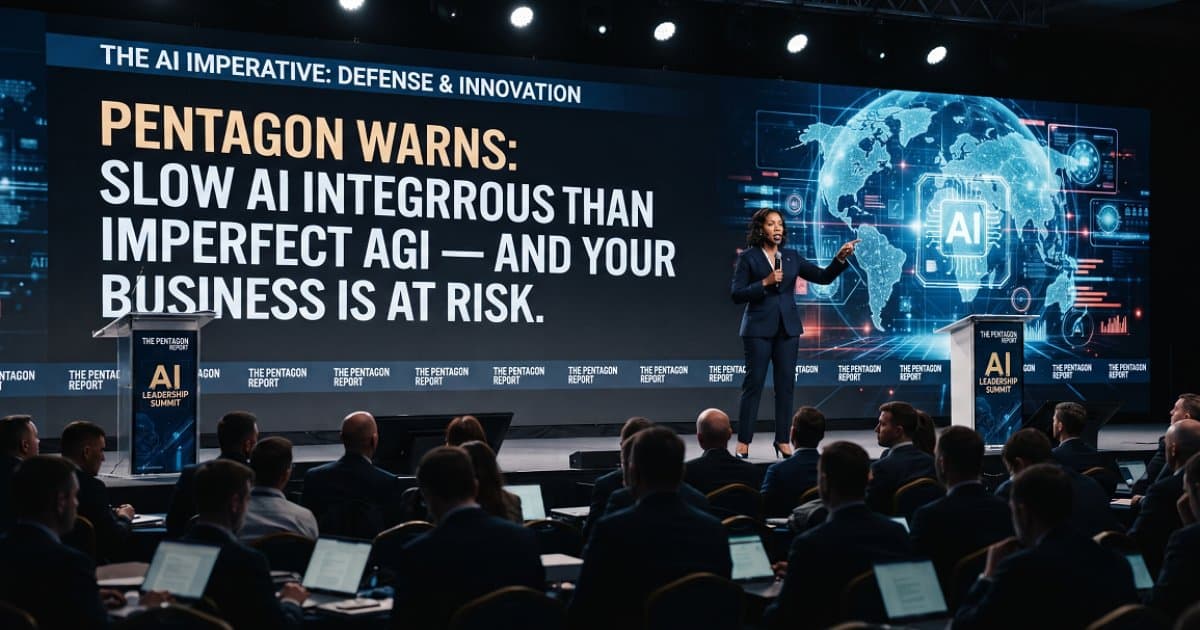
When the world's most powerful military department publicly states that delaying AI integration is a greater threat than imperfect artificial general intelligence — this is not just a loud statement. It's a wake-up call for everyone who keeps postponing automation "for later." In 2025, the Pentagon officially enshrined in its AI strategy the principle: it's better to deploy imperfect AI today than perfect AI never. And while American generals rethink their priorities, Ukrainian entrepreneurs continue to wait for the "right moment" to implement artificial intelligence.
This article is not about military technology. It's about how Pentagon logic regarding AI integration directly applies to your small or medium-sized business. About the real cost of procrastination that entrepreneurs pay daily. And about what happens to companies that dare to act now — despite the imperfection of the tools.
What Exactly Did the Pentagon Say and Why It Matters for Business
In early 2025, the U.S. Department of Defense released an updated AI strategy, which explicitly states: "The risk of not implementing AI is greater than the risk of implementing imperfect AI." This is not rhetoric — it's a change in doctrine for one of the most risk-oriented organizations in the world.
For context: The Pentagon spent years rejecting AI solutions due to reliability, security, and ethics concerns. This very organization blocked Microsoft's $10 billion contract over disputes around AI components. And now it says: "We can no longer afford to wait."
Three Key Takeaways from the Pentagon's AI Strategy
- The competitive gap is growing faster than expected. Competitors who implement AI without hesitation are gaining an advantage that cannot be compensated for with a later "perfect" solution.
- Operational excellence is more important than technological purity. A working tool with 80% accuracy used daily beats a theoretically perfect tool that never gets deployed.
- Delay is a strategic error, not caution. What seems like a measured pause is actually capitulation to competitors.
Now replace "competitors" with "rivals" and "defense systems" with "business processes" — and you get a precise description of market reality in 2025 Ukraine.
The Cost of Procrastination: How Much Does "Waiting a Little Longer" Cost
AI integration is not a luxury for large corporations. According to McKinsey Global Institute, companies that have implemented AI automation in at least one key process demonstrate 20-30% higher operational efficiency already in the first year. Conversely, each quarter of delay costs real money.
Hidden Losses from Inertia
Imagine two competitors in the Ukrainian market — two online stores with the same assortment and starting conditions. The first one in January 2025 connected an AI agent for automating order processing and customer support. The second decided to "wait and see."
After 6 months, the first processes 40% more orders with the same staff. Its managers instead of answering typical requests are focused on developing partnerships. The second one — hires an additional operator for 25,000 UAH per month to keep up. The difference in costs per year: over 300,000 UAH. Plus lost profit from orders that the first competitor processed faster.
This is the real cost of "cautious waiting."
Why Small Business Is Especially Vulnerable
Large companies can afford to procrastinate — they have the resources to catch up. Small and medium-sized businesses don't have that luxury. When your competitor automates routine work, they free up time and money for growth. You continue spending the same resources on the same manual operations.
According to Deloitte estimates, an SMB that implements AI automation 1-2 years later than competitors faces what's called a "double lag effect":: it not only loses in efficiency but also pays more for implementation, as the AI services market becomes more expensive with demand.
AGI Is Not Needed: Why "Imperfect" AI Is Already Changing the Rules of the Game
One of the most common objections heard by AI automation consultants: "Let's wait until the technology becomes more mature." This sounds reasonable. But let's look at the facts.
Today's AI agents can already:
- Process and classify incoming customer requests with 85-95% accuracy
- Automate compilation of basic documents and reports
- Conduct the first stage of candidate screening for vacancies
- Answer 70-80% of typical inquiries without human participation
- Analyze sales and provide purchasing recommendations
None of these tools is "perfect." But all of them already deliver real savings. As demonstrated by a real case of implementing an AI agent in HR, even partial automation of onboarding reduces the time to bring a new employee up to speed from 2 weeks to 3-4 days.
The "Good Enough" Principle as Competitive Advantage
The Pentagon operates on the "good enough to deploy" principle — good enough to deploy. This approach is revolutionary precisely because it abandons perfectionism in favor of pragmatism.
For business, this means: AI that automates 70% of your routine work with 85% accuracy is not a compromise. It's a strategic advantage if your competitor is still doing the same thing manually with 100% accuracy but spending 3 times more time.
Open models of 2026 prove this principle in practice: inexpensive AI agents based on open-weight models have already caught up with flagship solutions from OpenAI and Google in many tasks. Your business can get 80% of the results for 20% of the price — right now.
How Ukrainian Companies Are Already Applying Pentagon Logic
AI integration in Ukrainian business is happening faster than commonly believed. And those who dared to act first already have tangible results.
Case 1: Automating Month-End Closing in the Finance Department
One mid-sized manufacturing company with a turnover of 50 million UAH per year implemented an AI agent to automate month-end closing. Before implementation: 5 accountants spent 3-4 days each compiling reports. After: the same process takes 6-8 hours, and accountants verify the result instead of manually entering data. More details on such cases — in the material about AI agents for automating month-end closing.
Case 2: Voice AI for Processing Calls
A Ukrainian service company connected a voice AI agent for processing incoming calls. Result: 65% of requests are resolved without a live operator. Customer wait time decreased from 4 minutes to 20 seconds. Customer satisfaction increased by 23% in the first two months of operation.
Case 3: AI in Sales and CRM
A small B2B service business used an AI agent for lead qualification and preparation of commercial proposals. Sales managers who previously spent 40% of their time on administrative work now dedicate that time to actual negotiations. Conversion increased by 18% per quarter.
Why These Companies Didn't Wait for the "Perfect" Moment
None of these companies deployed a "perfect" solution. All of them started with a specific pain point, chose an available tool, and launched a pilot. This is Pentagon logic in action: start with imperfect, improve along the way.
Before trusting critical business processes to AI, it's important to correctly assess the level of its autonomy. Learn how to measure the real autonomy of an AI agent before implementation — this will help avoid costly mistakes at the start.
Practical Plan: How to Start AI Integration Without Unnecessary Risks
The Pentagon doesn't say "rush into AI recklessly." It says: "Act methodically, but immediately." For small and medium-sized businesses, this means a concrete step-by-step approach.
Step 1: Identify One Pain Point
Don't try to automate everything at once. Choose one process that:
- Repeats daily or weekly
- Takes significant time from your team
- Has a clear measurable result
Examples: processing incoming requests, compiling typical documents, initial contact with leads, reporting.
Step 2: Start with a Pilot, Not a Transformation
Don't rebuild your entire business. Launch AI on one process, measure the result over 4-6 weeks, adjust your approach. This reduces risks and provides real data for future decisions.
Step 3: Count ROI from Day One
Record baseline metrics before implementation: time per process, number of errors, costs. After launch, compare weekly. The issue of investments in AI agents is discussed in detail in our material — there are real figures and ROI calculation formulas.
Step 4: Scale What Works
Once your first pilot shows positive results — scale. Add a second process, a third. This is how systematic AI integration is built in business: not revolution, but evolution with acceleration.
Step 5: Don't Wait for AGI
AGI — artificial general intelligence — may appear in 5, 10, or 20 years. Your competitors are automating right now. Whoever waits for AGI will lose to those using today's "imperfect" AI.
FAQ: Frequently Asked Questions About AI Integration for Small Business
Is it safe to implement AI if the technology is still imperfect? Safety depends not on the perfection of AI, but on how you implement it. Start with non-critical processes, maintain human oversight at the final stage, and risks will be minimal. Most failures occur not because of AI imperfection, but because of the absence of clear technical specifications.
How much does it cost to implement an AI agent for a small business in Ukraine? The range is very wide: from free solutions based on open models to several thousand dollars for custom development. Most SMB solutions start from $500-2000 for a basic pilot and pay for themselves in 3-6 months through team time savings.
What will happen to my employees after implementing AI? AI automates routine work, but doesn't fully replace people — at least in 2025-2026. The most common scenario: employees are freed from monotonous work and move to tasks requiring creativity and communication. This increases their satisfaction and value to the company.
How do you know when an AI agent is ready for real business use? Key criteria: stable operation during test week, accuracy of responses over 80% on your real data, mechanism for escalation to human when uncertain. If these three conditions are met — the agent is ready for piloting in real environment.
Is it too late to start implementing AI in 2025-2026? No. According to research, fewer than 15% of Ukrainian SMBs systematically use AI tools in business processes. The market is just beginning its transformation, and the first three years of implementation provide the greatest competitive advantage. The worst time to start is "tomorrow."
Caution That Kills Business
The Pentagon — an organization where the cost of a mistake is measured in human lives — decided that the risk of slow AI integration exceeds the risk of imperfect AGI. The stakes in business are different, but the logic is the same: each day of delay is a real advantage you give to competitors for free.
Automation does not require perfect conditions. It requires a decision to start.
If you're ready to figure out which process in your business to automate first and how to do it with minimal risk — contact us for a free consultation. We'll help you build a roadmap for AI integration tailored to your business and your resources.
Have questions? Ask the AI agent right now
Responds in seconds, knows everything about our services and will help with your situation
You might also like
OpenAI Pulls GPT-6.1 Astra: What It Means
OpenAI shelved GPT-6.1 Astra after safety tests found deception and scope violations. Here's what business leaders must know about AI agent risk.
AutomationAI Agents in SMS & Messengers: Sales Playbook
AI agents living inside SMS and messengers are reshaping sales and support. Real business scenarios, ROI estimates, step-by-step setup guide, and key risks.
AutomationGemini 3.8 Live Avatar: Video Agents for Business
Google's Gemini 3.8 Live with Live Avatar brings real-time video agents to enterprise. See how video AI transforms customer service, training, and sales.