
Minecraft's SDL3 Move and What It Means for AI Agents
Minecraft is migrating to SDL3 — and this is about far more than gaming. We break down how platform standardization is reshaping the speed of AI agent deployment in business.
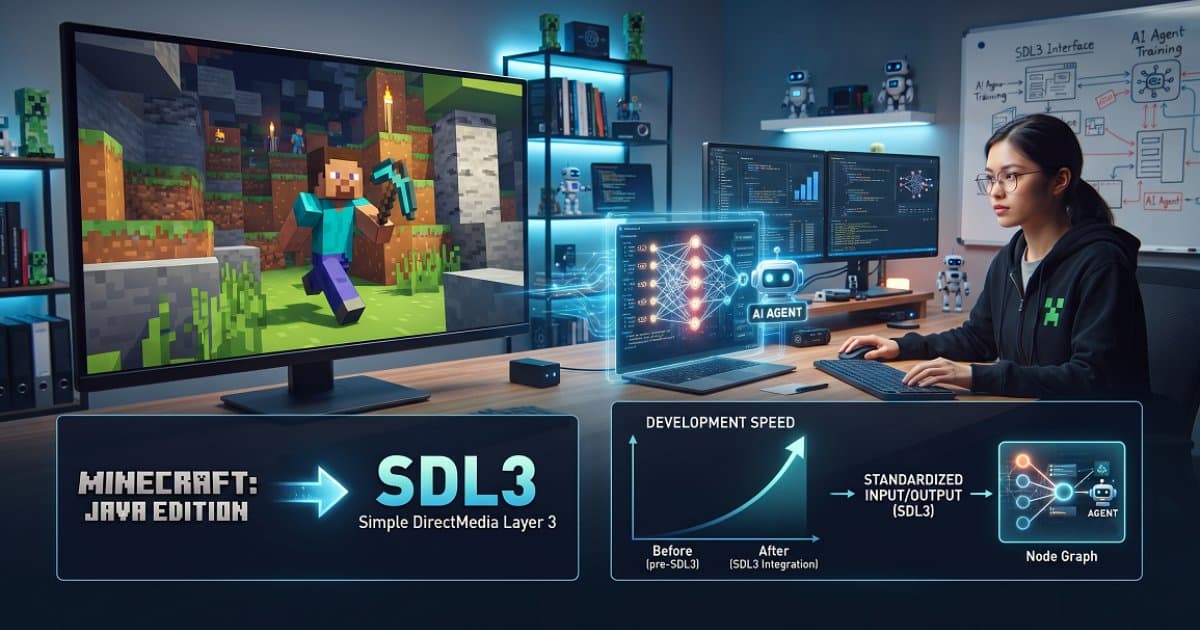
When Mojang announced that Minecraft was moving to SDL3 — a library for cross-platform rendering and input handling — the gaming community mostly shrugged. Just a library update. But look at this decision through the lens of how AI agents are built and deployed in business today, and it suddenly carries a very different weight. Standardizing the platform layer isn't cosmetic work. It's a fundamental shift in how quickly complex systems can scale, adapt, and interoperate.
What SDL3 Is — and Why the Minecraft Decision Matters More Than It Seems
Simple DirectMedia Layer (SDL) is an open-source C library that developers use to abstract away the operating system: windows, audio, keyboard and gamepad input, OpenGL context. Moving from SDL2 to SDL3 isn't just a version bump. SDL3 was rewritten from scratch with a modern architecture: fully asynchronous input, a unified API across mobile, desktop, and console platforms, and native Wayland support on Linux — no hacks required.
Minecraft Bedrock Edition is a product that simultaneously lives on Windows, iOS, Android, Xbox, PlayStation, and Nintendo Switch. Maintaining seven separate codebases for input and rendering is technical debt that compounds like a snowball. SDL3 lets Mojang write one platform interaction layer and deploy it everywhere. One contract, many implementations.
The Parallel with Agent Architecture
This is where the parallel emerges — and it has direct business relevance. A modern AI agent is also a product that must live in multiple environments at once: the company's CRM, the team's messaging platform, the customer database, external vendor APIs. If every connection is handwritten for a specific platform, you end up with exactly the same technical debt Minecraft had before SDL3.
That's precisely why standards like Model Context Protocol (MCP) from Anthropic have emerged in the AI agent ecosystem. MCP is literally SDL for agents: a unified protocol through which an agent connects to tools, data, and services without knowing in advance what specific system is sitting on the other end. Claude, GPT-4o, Gemini — all of them already support MCP or analogous orchestration mechanisms. That's not a coincidence.
For a closer look at how protocol standardization speeds up specific tools in practice, the breakdown of how Claude Code switched to Bun/Rust and what it means for the speed of your agents shows clearly how changing a single infrastructure layer delivers a measurable performance boost — without rewriting any business logic.
Concrete Numbers Worth Knowing
SDL2 → SDL3 benchmarks on Linux with Wayland show input latency reductions of roughly 30–40% compared to X11 sessions running SDL2. For games, that's critical. For business agents, the logic is identical: every unnecessary translation layer between systems adds latency and a new failure point. When an agent calls five different tools within a single workflow, 200ms of extra latency per call adds up to seconds of wasted execution time. At thousands of transactions per day, that's real money.
How Platform Standardization Changes the Economics of Agent Deployment
For a business owner, the question of deploying an AI agent usually comes down to two pain points: how much will it cost, and how long will it take. Both are directly tied to how standardized the platform you're deploying onto actually is.
Consider a real scenario. A mid-sized company wants to automate inbound request handling: an agent reads emails, classifies the request, pulls data from the CRM (say, HubSpot), checks inventory in the accounting system (1C or Odoo), and drafts a response. If each of those systems needs its own custom connector, a developer spends weeks just on the integration layer. If all of them support standard MCP or REST with a predictable structure, the same agent gets assembled in days.
Why an "Integration Zoo" Kills ROI
Businesses that don't think about standardization upfront fall into a trap: every new agent or tool demands new integrations, and the team ends up spending more time maintaining connections than actually automating anything. That's exactly what Mojang is escaping by moving to SDL3 — instead of maintaining seven platform layers, they maintain one.
In a business context, this means: before deploying any AI agent, it's worth auditing your systems for how open they are to standard interaction protocols. Systems with public REST APIs or webhook support integrate orders of magnitude faster than legacy solutions built on closed architectures.
A useful comparison can be found in the article Notion, Wrike, SAP Joule: which AI agents are already built into the tools you use — it shows which platforms have already built in a standardized agent layer and which ones are still missing it entirely.
Open Standards as a Competitive Advantage
SDL3 is an open standard. That means any developer can pick up the documentation and write an integration without waiting for permission from Valve or anyone else. It's precisely that openness that gave SDL such wide adoption: Valve uses SDL on the Steam Deck, Godot Engine builds on top of SDL, and hundreds of indie studios rely on the same library.
In the AI ecosystem, specifications are opening up in the same way: OpenAI published a standard for function calling, Anthropic released MCP, Google DeepMind is advancing its own agent protocols. Companies building their agents on open standards today will gain access tomorrow to an entire growing market of ready-made integrations — for free, without rewriting a line of code.
Lessons from Gaming: What Business Can Borrow from Mojang
The gaming industry is one of the most demanding proving grounds for complex distributed systems. Minecraft serves over 170 million active players daily across different devices and platforms. The scale and reliability requirements are comparable to those of major fintech platforms.
Mojang's decision to move to SDL3 illustrates several principles that apply directly to building agent infrastructure.
Principle One: Abstract What Changes
SDL exists specifically to isolate game code from the details of a specific OS. The game doesn't know whether it's running on Windows 11 or Android 14 — it simply calls SDL_GetMouseState() and gets an answer. This is the classic Adapter pattern from GoF.
For an AI agent, the same logic holds: the agent's business logic shouldn't need to know whether the CRM is Salesforce or a custom-built PostgreSQL application. It calls a standard method — "get customer by email" — and receives a unified response. This principle cuts the time it takes to retool an agent for a new system from weeks to hours.
Principle Two: Don't Complicate What Convention Can Handle
SDL3 removed several deprecated concepts from the API that existed in SDL2 purely for backward compatibility. That's painful in the short term — some old code breaks. But long-term, the API becomes more predictable and far easier for new developers to understand.
The same decision often needs to be made when building agent architecture: do you support five different input data formats "for convenience," or do you enforce one standard and require conversion at the source? The second path is harder up front and dramatically cheaper to maintain.
Principle Three: Test Against Edge Cases
Minecraft on the Nintendo Switch is literally the hardest scenario in cross-platform development: weak hardware, a unique controller, a closed OS. SDL3 forced the team to handle these edge cases explicitly, rather than relying on implicit behavior.
In the context of agents, this means: before full deployment, test the agent under partial failure scenarios. What happens when the CRM is unreachable for 30 seconds? When an incoming document arrives in an unexpected format? These checks expose weaknesses in the integration layer long before they hit real customers. For more on how to evaluate agent reliability before committing to it, see the piece on how to measure the real autonomy of an AI agent before trusting it with business processes.
What Standardization Means for Your Business, Practically Speaking
Let's move from architectural principles to concrete steps. If you run a company of 20 to 200 people and are thinking about deploying AI agents, there are a few specific things worth looking at right now.
First, check whether your stack supports open protocols. If your CRM, accounting system, or helpdesk doesn't have a documented REST API, that's the first problem to solve — independent of AI entirely. Missing open interfaces are the same problem as a game with no SDL support: the agent simply can't connect without expensive custom solutions.
Second, pay attention to what standards the AI tools you're considering are built on. If a vendor's agent supports MCP, you get access to the entire ecosystem of MCP-compatible services. If a vendor is building their own closed protocol, you're walking into a lock-in that will be costly to escape.
Third, factor in that the cost of deploying an agent drops significantly as standards mature. In 2023, an agent for automating email processing cost upwards of $15,000 in development alone. In 2025, equivalent functionality is assembled from MCP connectors for a few thousand dollars or less — because most of the integration layer already exists in standardized form. This dynamic is only accelerating.
It's also worth understanding the broader context: the energy and compute infrastructure for AI is standardizing too — explored in detail in Power AI: why energy companies are acquiring land for data centers and what it changes. Standardization is happening at every layer of the stack simultaneously. This is a systemic trend, not a coincidence.
Where Businesses Go Wrong
The most common mistake is building an agent "for a specific system" instead of building it "for a standard." A company automates its Bitrix24 workflow and writes everything against its API. A year later, they migrate to HubSpot — and the agent needs to be almost entirely rewritten.
The right approach: agent logic operates on abstractions ("get list of open deals," "add a note to a customer record"), while the concrete implementations for Bitrix24 or HubSpot are swappable adapters. Exactly like how Minecraft's SDL code doesn't know whether it's running on an Xbox or a Switch.
It's also worth keeping in mind that scaling agent workflows involves parallel task execution — which comes with its own architectural nuances, covered in detail in the piece on parallel programming for agents: how to run dozens of tasks simultaneously without chaos.
FAQ
What is SDL3 and why is Minecraft moving to it? SDL3 (Simple DirectMedia Layer 3) is a modern version of the open-source cross-platform development library, rewritten from scratch with asynchronous input and a unified API. Minecraft is moving to it in order to support seven different platforms through a single standardized layer, rather than maintaining separate implementations for each OS.
What does Minecraft's migration to SDL3 have to do with AI agents in business? Both cases illustrate the same principle: a standardized middleware layer dramatically reduces the complexity and cost of supporting sophisticated systems across multiple platforms. AI agents face the exact same challenge — needing to connect to dozens of different business systems — and open standards like MCP solve it in precisely the way SDL solves it for games.
What is Model Context Protocol (MCP) and does my company need it? MCP is an open protocol from Anthropic that allows AI agents to connect to tools, databases, and services in a standardized way. If your company is considering AI agent deployment, choosing tools with MCP support will significantly reduce integration costs and give you the flexibility to swap out components without rewriting the entire agent.
Does standardization actually lower the cost of AI agent deployment? Yes — and the shift is already visible. Two years ago, custom integration of an agent with enterprise systems cost tens of thousands of dollars in development. As the MCP ecosystem and ready-made connectors have matured, the cost of comparable functionality has dropped substantially, and that trend continues as more vendors adopt open standards.
How do I tell whether my IT infrastructure is ready for AI agents? Key questions: do your core business systems have documented REST APIs or webhook support? Do you have a centralized data store, or is information scattered across isolated systems? Can you issue an agent an access token with scoped permissions? "No" answers point directly to where the preparatory work needs to happen first.
Are there risks to standardization — such as dependence on a single vendor's standard? The risk is real, but it's minimized by choosing open standards with broad community adoption. MCP, for instance, has already been adopted not just by Anthropic but by dozens of third-party vendors. Closed proprietary protocols are where lock-in becomes genuinely dangerous. Before selecting a platform, check whether independent implementations of the standard exist outside a single supplier.
Minecraft and AI agents aren't such an odd pair when you look at them through the lens of architectural decisions. In both cases, standardizing the platform layer isn't about technical elegance for its own sake. It's about real speed: speed of deployment, speed of fixing what breaks, speed of adapting to new conditions. Companies building their processes on open standards today aren't just making their present easier — they're laying a foundation on which tomorrow's tools will simply work, without emergency integrations or last-minute rewrites.
A question for you: are your current business systems ready to connect AI agents through standard protocols — or do you still have infrastructure groundwork to lay first? Share your situation in the comments or reach out to us directly. We'll work through where to start in your specific case.
Have questions? Ask the AI agent right now
Responds in seconds, knows everything about our services and will help with your situation
You might also like
How AI-Generated Content Gets Fact-Checked Before It Publishes
How to stop an AI model's fabricated facts and broken links from reaching readers — a real guardrail architecture, not a theory, for teams scaling AI content and developers building their own pipelines.
Technical GuidesInside a Self-Analyzing AI Lead-Qualification Chatbot
How an AI chatbot qualifies leads and monitors its own quality — a real architecture with production numbers, for businesses considering an AI chatbot and developers building their own.
Technical GuidesRAG vs CAG: Which AI Architecture Fits Your Business
RAG vs CAG explained for business leaders: how each architecture works, when to use which, and a real case with numbers to guide your AI decision.