
NVIDIA Physical AI and Isaac GR00T: A New Robotics Era
NVIDIA Physical AI and Isaac GR00T are opening a new era of robotics. What this means for Ukrainian businesses and how to prepare now.
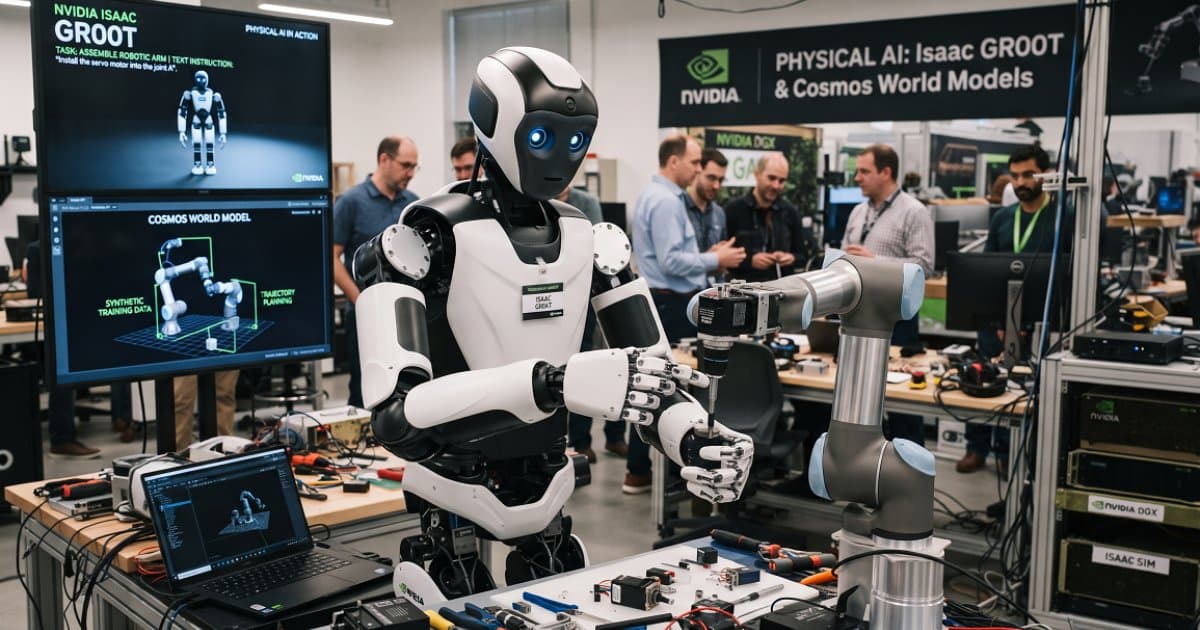
NVIDIA Advances "Physical AI": What It Means for Your Business
Imagine your warehouse robot receives a text instruction — "assemble order #4471 and send it to the packing line" — and executes it without a single line of additional code. That's exactly the scenario NVIDIA is turning into reality. The company is actively promoting the concept of physical AI — artificial intelligence that not only thinks in digital space but also acts in the physical world. The new open models Isaac GR00T and Cosmos world-models became the central tools of this revolution. For small and medium-sized business owners in Ukraine who are already thinking about automating manufacturing, logistics, or warehouse processing today, these technologies are not an abstract future, but a quite concrete horizon for the next 2–3 years. Let's figure out what NVIDIA presented, how it works, and when real-sector businesses will be able to profit from it.
What is "Physical AI" from NVIDIA and Why It's a Breakthrough
Physical AI — a term NVIDIA uses to describe artificial intelligence systems capable of understanding and interacting with real physical environments. Unlike conventional language models that work only with text or images, physical AI must understand spatial relationships, gravity, friction, movement sequences, and other properties of the material world.
Until now, the main problem with robotics was training cost. To teach a robot to perform one new task required thousands of hours of real demonstrations, expensive sensors, and a team of engineers. NVIDIA solved this problem on two levels simultaneously — through new robot behavior models and through synthetic generation of training data.
Solution Architecture: Two Key Components
NVIDIA's approach is built on two interconnected technologies:
- Isaac GR00T N1.5 — an open multimodal model for humanoid robots that allows performing complex multi-step physical tasks based on text or voice instructions
- Cosmos World Foundation Models — generative models that create realistic synthetic video data of physical interactions for large-scale robot training
Essentially, Cosmos generates an "imaginary simulator" — millions of hours of video of how robots interact with objects in various conditions. And GR00T uses this data to develop skills that are then transferred to the real world.
Isaac GR00T: How Text Instructions Control Robots
Isaac GR00T is not just another motion control model. It's a fundamental change in how robots are programmed. Previously, each new task required writing separate code or recording manual demonstrations. Now a robot can receive a natural language instruction and execute it based on basic understanding of the physical world.
Key Capabilities of GR00T N1.5
The updated version of the model, presented in 2025, includes:
- Multi-step task planning: a robot can break down a complex task into subtasks and execute them sequentially
- Adaptation to new environments: the model transfers knowledge between different physical contexts without complete retraining
- Multi-sensor processing: simultaneous work with video, tactile data, and voice commands
- Open access: NVIDIA made basic versions of the models available through NVIDIA NGC and Hugging Face, dramatically lowering the entry barrier for developers
For comparison — previously configuring an industrial robot for a new task cost between $50,000 and $200,000 and took months. With GR00T, this process can potentially be shortened to weeks and much smaller budgets.
What Robots Can Already Do
At NVIDIA demonstrations and partner company events, robots based on GR00T performed:
- Sorting and packing goods of various shapes and sizes
- Assembling parts from multiple components based on text instruction
- Moving between warehouse zones with spatial map understanding
- Responding to unforeseen situations — for example, if an item fell or changed position
NVIDIA partners — 1X Technologies, Agility Robotics, Boston Dynamics — are already integrating these models into their humanoid robots. This means the ecosystem around GR00T is forming faster than the market expected.
Cosmos: Synthetic Data as a Solution to Robot Training Problems
One of the main reasons robotics remained an expensive niche for so long is the data problem. To teach a model to well understand the physics of the real world requires millions of examples of real interactions. Collecting such data in reality is extremely expensive and slow.
Cosmos World Foundation Models is NVIDIA's answer to this problem. Essentially, these are video generative models specifically trained to understand and reproduce physical laws. They can generate synthetic videos of how a robot grasps an object, moves it, interacts with various surfaces — and all of this is physically correct, without violating laws of mechanics.
How It Works in Practice
The Cosmos use case looks like this:
- An engineer describes a new task for the robot — for example, "sort bottles by color on a conveyor"
- Cosmos generates thousands of variants of synthetic videos of this process — with different lighting, camera angles, bottle types
- GR00T learns from this synthetic data in simulation
- The finished model is transferred to a real robot with minimal additional configuration
This is the "sim-to-real transfer" approach — transferring skills from simulation to reality. Before Cosmos appeared, this approach often failed due to the "reality gap" — simulations were not accurate enough. Cosmos significantly closes this gap thanks to physically correct generation.
It's important to understand the context: NVIDIA is not building just a product, but an entire infrastructure for physical AI. This resembles how the company once created CUDA — and turned GPU into the standard for ML. Now it's trying to do the same for robotics. If you're curious how this fits into the broader AI chip race, we recommend reading our article about inference chips from OpenAI, Broadcom, and NVIDIA.
What NVIDIA's Physical AI Means for Small and Medium-Sized Businesses in Ukraine
Perhaps you're thinking now: "This is interesting, but it's for big corporations, not for me." Let's figure out why this is a misconception — and why it's worth paying attention to this direction right now.
Three Waves of Impact on Business
First wave (2025–2026): large warehouses, logistics operators, and manufacturers begin pilot deployments of humanoid robots based on GR00T. For SMBs this means that large competitors will gain an advantage in speed and operating costs.
Second wave (2027–2028): when the technology matures and the partner ecosystem expands, physical AI-based solutions will become available to mid-sized businesses — through service companies like "robotics as a service" (RaaS). This is similar to how cloud services made server capacity available to small businesses.
Third wave (2029+): physical AI will become standard in logistics, manufacturing, and service sectors — just as CRM systems and online payments are standard today.
Which Sectors Will Be Affected First
For Ukrainian SMBs, the most relevant industries include:
- Warehouse logistics and fulfillment: sorting, packing, inventory — all of this is already being tested with GR00T robots. If your business is related to logistics, our article about AI-agent for logistics and transportation company will show how to automate the customer-facing part right now
- Light manufacturing: assembly, quality control, packing — tasks where repetitiveness is high and variability is moderate
- Retail: shelf replenishment, inventory, preparation for online order shipment
- Food industry: sorting, packing, ingredient preparation
What to Do Right Now
Even if robots appear in your sector in 3–5 years, you should prepare today:
- Conduct an audit of repetitive physical operations in your business
- Document processes — this will become the foundation for future robotization
- Invest in digital automation now — AI-agents for sales, support, and operations
- Follow NVIDIA partnership programs and system integrator news
In parallel with physical AI, software automation is actively developing. If you're interested in how multi-agent systems are changing business automation right now — this is directly available for implementation now.
Competitive Landscape and NVIDIA's Position
Physical AI is not a monopoly niche for NVIDIA. Competition here is fierce, and understanding the landscape will help you evaluate which ecosystem to focus on.
Who Competes with NVIDIA in Physical AI
- Google DeepMind — developing RT-2 and subsequent versions of robot models, actively uses multimodal approaches
- Tesla — development of Optimus humanoid with its own AI stack, focused on its own manufacturing
- Microsoft + OpenAI — partnerships with robotics companies, integration of GPT-level models into control systems
- Figure AI, Apptronik, Physical Intelligence (Pi) — startups with hundreds of millions in funding
Why NVIDIA Has an Advantage
NVIDIA's main advantage is vertical integration. The company controls:
- Hardware level: GPUs and specialized chips for robots (Jetson, Thor)
- Simulation level: Omniverse platform for digital twins
- Model level: Isaac GR00T and Cosmos
- Ecosystem level: thousands of partners already using CUDA and NGC
This is a platform effect — a company that builds not just a product, but an entire infrastructure around which a market forms. That's why the GR00T opening is a strategic move: to attract as many developers and companies into NVIDIA's ecosystem so they build their solutions based on its infrastructure.
It's worth noting that this race is taking place against the backdrop of broader competition in AI chips and infrastructure. Understanding how AI-automation for medium-sized business is developing will help you make more informed decisions about technology investments.
Risks and Current Limitations
Let's be honest: despite impressive demonstrations, physical AI is not yet ready for mass commercial use in most sectors. Key challenges:
- Reliability: robots still make mistakes in non-standard situations
- Hardware cost: humanoid robots cost between $50,000 and $200,000 per unit
- Regulatory issues: safety standards for robots in industrial environments are still being formed
- Technical support: there's a catastrophic shortage of qualified specialists for maintenance
But the pace of progress is striking. What seemed like a research project a year ago is today a commercial product in testing. What's in testing today will be a mass market tomorrow.
FAQ: Answers to the Most Common Questions About Physical AI and Isaac GR00T
Are Isaac GR00T models available for small businesses right now? Basic versions of GR00T models are open and available through Hugging Face and NVIDIA NGC — developers can download and explore them. However, for real business implementation, a hardware base (robots, GPU servers) and a team of specialists are needed, which keeps this solution outside the typical SMB budget for now.
How soon will robots with physical AI appear at Ukrainian enterprises? Pilot projects at large logistics and manufacturing companies are possible within 2–3 years — provided the situation stabilizes and international suppliers remain accessible. Mass adoption in mid-sized businesses is realistically expected in 4–6 years, when hardware costs drop significantly.
How does physical AI differ from conventional industrial robots? Traditional industrial robots perform rigidly programmed movements and cannot adapt to changes. Robots with physical AI based on GR00T understand context, respond to non-standard situations, and can perform new tasks based on text instructions — without rewriting code. This is a fundamentally different level of flexibility.
What are Cosmos world-models and why are they needed? Cosmos are generative AI models that create realistic synthetic videos of physical interactions. They're needed to train robots without expensive real demonstrations: first the robot learns in simulation on millions of synthetic examples, then these skills are transferred to the real world with minimal additional training.
How should I prepare my business for the physical AI era right now? The best preparation is to start with digital automation: implement AI-agents for operational processes, document repetitive physical operations, and monitor market development. Companies that automate routine processes today will have much lower adoption barriers when physical robots become available.
Preparing Today for Tomorrow's Robotics
NVIDIA's Physical AI is not another marketing trend, but a real technological change that's already transforming robotics and will significantly impact manufacturing, logistics, and the service sector in 3–5 years. Isaac GR00T and Cosmos models remove the main barrier in robotics — the cost and complexity of training robots. For Ukrainian SMBs, this is a signal: it's time to start preparing, and the best first step is automating digital processes right now. Contact us for a consultation — we'll help you identify which AI solutions will give your business a competitive advantage today and prepare it for tomorrow's technological changes.
Have questions? Ask the AI agent right now
Responds in seconds, knows everything about our services and will help with your situation
You might also like
Claude Found a New Enzyme: AI Enters Science
Claude's AI agents discovered the ART enzyme system in 21 hours. What this means for pharma and biotech R&D — and why business leaders must pay attention now.
NewsAI Slowdown Pact: A Prisoner's Dilemma
Amodei, Altman, Musk, and Hassabis agree to slow AI. But game theory says the deal may collapse before it starts. Here's what that means for your business.
NewsChatGPT for Financial Services: What Business Gets Now
OpenAI launched ChatGPT for Financial Services on GPT-6 Astra. See which processes it automates, what ROI to expect, and how financial firms use it today.