
The Inference Chip Race: OpenAI, Broadcom, and NVIDIA
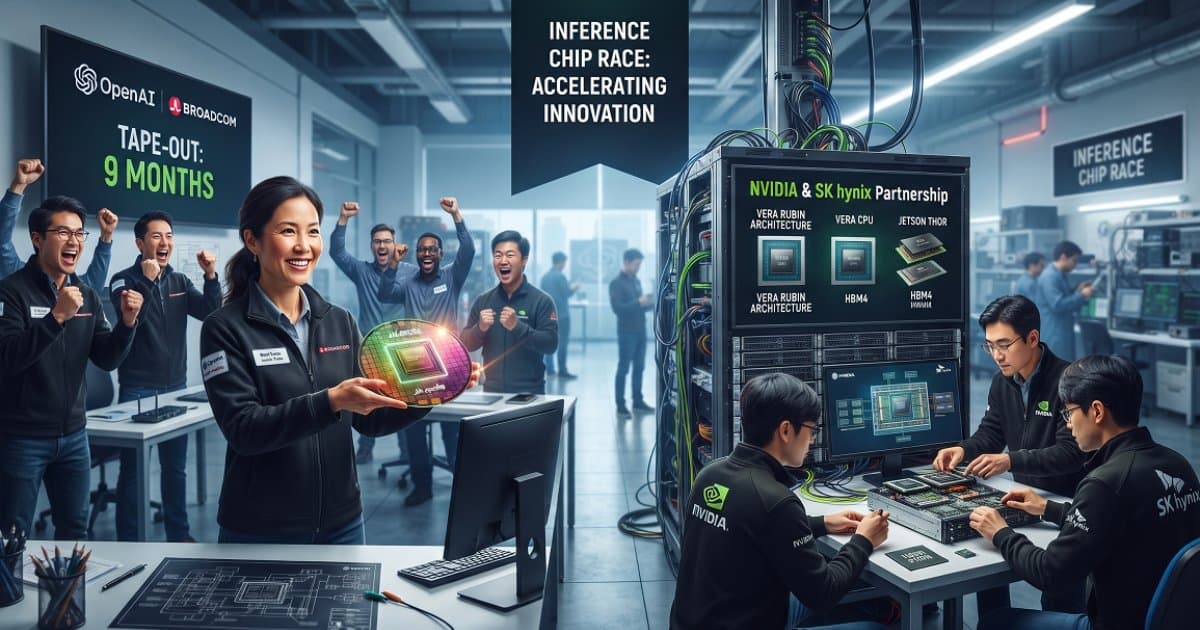
Inference chip race: OpenAI brought Jalapeño to tape-out in 9 months, while NVIDIA and SK hynix are building memory for Vera Rubin. What does this mean for your business?
Why the Inference Chip Race Matters to Your Business
When tech giants spend billions developing specialized inference chips, many entrepreneurs think it's a game exclusively for Silicon Valley corporations. But the reality is different: every time you use ChatGPT, launch an AI agent to process applications, or automate customer service, these chips are working behind the scenes. The inference chip race determines how fast, cheap, and reliable AI tools will work for your business tomorrow.
Two resonant announcements shook the industry: OpenAI together with Broadcom brought its own "Jalapeño" chip to tape-out in just 9 months — a record pace for the semiconductor industry. In parallel, NVIDIA and SK hynix signed a multi-year partnership to develop memory for the Vera Rubin, Vera CPU, and Jetson Thor platforms. For Ukrainian business owners and managers, this is not just tech conference news — it's a signal about which AI solutions will become more accessible and powerful in the coming years.
OpenAI and Broadcom: How "Jalapeño" Is Changing the AI Infrastructure Market
A Speed Record: 9 Months from Idea to Tape-Out
Tape-out is the moment when a microchip design is considered complete and sent to manufacturing. In traditional semiconductor industry, this process takes 18 to 36 months. OpenAI and Broadcom cut this cycle nearly in half, which is a technological breakthrough in itself.
The "Jalapeño" chip is OpenAI's own ASIC (Application-Specific Integrated Circuit), optimized specifically for AI inference tasks: not model training, but their real-time use. Inference is responsible for how quickly ChatGPT responds to your query, how accurately an AI agent classifies a customer inquiry, and how much each such query costs.
Why OpenAI Decided to Develop Its Own Chips
Until this moment, OpenAI was completely dependent on NVIDIA — the largest supplier of GPUs for AI tasks. This dependency had two critical drawbacks:
- Cost: renting or buying NVIDIA H100/H200 GPUs costs from thousands to tens of thousands of dollars per unit
- Queues: after the hype of 2023–2024, demand for GPUs significantly exceeded supply
Its own chip allows OpenAI to optimize hardware for the specific architectures of its models — GPT-4o, o3, and future generations. This means lower inference costs and, theoretically, lower prices for end users and businesses.
To understand the scale: if today one million tokens through GPT-4o API cost from $2.50 to $10, custom chips are capable of reducing this figure many times over. For a business processing thousands of requests daily through AI agents for customer support, this is direct budget savings.
Broadcom's Role in the Partnership
Broadcom is no newcomer to ASIC development. The company has already created specialized chips for Google (TPU) and Meta. Partnership with OpenAI confirms a new trend: leading AI companies are moving away from universal GPUs in favor of specialized "hardware".
For the market, this is a signal: the inference chip race is no longer the exclusive domain of hardware companies. Now the developers of AI models themselves are taking part in it.
NVIDIA and SK hynix: A Multi-Year Partnership for Vera Rubin
What Is the Vera Rubin Platform and Why Is It Important
NVIDIA announced the Vera Rubin platform as the successor to the Hopper (H100/H200) and Blackwell series. Vera Rubin is not just a new GPU, but a comprehensive computing platform that includes:
- GPU Vera Rubin — the next generation of graphics processors for AI
- CPU Vera — NVIDIA's own processor based on ARM architecture
- Jetson Thor — a platform for edge-AI, i.e., data processing directly on the device, without the cloud
To achieve peak performance of such a platform, memory is critical. This is where SK hynix comes in.
SK hynix and HBM: Memory That Decides Everything
HBM (High Bandwidth Memory) is a type of memory with extremely high bandwidth, without which modern AI accelerators simply cannot function at full capacity. SK hynix is one of three HBM manufacturers in the world (along with Samsung and Micron) and already supplies HBM3E for NVIDIA's current H200 chips.
The multi-year partnership between NVIDIA and SK hynix means:
- Joint development of next-generation HBM (HBM4 and HBM4E) specifically for Vera Rubin architecture
- Guaranteed supply volumes — critical in conditions of shortage
- Optimization at the hardware interface level between memory and computing core
This partnership strengthens NVIDIA's position in the inference chip race against competitors such as AMD, Intel Gaudi, Google TPU, and now — OpenAI's custom chip.
Jetson Thor: AI at the Edge of the Network for Small Business
Jetson Thor deserves special attention — a platform for edge-AI computing. Unlike server GPUs, Jetson is designed for local devices: industrial robots, smart cameras, medical equipment, autonomous systems.
For small and medium-sized businesses, this opens interesting prospects: running AI models directly in the office or on production without constant cloud connection. This is relevant for Ukraine, where cybersecurity and connectivity failures remain real challenges.
What Does This Race Mean for the Cost and Accessibility of AI Tools
The Scale Effect: Why Competition Lowers Prices
Each time a new competitive inference chip appears on the market, prices for AI services fall. This has already happened: the release of Anthropic Claude 3 Haiku and Google Gemini Flash in 2024 forced OpenAI to lower GPT-4o mini prices several times over.
With the release of "Jalapeño" from OpenAI and Vera Rubin from NVIDIA, we can expect:
- A reduction in API query costs for leading AI models by 30–60% during 2025–2026
- Increase in context windows (the amount of text a model can process in one query)
- Acceleration of AI agent response times — critical for real-time customer service
For Ukrainian businesses already implementing or planning to implement AI automation, this means the ROI from such investments will grow: the same tasks will cost less.
New Opportunities for AI Agents in Business
More powerful and cheaper chips directly affect the quality of AI agents — autonomous systems that perform business tasks without constant human intervention. Today, an AI agent for, for example, a logistics company is already capable of tracking shipments, responding to customer inquiries, and generating reports.
With new inference chips, such agents will become:
- Faster: response time will be reduced from seconds to milliseconds
- Smarter: larger context windows will allow retaining more information about the customer in one session
- Cheaper to maintain: lower token cost = lower operating cost of the agent
Similar improvements will affect agents for marketing agencies, where processing large volumes of content and analytics is a key task.
Competitive Landscape: Who Else Is in the Race
Besides OpenAI/Broadcom and NVIDIA/SK hynix, participants in the inference chip race include:
- Google with TPU v5 and v6 lineup (although the company is going through difficult times, which we discussed in detail in an article about Gemini crisis)
- AMD with Instinct MI300/MI350 series
- Amazon with Trainium and Inferentia chips
- Chinese manufacturers — Huawei Ascend, Biren and others, despite US sanctions
This competition is the best news for business: it guarantees that AI tools will continue to become cheaper and improve.
Practical Conclusions for Ukrainian Business: How to Act Now
Don't Wait for the "Perfect Moment"
One of the most common mistakes managers make is postponing AI implementation until "perfect" technologies appear. But the inference chip race shows: technologies will improve constantly. The one who starts automating business processes today will gain a competitive advantage that will be hard to catch up with.
Let's consider a concrete example: an AI agent for recruitment is already capable today of automatically screening hundreds of resumes in minutes. A company that implemented this solution in 2024 will have two years of process optimization experience, a system trained on its own data, and freed HR team resources for strategic tasks by 2026.
What Specifically to Plan Considering New Chips
Short-term perspective (2025):
- Implement AI agents for tasks with clear KPIs: application processing, FAQ responses, initial lead qualification
- Use APIs of leading models (GPT-4o, Claude, Gemini) — they are already powerful enough for most business tasks today
- Build internal AI culture: train your team, test approaches
Medium-term perspective (2026–2027):
- Review the architecture of AI solutions with the release of Vera Rubin platform and cheaper inference
- Consider multi-agent systems, where multiple AI agents interact with each other to solve complex tasks
- Evaluate edge-AI capabilities (Jetson Thor) for specific industry tasks
Risks and Caveats
Despite all optimism about new chips, it's worth remembering real risks:
- Vendor dependency: concentration in two or three vendors creates supply chain vulnerabilities
- Geopolitical factors: American sanctions against China in the chip sector can affect the global market — we discussed this issue in detail in the context of Chinese AI models
- Cybersecurity: more powerful AI systems are more powerful tools for attacks. This is a real threat that must be considered when planning an AI strategy
FAQ: Frequently Asked Questions About Inference Chips and AI for Business
What Is an Inference Chip and How Does It Differ from a Regular GPU?
An inference chip is a specialized processor optimized for running already trained AI models in real-time, whereas classic GPUs are predominantly used for training models from scratch. For business, inference is what matters: it determines the speed and cost of ChatGPT, AI agents, and other tools you use daily.
How Will OpenAI's "Jalapeño" Chip Affect ChatGPT and API Prices?
Its own chip will allow OpenAI to significantly reduce the cost of processing requests, which in theory should lead to lower API prices for businesses. Analysts predict that inference costs for end users could drop by 40–70% over 2025–2027 as production of new chips scales up.
What Is NVIDIA's Vera Rubin Platform and When Will It Be Released?
Vera Rubin is NVIDIA's next-generation AI platform after Blackwell, including GPU, its own CPU, and edge-AI solutions (Jetson Thor). Production of the first Vera platform chips is expected in 2026, and mass shipments in 2026–2027. Partnership with SK hynix ensures specially developed HBM4 memory for maximum performance.
Does Small Business Need to Follow News About AI Chips?
What directly relates to your business is not the chips themselves, but their impact on the cost and capabilities of AI tools you use. Competition between chip manufacturers lowers prices for AI services and improves their quality. This means AI automation for small and medium-sized businesses will become more accessible with each passing year.
How Quickly Will New Inference Chips Affect the Work of AI Agents for Business?
Changes will be felt gradually: leading AI platforms (OpenAI, Anthropic, Google) first update their own infrastructure, then the effect manifests as faster responses, lower prices, and expanded capabilities for end users. The first noticeable improvements for businesses using APIs are expected in the second half of 2025 — first half of 2026.
Building AI Competence Before the Next Wave
The inference chip race between OpenAI/Broadcom with the "Jalapeño" chip and NVIDIA/SK hynix with the Vera Rubin platform is not just tech news. It's a structural shift that will make AI tools faster, more powerful, and more accessible to businesses of any size, including Ukrainian companies, in the coming years. Those who are already building AI competence within their business today will get the most out of these changes.
If you want to understand how to leverage current AI automation capabilities for your business and prepare for the next wave of technology — contact us for a free consultation. We will help develop a practical strategy for implementing AI agents taking into account the specifics of your industry and real budgets.
Have questions? Ask the AI agent right now
Responds in seconds, knows everything about our services and will help with your situation
You might also like
Claude Found a New Enzyme: AI Enters Science
Claude's AI agents discovered the ART enzyme system in 21 hours. What this means for pharma and biotech R&D — and why business leaders must pay attention now.
NewsAI Slowdown Pact: A Prisoner's Dilemma
Amodei, Altman, Musk, and Hassabis agree to slow AI. But game theory says the deal may collapse before it starts. Here's what that means for your business.
NewsChatGPT for Financial Services: What Business Gets Now
OpenAI launched ChatGPT for Financial Services on GPT-6 Astra. See which processes it automates, what ROI to expect, and how financial firms use it today.